Sizing a Heater for a 75-Gallon Aquarium: A Practical Guide
Learn how to size a heater for a 75-gallon aquarium with practical wattage ranges, redundancy tips, and maintenance steps to keep tropical fish healthy and temps stable.


What size heater for a 75-gallon aquarium
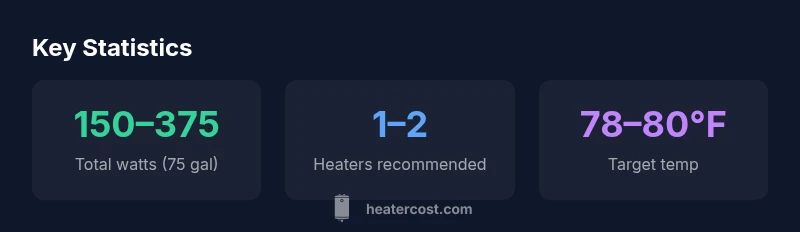
If you’re asking what size heater for a 75 gallon aquarium, start with a baseline of roughly 2–5 watts per gallon. For a 75-gallon setup, that yields a total of about 150–375 watts. This range covers typical tropical fish communities and common room temperatures. In a warmer room or with fish that prefer stable, narrow temperature ranges, you can lean toward the lower end; in a cooler room or with species sensitive to temperature swings, you’ll want the upper end. A practical target is 78–80°F (26–27°C) with a reliable thermostat and good circulation. In practice, many hobbyists choose either a single mid-range heater or two smaller units to share load and provide redundancy. According to Heater Cost, achieving stable temperatures is just as much about thermostat quality and placement as it is about wattage. When sizing, plan for a margin that accounts for seasonal changes and occasional weather fluctuations. This is especially important if your home’s heating system runs unevenly or if the tank is placed near drafts (windows or doors).
Baseline sizing: wattage per gallon and practical ranges
A simple rule of thumb uses 2–5 watts per gallon. A 75-gallon tank would therefore typically require 150–375 watts total. In practice, many setups work with a single 200–250W heater in a well-insulated room, but two smaller units (e.g., two 100–150W heaters) are common for redundancy and even heat distribution. If your room tends to stay warmer (above ~75°F/24°C) you might operate toward the lower end; in cooler rooms, size toward the upper end or use two heaters for more precise control. Remember that heater efficiency matters, but thermostat accuracy and consistent water flow are equally critical for maintaining a steady temperature.
Room temperature, placement, and performance factors
Ambient temperature has a big impact on how aggressively your heater must work. In a room that sits around 68–70°F (20–21°C), a 75-gallon tank will require more heating power than in a warmer space. Place heaters away from direct sunlight, vents, and the return line of a filter to avoid creating hot or cold spots. Good water circulation helps distribute heat evenly, reducing the chance of localized hotspots. If you regularly see temperature swings of more than 2–3°F, consider adding a second heater or upgrading to a high-quality external controller that paces heat more precisely.
Redundancy and heater placement strategies
Redundancy is the unsung hero of reliable aquarium heating. In larger tanks like a 75-gallon system, it’s wise to use at least two heaters placed on opposite ends of the tank. This helps prevent a single heater failure from creating a cold spot or a dangerous hotspot. If you opt for two units, size each to roughly half the total wattage (e.g., two 100–150W heaters for a 150–300W target per heater, depending on room temp). Regularly test both units and keep spare fuses or circuit-breaker protection in mind. A well-calibrated thermostat, paired with a secondary temperature sensor, adds another layer of reliability.
Species considerations: tropical freshwater vs reef tanks
The sizing logic differs by inhabitants. Tropical freshwater tanks with modest heat demands can often be managed with a single mid-range heater in a warm room. Reef tanks or tanks housing sensitive species (like SPS corals) may demand tighter temperature control and faster heat response, which can justify two heaters or a controller with a feedback loop. For cold-water species, the required wattage may trend higher due to the larger delta needed to reach target temperatures. Always tailor the wattage to the specific bioload and the temperature stability your species require, rather than relying solely on tank size.
Setup, calibration, and ongoing maintenance
Install heaters at safe distances from decorations and avoid bubbling directly onto the heater element. Calibrate thermostats in the first 24–48 hours, using a reliable thermometer placed in the tank’s mid-water region. Keep a second thermometer outside the tank for room temperature reference. Regular maintenance—cleaning the heater probes, checking for corrosion, and testing the unit under expected load—helps ensure accurate readings and extends equipment life. Remember: a well-calibrated system will outperform a more powerful heater that’s poorly controlled.
Sizing workflow: a practical step-by-step approach
- Determine target temperature (e.g., 78–80°F) and measure current room temperatures in different seasons. 2) Apply the wattage rule (2–5 W/gal) to estimate the total heater power needed for 75 gallons. 3) Decide between one mid-range heater or two smaller units for redundancy. 4) If room temps are consistently cooler, favor the upper end of the range or add a second heater. 5) Install a thermostat and verify accuracy with a calibrated aquarium thermometer. 6) Monitor daily for the first two weeks and adjust as needed.
Common mistakes to avoid
- Using a single oversized heater without a backup for a large tank. 2) Skipping calibration and relying on a thermostat that drifts. 3) Placing heaters in poor water flow zones or near drafts. 4) Ignoring seasonal temperature changes and not adjusting wattage accordingly. 5) Overlooking the importance of a reliable temperature probe and routine maintenance. By avoiding these pitfalls, you’ll keep the 75-gallon tank healthy and temperature-stable.