How Much Heater for a Fish Tank: Sizing, Costs, and Maintenance
Discover how much heater for fish tank you need, with practical sizing by tank size, cost ranges, and maintenance tips from Heater Cost to keep water stable and fish healthy.


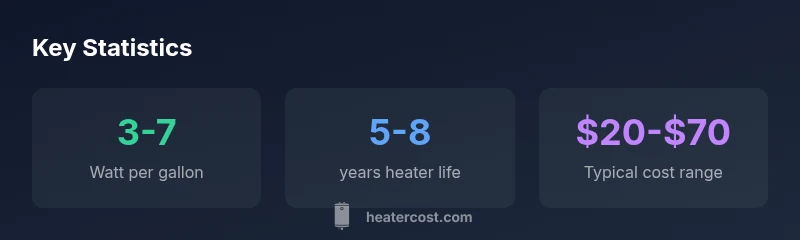
Most hobbyists size aquarium heaters by a simple rule: about 3-7 watts per gallon, depending on room temperature and fish needs. For a typical 20-gallon tank, a 100–150 watt heater is common, while smaller tanks use 50–100 watts and larger tanks may require 200–300 watts or more to reach and hold the target temperature.
Understanding Temperature Needs for Freshwater Aquariums
Temperatures in community freshwater tanks generally fall within a comfortable range for most tropical fish, typically around 74-78°F (23-26°C). Some species prefer warmer water, while others tolerate cooler conditions. The key is to establish a stable temperature with minimal fluctuations. Temperature swings stress fish, alter metabolism, and can lead to increased disease risk. When sizing a heater, start with your target temperature for your fish, then consider the room where the tank sits, the lid or cover on the tank, and the heater’s ability to maintain a steady state. If you keep invertebrates or sensitive species, you may need tighter control or a different setup. In short, how much heater for fish tank depends on both tank size and the ambient environment, not just the fish alone. This context is why guidance often cites a watt-per-gallon rule as a starting point rather than a hard rule.
This article follows the Heater Cost approach to present practical guidelines, but always adapt to your unique setup and species.
How to Size a Heater by Tank Size
Sizing a heater starts with a baseline wattage per gallon and then adds a margin for heat loss and room conditions. A common starting point is roughly 3-7 watts per gallon, with 3-5 W/gal for well-insulated setups and 5-7 W/gal in cooler rooms. For example, a 20-gallon tank often uses a 100-150 watt heater. A 10-gallon setup might use 50-100 watts, while a 55-gallon tank could require 150-300 watts, or even two smaller heaters for redundancy. Remember to choose a heater with a thermostat that can hold a narrow temperature band (±1-2°F where possible). If you already have a lid and good water motion, you may be able to run slightly lower wattage, but never compromise on stable temperature.
Consider the heater’s placement and the tank’s filtration, as strong water flow can help distribute heat more evenly.
Ambient Temperature and Other Environmental Factors
Room temperature significantly affects heater needs. A tank in a temperate living room may need less wattage than a similar tank in a drafty basement or sunlit, south-facing room. Insulation, tank cover, and substrate depth all influence heat retention. A well-sealed lid minimizes evaporative cooling and helps stabilize temperature, reducing the heater’s workload. If you keep a species that requires stable 76°F versus another that tolerates 72-78°F, you’ll need to tailor the heater’s setpoint accordingly. In high-heat environments, you may need to compensate with active cooling or simply a tighter thermostat range.
Overall, the environment around the tank sets the cost and power requirements just as much as the tank size does.
Choosing Between Submersible and Inline Heaters
Most hobbyists favor submersible, fully adjustable heaters for freshwater tanks due to their simplicity and broad compatibility. Submersible units are easy to install, monitor, and replace, and many models feature precise digital thermostats. Inline heaters, attached to canister or external filters, provide a cleaner look and can offer excellent heat distribution in larger setups with strong water movement. However, inline heaters require proper integration with the filter loop and can be harder to service. When sizing, ensure the heater type supports your tank volume and filtration flow, and always pair with a reliable thermometer to verify temperature accuracy.
In either case, choose a model with automatic shutoff and adjustable temperature control to minimize overshoot.
Calculating a Safe Temperature Range and Margin
Set a target range that matches your fish’s needs and your room temperature. A typical tropical range is 74-78°F, but some species require warmer or cooler water. Use a small dead-band (the difference between the temperature at which the heater turns on and off) to avoid rapid cycling. For most tanks, a ±1-2°F stability margin is achievable with a good heater and proper placement. If you notice frequent temperature swings, verify that the heater is properly submerged, that the thermostat is calibrated, and that the room isn’t forcing the tank to chase outside temperatures.
Documenting a consistent routine helps you spot deviations early.
Cost Implications and Value: How Much to Budget
Upfront cost for a heater varies with wattage, brand, and features. Budget ranges typically fall between $20 and $70 for standard hobby heaters, with higher-end units offering precise thermostats and digital displays. Running costs depend on how often the heater cycles on, the setpoint, and the room’s ambient temperature. In a well-insulated system, annual energy use remains modest, often within a low-to-moderate range compared with other aquarium equipment. When planning, factor in potential maintenance costs if you need to replace a failed thermostat or seal.
Practical Sizing Examples for Popular Tank Sizes
Here are practical guidelines for common tank sizes to help you decide how much heater for fish tank you need:
- 5 gallon: ~25-40W
- 10 gallon: ~50-100W
- 20 gallon: ~100-150W
- 29 gallon: ~100-300W (often two smaller heaters for redundancy)
- 55 gallon: ~150-300W (or two 150W units)
- 75-125 gallon: ~300-600W (dual heaters recommended)
Remember, these ranges are starting points; verify with a reliable thermometer and adjust for room Temperature and species.
Safety, Maintenance, and Best Practices
Always use a heater with a built-in thermostat and a visible indicator to ensure you know when it’s active. Place the heater where it can circulate water and avoid direct contact with substrate to minimize hotspots. Calibrate thermostats periodically; digital readouts are usually more accurate but still require verification with a separate thermometer. Regularly inspect for leaks, corrosion, or signs of wear. If you have a heavily planted tank or high bioload, consider monitoring more frequently during seasonal changes. Finally, never rely on a single measurement; cross-check with at least two thermometers placed at different depths.
Putting It All Together: Quick Decision Checklist
- Determine target temperature for your fish species.
- Estimate wattage per gallon based on room temperature and insulation (start with 3-7 W/gal).
- Choose heater type (submersible vs inline) that fits your tank and filtration.
- Verify with a calibrated thermometer and set a tight, but safe, temperature range.
- Budget upfront cost and estimated annual energy use to guide the total cost of ownership.
- Plan for maintenance and have a backup strategy in case of thermostat failure.
Final Thoughts
Sizing a heater for a fish tank isn’t just about gallons; it’s about stabilizing the environment where your aquatic inhabitants live. A well-sized heater minimizes stress and disease risk for fish and reduces maintenance surprises. By starting with a watt-per-gallon guideline, adjusting for ambient temperature, and choosing a reliable heater with a precise thermostat, you can maintain a healthy, thriving aquarium with predictable costs. Heater Cost’s practical approach emphasizes both accuracy and affordability, helping you make informed decisions without overpaying for features you don’t need.
Next Steps for Readers
- Review your tank size and current room temperature.
- Pick a heater with a reputable thermostat and good reviews.
- Set up an accurate thermometer and verify temperature stability over 48-72 hours.
- Monitor fish behavior and adjust as needed to keep stress levels low.
Sizing guide: heater wattage by common aquarium sizes
| Tank Size (gal) | Recommended Wattage (W) | Typical Heater Type | Notes |
|---|---|---|---|
| 5 | 25-40 | Submersible | Small tanks require compact heaters; ensure lid coverage. |
| 10 | 50-100 | Submersible | Lid helps reduce temperature drift. |
| 20 | 100-200 | Submersible | Aim for ambient room temp of around 70-78°F. |
| 29 | 100-300 | Submersible/dual | Consider dual heaters for redundancy. |
| 55 | 150-300 | Submersible/dual | Place heater in a well-flowing area. |
Got Questions?
What wattage should I use for a 20-gallon tank?
For a 20-gallon tank, a typical range is 100-150 watts, depending on room temperature and fish needs. Use a heater with a precise thermostat and monitor the temperature with a calibrated thermometer to ensure stability.
For a 20-gallon tank, expect about 100 to 150 watts, depending on your room. Always double-check with a thermometer.
Is it better to use multiple smaller heaters?
In larger or higher-risk tanks, multiple smaller heaters can provide redundancy and more uniform heat distribution. This reduces the chance of a single point failure causing a temperature spike or drop.
In big tanks, two smaller heaters can help keep the temperature steady. It also avoids a single point failure.
Do I need a heater in a heavily planted tank?
Yes, unless your plants are truly tolerant of room temperature, many planted aquariums benefit from a heater to maintain stable warmth for tropical fish. Ensure the heater is well-placed to avoid affecting plant growth and CO2 balance.
Most planted tanks still need a heater to keep tropical fish comfortable; place it where it won’t disrupt the plants.
How often should I check aquarium temperature?
Check at least once daily for the first week after installation, then at least a few times per week to ensure the target range is maintained. Increase frequency during seasonal changes or if you notice behavioral changes in fish.
Check the temp daily after installing, then a few times a week to stay on target.
What safety features should I look for in a heater?
Look for a heater with an automatic shutoff, a clear temperature display, and a proven thermostat with tight tolerances. Ensure it is rated for your tank size and is fully submersible if recommended by the manufacturer.
Choose a heater with auto shutoff and a precise thermostat, suitable for your tank.
“Accurate heater sizing reduces temperature fluctuations that stress fish and simplifies routine maintenance.”
The Essentials
- Size heaters by tank volume and room temperature.
- Prefer a precise thermostat and reliable submersible units.
- Aim for a narrow temperature band to minimize stress.
- Consider redundancy for larger tanks.
- Budget upfront cost plus ongoing energy use.