How Long Should an Immersion Heater Be On For? A Practical Guide
Learn how to estimate immersion heater run time for domestic hot water using a simple energy calculation, accounting for cylinder size, starting temp, target temp, and insulation. Includes step-by-step methods, safety tips, and energy-saving practices from Heater Cost.


By the end of this guide, you’ll know how to estimate immersion heater run time for a given water volume and temperature rise. You’ll factor in heater power, starting water temperature, target temperature, and cylinder insulation, plus a simple energy-based calculation you can re-run for any home. Practical checks and safety reminders are included.
Understanding immersion heaters and why run time matters
An immersion heater is an electric heating element placed inside a hot water cylinder. It heats water directly in the tank, which means the energy you pour into the element translates into hot water delivered to taps and showers. Homeowners commonly find two common power ratings: 2 kW and 3 kW, with the higher rating delivering water more quickly but drawing more electricity. The overall heating time depends on the amount of water in the cylinder, the desired temperature rise, the efficiency of heat transfer, and how well the cylinder is insulated. In practice, run time is not a fixed number; it varies with the starting temperature and the amount of hot water you need at a given moment. A well-insulated cylinder reduces heat losses, making the run time closer to the theoretical calculation. For planning purposes, expect longer times if the water starts cold, the volume is large, or if insulation is poor. In all cases, having a plan helps you avoid energy waste and unexpected bills. According to Heater Cost, a simple upfront estimate is a good starting point for budgeting monthly energy use and choosing a heater size.
Key variables that affect heating time
Several factors determine how long an immersion heater runs before water reaches the target temperature:
- Cylinder volume: Larger tanks hold more water, requiring more energy to raise the temperature by the same deltaT.
- Starting water temperature: Water that enters the cylinder near the target temperature requires less heating than cold water from a well fill.
- Target temperature: Higher temperatures require more energy and longer run times.
- Heater power: A 3 kW element will normally heat water faster than a 2 kW element, all else equal.
- Insulation and heat losses: Good insulation reduces losses to the room, while poor insulation increases them.
- Heat losses during operation: If you draw hot water during heating or if the tank sits in a cold environment, heat loss rises.
- Electrical supply and efficiency: Voltage drop or aging elements can reduce heating efficiency.
- Temperature controls: If your cylinder uses a timer or thermostat, it can prevent unnecessary over-heating.
Understanding these variables helps you adjust expectations and choose the right strategy for your home. Heater Cost analyses show that even small changes in insulation or initial water temperature can shave or extend heating times by a noticeable margin. Use a consistent starting point when you compare different scenarios to avoid confusing results.
How to estimate run time using a simple calculation
A practical estimate uses a basic energy calculation. Treat water as the heat sink, and account for the deltaT you want to achieve. Steps:
- Step 1: Determine mass of water in kilograms. For home cylinders, assume 1 liter = 1 kilogram, so L × 1 kg/L equals mass.
- Step 2: Decide the temperature rise deltaT. Subtract the starting water temperature from the target temperature.
- Step 3: Compute energy required in kilowatt-hours using energy_kWh ≈ (mass × deltaT) / 860. This is a handy approximation because 1 kWh equals about 3.6 MJ.
- Step 4: Divide the energy by the heater rating in kilowatts. Time in hours ≈ energy_kWh / power_kW.
- Step 5: Add a safety margin for heat losses, typically 10–20%. Round to the nearest quarter hour for planning.
Notes: The exact constant 860 is a convenient approximation derived from 4.186 kJ/kg°C and 3600 s per hour. If you prefer, use the exact formula energy_kWh = (mass × deltaT × 4.186) / 3600. Heater Cost suggests that practical results will vary with real-world losses.
Worked example: a 120–150 L cylinder
Assume a standard 120 L cylinder, water at 15°C, target 60°C (deltaT = 45°C). Energy needed ≈ 120 × 45 × 4.186 / 3600 ≈ 6.28 kWh. If the immersion heater is 3 kW, heating time in an ideal world is 6.28 / 3 ≈ 2.09 hours. Allow for losses and practical inefficiencies by adding 20%: ≈ 2.51 hours. For a larger 150 L cylinder with the same deltaT and a 3 kW heater, energy ≈ 7.85 kWh; heating time ≈ 2.62 hours; with losses, ≈ 3.14 hours. The takeaway is that even with the same heater, bigger tanks take longer. If your heater is only 2 kW, multiply those times by 1.5, giving 3.75 hours or more. These are rough estimates; actual times depend on insulation and heat losses.
Tools & Materials
- Digital thermometer(for measuring starting water temperature in Celsius)
- Measuring jug or calibrated container(to estimate water volume in liters if the cylinder label is unclear)
- Calculator or calculator app(to compute energy and time using the formulas)
- Immersion heater power rating (kW) and cylinder capacity label(needed from the label on the heater or manual)
- Pen and notebook(for recording measurements and calculations)
- Ambient room thermometer (optional)(to gauge heat loss potential)
Steps
Estimated time: 45-60 minutes for calculation, setup, and validation; heating time depends on cylinder size, water temperature, and power.
- 1
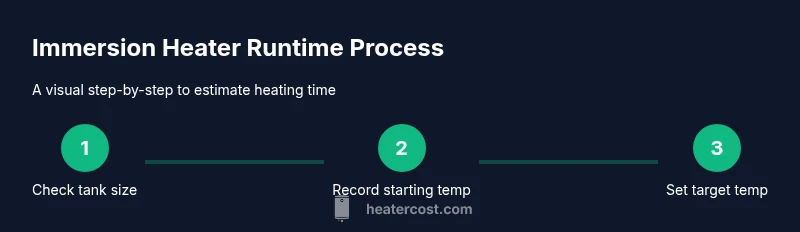
Identify cylinder size and starting water temperature
Check the cylinder label or manual to confirm capacity and inspect the current water temperature with a thermometer. Record both values before you start any calculation so your estimates reflect the actual system.
Tip: Use water at a representative temperature (e.g., early morning fill) to avoid skewing the deltaT. - 2
Set your target water temperature
Decide the temperature you want for taps and showers. Common targets are 50–60°C for domestic hot water, but consider household needs and safety (burn risk at the point of use).
Tip: Note that higher targets save energy per use but require more energy upfront. - 3
Check heater power rating
Locate the immersion heater rating on the element or the cylinder labeling. The rating (in kW) determines how quickly energy is delivered to the water.
Tip: If you have two elements, confirm whether you’ll run them serially or in parallel. - 4
Compute deltaT and mass
Calculate deltaT = target temperature − starting temperature. Treat water volume in liters as mass in kilograms (1 L ≈ 1 kg).
Tip: Accurate volumes improve the estimate more than minor temperature tweaks. - 5
Calculate energy required
Use energy_kWh ≈ (mass × deltaT) / 860 (approximately). For exactness, you can use energy_kWh = (mass × deltaT × 4.186) / 3600.
Tip: The constant 860 comes from converting kJ to kWh; the exact formula is fine to use. - 6
Estimate heating time
Divide energy_kWh by power_kW to get hours. Add 10–20% for losses, then round to a practical interval (e.g., 15 or 30 minutes).
Tip: Rounding helps when planning around daily routines. - 7
Account for real-world factors
Adjust your estimate for heat losses, standby cooling, and potential hot-water draw during heating. This step ensures a more realistic result.
Tip: Conservatively add margin if the tank is uninsulated or in a cold environment. - 8
Test with timer and validate
Run the heater with a timer for the calculated interval, then measure water temperature and adjust future estimates if needed.
Tip: Always monitor for unusual heat or smells and stop if you suspect a fault.
Got Questions?
Is it safe to leave an immersion heater running for long periods?
Leaving an immersion heater on for extended periods is not recommended. It can waste energy and increase the risk of overheating, especially in poorly insulated tanks. Use timers or smart controls to limit runtime and monitor temperatures.
Leaving it on for long periods wastes energy and can risk overheating. Use timers and monitor the water temperature.
Does the size of my hot water cylinder affect run time?
Yes. Larger cylinders require more energy to raise the same temperature, so their heating time tends to be longer. Insulation quality also influences how quickly heat is retained.
Bigger cylinders take longer to heat, especially if insulation is poor.
Why do times vary between households?
Variations come from differences in cylinder size, insulation, starting water temperature, target temperature, and heater power. Real-world factors like ambient temperature and hot-water draw during heating also affect results.
Different homes heat water at different rates due to tank size and insulation, among other factors.
Can running the heater to heat water that is already hot be harmful?
Re-heating hot water once it is already hot wastes energy and can shorten the life of the heating element if used improperly. Plan heating to align with actual hot-water needs.
Re-heating water that’s already hot wastes energy and isn’t efficient.
What is a safe target temperature for domestic hot water?
A common and safe target range is about 50–60°C. This range balances comfort, sanitation, and energy use, while reducing the risk of scalding.
Most homes aim for 50 to 60 degrees Celsius for hot water safety and comfort.
How accurate is the energy calculation method?
The energy-based method provides a practical estimate. Real-world losses and variations can shift the actual time, so use it as a planning guide and adjust with real measurements.
The calculation gives a good plan, but real results may vary slightly.
Watch Video
The Essentials
- Estimate runtime with a simple energy calculation
- Know your cylinder volume, deltaT, and heater power
- Add a safety margin for heat losses
- Improve insulation to reduce actual heating times
- Use timers to optimize energy use