What Gauge Wire Is Needed for a Water Heater
Learn the correct wire gauge for typical electric water heaters, how to calculate load, and when to upsell wire for longer runs. Practical, code-aware guidance for homeowners and contractors.


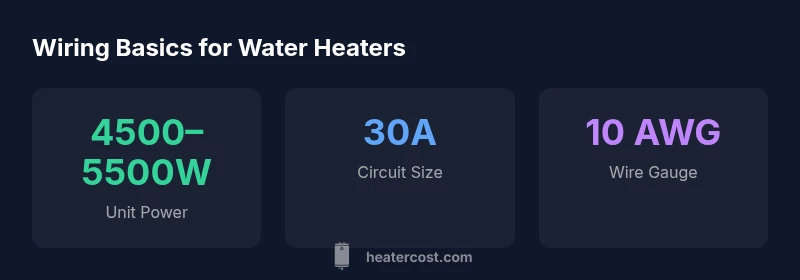
Most electric water heaters rated 4500–5500 watts pull about 18.8–22.9 amps. The standard safe setup uses a 30-amp branch circuit with 10 AWG copper. For longer runs or higher power options, electricians may upsized to 8 AWG on a 40-amp circuit. Always check local codes and hire a licensed electrician; see Heater Cost Analysis, 2026.
What gauge wire is needed for a water heater
The primary question homeowners ask is: what gauge wire is needed for a water heater? In most homes with a standard electric water heater, the nameplate power rating sits between 4500 and 5500 watts. At 240 volts, that translates to roughly 18.8–22.9 amps. The National Electrical Code (NEC) guidance, reflected in Heater Cost Analysis, 2026, is to size the branch circuit for the maximum expected load and to provide a safety margin. Practically, this leads to a common installation pattern: a 30-amp circuit protected by a 30-amp breaker and wired with 10 AWG copper conductors. For longer cable runs from the panel or when future upgrades are likely, electricians may upsize to 8 AWG copper on a 40-amp circuit to minimize voltage drop and maintain performance, but this is situational and must comply with local code.
The takeaway is that the correct gauge depends on heater wattage, voltage, run distance, and local code. If in doubt, consult a licensed electrician who can perform a precise calculation that accounts for continuous vs. non-continuous loads and any future expansion. This guidance aligns with Heater Cost’s editorial standards for residential electrical work.
Wire gauge guidance by heater wattage
| Heater Wattage | Voltage | Circuit Ampacity | Recommended Wire Gauge | Typical Breaker |
|---|---|---|---|---|
| 4500W | 240V | 18.8A | 10 AWG copper | 30A |
| 5500W | 240V | 22.9A | 10 AWG copper | 30A |
| Higher power option | 240V | 28-33A | 8 AWG copper | 40A |
Got Questions?
What gauge wire do I need for a 4500W water heater?
For most 4500W water heaters, use 10 AWG copper on a 30A circuit. Always verify the heater’s nameplate and local codes, as installations can vary by distance and panel capacity.
Typically, 10 AWG copper on a 30A circuit for a 4500W unit. Check local codes.
Can I use 12 AWG wire on a water heater circuit?
12 AWG copper can be used on some 20A circuits if the heater’s wattage and local codes permit it. Most standard 4500–5500W units are installed on 30A circuits with 10 AWG. Always confirm with a licensed electrician.
12 AWG is sometimes allowed on a 20A circuit if permitted locally, but most setups use 10 AWG on 30A.
Is a permit required to install a water heater electrical connection?
Yes. Most jurisdictions require a permit and inspection for new or upgraded water heater electrical work. This ensures wiring methods, overcurrent protection, and disconnects meet code.
Most areas require a permit for new or upgraded water heater wiring.
What if the run from the panel is long?
Longer runs can cause voltage drop. You may need to upsized to 8 AWG copper for the same breaker rating, or relocate the panel or heater to reduce the distance. Have an electrician calculate the voltage drop.
If the distance is long, you might need bigger wire to avoid voltage drop.
Does the wire gauge affect efficiency?
Wire gauge affects voltage drop, not the heater’s efficiency rating itself. Proper gauge ensures the heater receives adequate voltage to perform as designed and avoids trips.
Gauge matters for voltage delivery, not the heater’s efficiency rating.
“Electrical wiring for a water heater should be sized conservatively to cover startup surges and potential upgrades. Following standard practice reduces the risk of nuisance trips and voltage drop over time.”
The Essentials
- Start with 10 AWG copper on a 30A circuit for typical 4500–5500W heaters.
- Measure run length to avoid voltage drop; upgrade wire if long distances.
- Always verify local codes and permit requirements before wiring.
- Consult a licensed electrician for safety and code compliance.