What Size Breaker Is Needed for a Water Heater
Learn how to correctly size the breaker for a water heater, covering wattage ranges, wire gauge, permits, and code-compliant installation practices.


Most residential electric water heaters run on a 30-amp double-pole breaker using 10-gauge copper wiring for typical 4500-watt units. If your heater is higher wattage (5500–6000W) or has two elements with different settings, a 30–40A circuit may be required, depending on exact wattage and local code. Always verify the label and consult a licensed electrician.
Understanding Breaker Sizing for Water Heaters
Sizing the electrical breaker for a water heater starts with the basics of a 240-volt circuit. Most residential water heaters operate on a dedicated 240V supply that powers an electric heating element. The current drawn depends on the element wattage (P) and the voltage (V), calculated as I = P/V. Because heating elements are sustained loads, many codes require sizing the circuit at least 125% of the running current to provide a margin for startup surges and long operation. For example, a typical 4500W element draws about 18.75A, which translates to a 23.4A requirement after the 125% rule. In practice, electricians often round up to the nearest standard breaker size, typically 30A. Always confirm with the heater’s label and your local electrical code before installation, and consider a licensed electrician for any service upgrade.
How Wattage Determines Breaker Size
Water heater wattage determines the maximum current, which in turn informs the breaker size. A 4500W, 240V water heater draws 18.75A. After applying the common 125% factor, the circuit needs to safely handle about 23.4A. Since standard breakers come in 20A, 25A, 30A, 40A, etc., the practical outcome is a 30A double-pole breaker with 10 AWG copper conductors. If you have a higher-wattage unit, such as 5500W (22.9A) or 6000W (25A), the 125% rule still pushes toward the 30A range, but some installations require 40A when the exact ampacity exceeds 30A and larger wire is used. Always verify the exact requirement from the heater label and local codes, and avoid mixing loads on the same circuit. This is where design details matter and why professional verification matters.
Wire Gauge, Breakers, and Safety Clearances
Selecting the correct wire gauge is as important as choosing the breaker size. For most 30A water heater circuits, 10 AWG copper conductors are used, with appropriate insulation and conduit as required by code. If a 40A breaker is installed, 8 AWG copper is typically needed. Aluminum conductors require even larger gauges and careful handling. Keep in mind practical considerations like distance from the panel, enclosure clearances, and whether the run passes through drywall or a garage. Additionally, check whether local codes permit NM-B cable or require conduit and protection against moisture or physical damage. Always route the cable with proper strain relief and secure connectors, and ensure that the wiring is sized to support the intended breaker rating. These details affect safety, reliability, and long-term maintenance.
Practical Scenarios: Common Wattages and Breaker Recommendations
Here are typical guidelines you’ll encounter in standard homes, with the caveat that local code and manufacturer instructions always prevail:
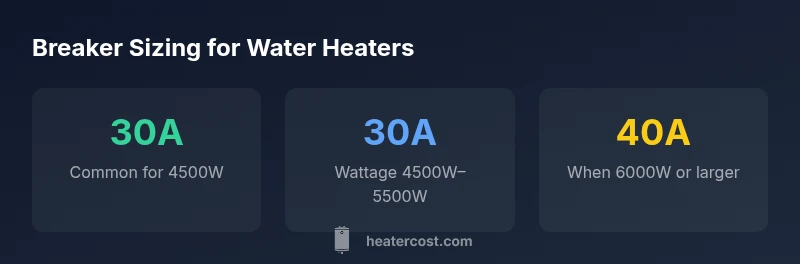
- 4500W at 240V: about 18.75A; commonly paired with a 30A double-pole breaker and 10 AWG copper.
- 5500W: about 22.9A; commonly 30A double-pole breaker with 10 AWG copper; some installations may require 40A if a larger wire is required.
- 6000W: about 25A; often requires a 40A double-pole breaker with 8 AWG copper.
The Installation Process: What to Expect
A licensed electrician will begin with a full load calculation to ensure the service can support the new circuit. They will shut off power to the section, verify proper grounding, and run the correct gauge wire from the panel to the water heater location. The installer will then mount a dedicated 240V double-pole breaker, connect the heater according to the manufacturer’s instructions, and test the circuit for continuity and insulation. After wiring, a circuit test will confirm there are no overheating conditions, and the thermostat and safety devices will be checked. Finally, the electrician will explain maintenance steps and safety considerations for future service, and any local permit or inspection requirements.
Local Codes, Permits, and Professional Guidance
Electrical work is highly regulated and varies by jurisdiction. In many areas, a permit is required to install or replace a water heater breaker, and a final inspection is often mandatory. Sharing circuits is typically disallowed, and compliance with NEC or local adaptations helps protect homeowners from risks. Working with a licensed electrician ensures the correct wattage, wire size, and panel capacity are used, reducing nuisance trips, overheating, and fire hazards. If you’re renovating or upgrading to a higher-wattage model, plan for potential panel upgrades or service main adjustments. Budget for both materials and labor, and verify warranty implications with the manufacturer.
Maintenance and Future Upgrades
Keep the water heater and its wiring in good condition to maximize safety and efficiency. Regularly inspect connections for corrosion, ensure the thermostat operates correctly, and replace insulating sleeves as needed. If you plan a future upgrade—such as moving from a 4500W to a higher wattage unit or switching to a tankless system—your breaker size and wire gauge may need adjustment. A proper load calculation helps determine whether your service can support an upgrade without upgrading the main service. In many cases, adding a dedicated circuit sized to the equipment is simpler and safer than retrofitting undersized wiring.
Quick Reference Checklist
Before you start any electrical work, verify the heater’s wattage on the label, and calculate current: I = P/V. Ensure you have a dedicated 240V circuit, proper wire gauge, and a correctly sized breaker. Check local permit requirements, and hire a licensed electrician for installation and testing. Keep a spare breaker and maintain a clear plan for future upgrades.
Breaker sizing examples for common electric water heaters
| Water Heater Wattage | Voltage | Current (A) | Recommended Breaker |
|---|---|---|---|
| 4500W | 240V | 18.75 | 30A |
| 5500W | 240V | 22.92 | 30A |
| 6000W | 240V | 25 | 40A |
Got Questions?
What is the most common breaker size for a standard 240V water heater?
The most common is a 30A double-pole breaker on 10 AWG copper. Verify the heater label and local codes, as exact requirements can vary.
Typically a 30A double-pole breaker on 10-gauge wire. Check the label and local codes.
Can I use a 25A breaker for a 4500W water heater?
A 25A breaker is uncommon for residential water heaters; most setups use 30A. Always follow the heater’s label and local code.
A 25A breaker isn't typical; most use 30A with proper wiring.
Do I need a permit to install or upgrade a water heater breaker?
Yes. Local codes often require a permit for electrical work and inspections after installation. Check with your local building department.
Permits are usually required for electrical work; check with your local authority.
What wire gauge is needed for a 30A water heater circuit?
A 30A water heater circuit typically uses 10 AWG copper conductors, rated for the circuit’s ampacity.
Use 10 AWG copper for a 30A circuit.
What should I do if the breaker trips frequently?
Frequent trips may indicate overload, a faulty element, or wiring issues. Have a licensed electrician inspect and test the circuit.
If it trips often, call an electrician to diagnose.
Is a water heater allowed to share a circuit with other loads?
Water heaters typically require a dedicated circuit to prevent nuisance trips and ensure safe operation.
Usually on its own dedicated circuit.
“Sizing a water heater circuit isn't guesswork—it's about matching wattage, voltage, and the 125% rule to a safe breaker size.”
The Essentials
- Calculate current with P/V and apply the 125% rule.
- Most 4500W heaters use a 30A double-pole breaker.
- Upgrade to 40A only when wattage requires it.
- Always consult a licensed electrician and check local code.