What Wire Is Needed for Electric Water Heaters
Learn the wire size, cable type, and breaker requirements for a safe electric water heater installation. This guide covers 10 AWG vs 8 AWG, NM-B vs THHN, grounding, and permits.


For most electric water heaters, expect a 240V circuit wired with 10 AWG copper conductors on a 30-amp double-pole breaker, plus a grounding conductor. In some cases, 8 AWG copper or THHN in conduit may be used for longer runs or higher wattages. Always consult local codes.
What wire is needed for electric water heater: Foundational principles
Determining the correct wire for an electric water heater starts with the heater’s wattage and the distance to the main panel. For homeowners asking what wire is needed for electric water heater, the general rule is a dedicated 240V circuit wired with copper conductors and a properly sized breaker. This guidance from Heater Cost, based on Heater Cost Analysis, 2026, helps you understand why a 10 AWG copper setup on a 30A breaker is common for typical 4500W units. Always verify with local codes and your appliance label.
How wattage and distance affect wire size
The heater wattage and the length of run between the panel and the heater determine the required conductor size. If you’re wiring a typical 4500W electric water heater, a 240V supply, and modest run length, 10 AWG copper is usually sufficient on a 30A circuit. Longer runs or higher wattage heaters may require larger sizes (8 AWG copper or THHN conductors in conduit). The key is to maintain voltage within safe limits and comply with NEC guidelines and local permits.
Choosing wire size: 10 AWG copper is common
In most homes, the question what wire is needed for electric water heater is answered with 10 AWG copper conductors for a dedicated 240V circuit. This size supports about 18–19A continuous load, leaving a safety margin for startup current. If your heater uses more power or if distance adds resistance, you may step up to 8 AWG copper or equivalent THHN in conduit. Always check the heater’s label and panel compatibility.
NM-B vs THHN: cable types explained
You have two main wiring approaches: NM-B cable (the common Romex found in many basements) or individual THHN conductors installed in conduit. NM-B 10/2 with ground is typical for shorter, dry runs in non-critic areas; THHN in conduit offers flexibility for longer runs and easier protection in exposed spaces. Regardless of method, maintain 240V between the two hot wires and ensure a dedicated grounding path.
Breakers, disconnects, and grounding
A dedicated 240V circuit for the water heater typically uses a double-pole breaker sized to match the heater’s wattage. The equipment grounding conductor must be connected to the heater’s ground terminal and the panel ground. Some installations require a disconnect near the heater; if so, ensure it is within sight and accessible. Grounding ensures safety against faults.
Run lengths, voltage drop, and code safety margins
Long wire runs increase resistance and can cause voltage drop, reducing heater performance. If your run approaches 50 feet or more, upgrading to 8 AWG or using THHN in conduit may be warranted. Always design per local code calculations and consider future expansion. The goal is safe operation and reliability, not just a single installation.
Permits and professional installation: Why hire a licensed electrician
Many jurisdictions require permits for new heater wiring, inspections, and an in-sight disconnect. A licensed electrician can interpret local codes, calculate voltage drop, select appropriate conductor type, and ensure proper grounding. If you’re asking what wire is needed for electric water heater, partnering with a pro can prevent costly mistakes and ensure safety.
Scenarios: replacements and upgrades
Replacing an older 120V heater with a 240V electric water heater often triggers a full circuit upgrade. If your existing panel lacks capacity, you may need service panel upgrades. In all cases, start with verifying the heater’s wattage, choosing the correct wire gauge, and ensuring a dedicated circuit. This is essential for both performance and safety.
Quick checks before wiring: safety checklist
Before you touch any wiring, turn off power at the main panel and test for zero voltage. Confirm the heater label for required wattage and wiring method. Gather necessary tools and materials, including 10 AWG copper conductors, 30A breaker, and grounding equipment. If in doubt, call a licensed electrician and avoid DIY mistakes.
Tools & Materials
- 10 AWG copper conductors (THHN in conduit) or NM-B 10/2 with ground(Two hot wires plus a grounding conductor; NM-B for dry, indoor runs; THHN for conduit runs.)
- 30-amp double-pole circuit breaker(Provides dedicated protection for the water heater; matches heater wattage and conductor size.)
- Electrical disconnect near heater (as required by code)(Some jurisdictions require a visible disconnect within sight of the heater.)
- Grounding conductor and grounding path(Connects heater to panel ground; ensures fault current safety.)
- Voltage tester / multimeter(Test for zero voltage before touching conductors; verify 240V across hot legs.)
- Wire stripper and pliers(Prepare conductors and secure terminations.)
- Electrical tape and wire nuts(Insulate and terminate splices safely.)
- Electrical conduit and fittings (if THHN is used)(Used to protect conductors; ensure proper support and bend radius.)
- Safety gear: insulated gloves and eye protection(Always wear PPE when working near live components.)
Steps
Estimated time: 2-6 hours
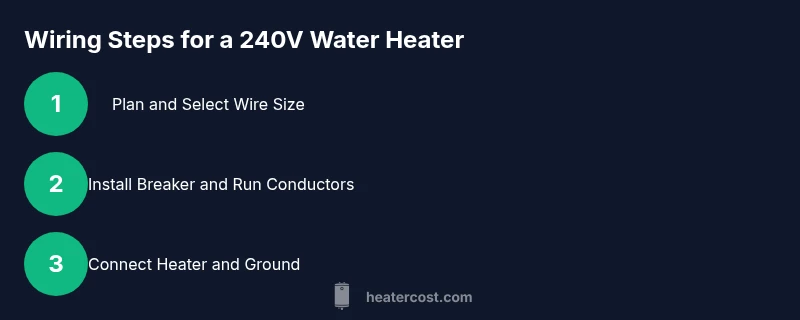
- 1
Plan and verify heater wattage
Identify the heater wattage from the model or label and map the run from panel to heater. This informs conductor size, breaker choice, and any required conduit. Cite the heater label to confirm the exact wiring method.
Tip: Double-check the heater's wattage and location before buying parts. - 2
Power down and confirm zero voltage
Shut off power at the main panel and use a voltage tester to confirm there is no live current on the circuit you’ll work with.
Tip: Always treat all wires as live until tested. - 3
Choose wire size and type
Based on the heater wattage and run length, select copper conductors (typically 10 AWG for many 4500W heaters) or upgrade to 8 AWG for longer runs. Decide between NM-B vs THHN in conduit.
Tip: Longer runs may require THHN in conduit to reduce voltage drop. - 4
Install the dedicated circuit breaker and run conductors
Install the 30A two-pole breaker and route conductors from the panel to the heater location, using conduit if THHN is chosen. Leave enough slack for later connections.
Tip: Keep the circuit on its own dedicated space in the panel. - 5
Connect heater terminals and grounding
Connect the two hot wires to the heater’s terminal block, attach the grounding conductor to the heater frame, and secure all connections. Install the disconnect if required by code.
Tip: Ensure the heater is isolated if a disconnect is installed. - 6
Test and restore power
With proper tools, re-energize the circuit and verify 240V across the heater terminals. Check for proper grounding and absence of loose connections.
Tip: If you detect any abnormal readings, power down and recheck connections.
Got Questions?
What wire size is typically needed for a 4500W electric water heater?
Most 4500W water heaters use 10 AWG copper conductors on a 30A double-pole breaker. Always verify with the heater label and local codes.
Most 4500W water heaters require 10 AWG copper on a 30A breaker. Always check the heater label and local codes.
Can I run a water heater on a standard 20-amp circuit?
No for most 4500W heaters. They typically require a dedicated 240V circuit on a 30A breaker due to continuous load and startup surge.
No, most electric water heaters need a dedicated 240V circuit on a 30A breaker.
Is copper always required, or can I use aluminum?
Copper is standard for reliability, but aluminum conductors can be used with proper sizing and terminations per code. Always confirm with a licensed electrician.
Copper is standard, but aluminum can be used with correct sizing and proper connections.
Do I need a permit to wire a water heater?
Often yes. Permits and inspections are common requirements for new wiring and circuit upgrades. Check with your local building department.
Permits are commonly required for new wiring and circuit upgrades; check your local regulations.
Is a disconnect required near the heater?
Many codes require a readily accessible disconnect within sight of the heater. Verify local requirements before installation.
A disconnect near the heater is often required; check your local codes.
What should I do if the run to the heater is long?
For longer runs, increase wire gauge (8 AWG or THHN in conduit) to minimize voltage drop and maintain performance.
Long runs may need bigger conductors to prevent voltage drop.
Watch Video
The Essentials
- Plan for a dedicated 240V circuit on 30A when wiring a typical electric water heater.
- 10 AWG copper is common; upgrade to 8 AWG where distance or heater wattage demands.
- Choose NM-B for simple indoor runs or THHN in conduit for longer or exposed routes.
- Follow local codes and obtain required permits; consider professional installation for safety.