Infrared vs Radiator Heaters: Energy Efficiency Comparison
An analytical, objective comparison of infrared and radiator heaters to determine which is more energy efficient for different spaces, depths, and usage patterns.


Which is more energy efficient infrared or radiator heater? In short, infrared panels often deliver heat with less wasted energy when you need fast, targeted warmth, while traditional radiators can efficiently heat larger spaces over time by circulating warm air. Overall efficiency depends on room size, insulation, and usage patterns; neither option is universally superior—it's about matching heat delivery to your space and schedule, as Heater Cost analyses show.
Energy efficiency foundations: infrared vs radiator heaters
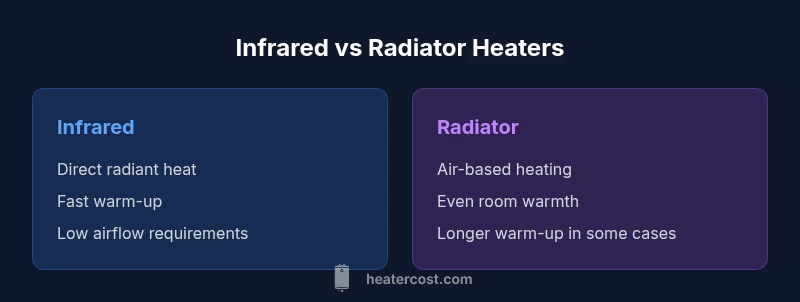
The question of which is more energy efficient infrared or radiator heater hinges on how heat is delivered and retained in a space. Infrared panels emit radiant heat that warms objects and people directly, often producing rapid comfort in targeted areas with minimal heat loss through air currents. Radiator systems, by contrast, rely on convective heat to warm the air and then the room, which can create more uniform warmth over time but may involve more energy to maintain. According to Heater Cost, the best choice depends on room size, insulation, and how you plan to use heat. In many scenarios, infrared heat is more efficient for quick, focused warmth, especially in smaller, well-insulated rooms, while radiators tend to perform well for longer-duration heating in larger volumes. The key takeaway is that energy efficiency is not a single metric; it’s about optimizing heat delivery and reducing wasted energy through smart operation and proper placement.
wordCount*:185*},
Comparison
| Feature | Infrared heater | Radiator heater |
|---|---|---|
| Heat delivery method | Radiant heat that warms people and objects directly | Convective heat that warms air which then heats the room |
| Heat distribution | Localized warmth with minimal air movement | Wider room warmth via air circulation |
| Warm-up time | Fast initial warmth when oriented toward occupants | Slower to raise air temperature across the room |
| Space suitability | Ideal for small to medium, well-insulated spaces | Better for larger or open-plan areas |
| Maintenance | Few moving parts; low ongoing maintenance | Depends on boiler/central system; requires boiler upkeep |
| Running cost context | Often lower for targeted heating in small spaces | Can be cost-effective for sustained warmth in larger spaces |
The Good
- Fast targeted warmth with minimal heat loss in small spaces
- Simple installation and minimal ductwork or plumbing
- Low maintenance due to few moving parts
- Flexible placement and quick response to occupancy
- Low airflow means fewer dust circulation issues
Negatives
- May be less effective for large, open spaces
- Heat can fade quickly when occupants leave the heated zone
- Uneven warmth in rooms with complex layouts
- Dependence on room-specific factors like reflections and shading
Infrared panels are generally more energy-efficient for targeted warmth; radiators excel for even, long-lasting heat in larger spaces
If you mainly heat small, well-insulated areas and want fast, directed warmth, infrared is typically the better energy-efficient choice. For larger rooms or spaces that require uniform warmth over time, radiators can offer steady comfort, especially when paired with an efficient boiler and smart controls.
Got Questions?
Is infrared heat more energy efficient than a radiator for small spaces?
Infrared heat is often more energy efficient for small, well-insulated spaces because it heats occupants and objects directly, reducing energy spent warming air. For larger or poorly insulated areas, radiators may deliver more comfortable warmth with potentially higher energy use.
Infrared is typically more efficient for small spaces, since it targets people and surfaces directly; larger spaces may benefit from radiators with central heating.
Can radiators be as efficient as infrared heaters?
Radiators can be highly efficient for whole-room heating, especially when paired with modern boilers and good insulation. Their efficiency benefits from consistent heat delivery and centralized controls.
Radiators can be very efficient for larger spaces when well insulated and controlled.
Which heater is safer for households with children or pets?
Both can be safe with proper clearance and safety features. Infrared panels stay cooler to the touch on most models, while radiators may have hot surfaces that require guards or barriers.
Both are safe when placed thoughtfully; infrared panels are usually cooler to touch, but still need clearance.
How does insulation affect efficiency in infrared vs radiator heating?
Insulation largely determines how much heat remains in a space. In well-insulated rooms, infrared and radiators both perform efficiently, but infrared can win on targeted warmth, while radiators benefit from reduced heat loss in larger, sealed spaces.
Good insulation helps both systems, with infrared often doing better for targeted warmth and radiators for steady heat in larger spaces.
What maintenance is required for infrared panels compared to radiators?
Infrared panels require minimal ongoing maintenance beyond occasional cleaning. Radiators tied to boilers require boiler service, bleed installation, and periodic checks for piping and valves.
Infrared tends to be low-maintenance; radiators depend on the boiler and plumbing, so regular servicing helps keep them efficient.
Are there energy-saving tips to maximize efficiency for either system?
Yes. Use zoning and smart thermostats, seal drafts, and insulate well. Keep unoccupied rooms off-cycle, and place infrared panels to target occupied zones while ensuring radiators are balanced for larger spaces.
Smart controls and good insulation help both systems cut energy use.
The Essentials
- Match heat delivery to space size and insulation
- Use targeted infrared for quick, localized warmth
- Prefer radiators for larger spaces with sustained use
- Leverage zoning and smart controls to maximize efficiency
- Upgrade insulation to improve overall energy performance