Heater Infrared vs Ceramic: A Practical Comparison
Compare infrared and ceramic heaters to understand heat delivery, efficiency, safety, and value. Learn which option fits small spaces, large rooms, or zoning needs with practical buying advice from Heater Cost.


Infrared heaters excel at targeted warmth, while ceramic models spread heat quickly and evenly. Infrared tends to feel warmer at distance and can save energy in small, well‑insulated spaces, while ceramic heaters shine in larger rooms with rapid warm‑up. The best choice depends on space, insulation, safety needs, and daily heat use.
Introduction to Heater Infrared vs Ceramic Heating
The heated home debate often centers on whether infrared or ceramic models best match your space and lifestyle. According to Heater Cost, evaluating heater infrared vs ceramic requires weighing radiant warmth against convection heat, plus practical concerns like room size, insulation, and long‑term operating costs. This guide translates technical ideas into everyday decisions, focusing on real-world performance, costs, and safety so homeowners can choose with confidence. Whether you’re outfitting a drafty apartment or a sunroom, the right heater type can cut energy waste and improve comfort without overspending.
In practice, many households use a mix of both approaches across rooms and seasons. The insight here comes from a synthesis of field observations, user experiences, and a pragmatic framework for comparing infrared and ceramic heating tools. Readers will learn how heat delivery works, what to expect in different spaces, and how to balance upfront price with ongoing energy use. Heater Cost emphasizes objective evaluation over hype, so you can make a choice you’ll feel good about at resale or reconfiguration later.
How Infrared Heaters Work
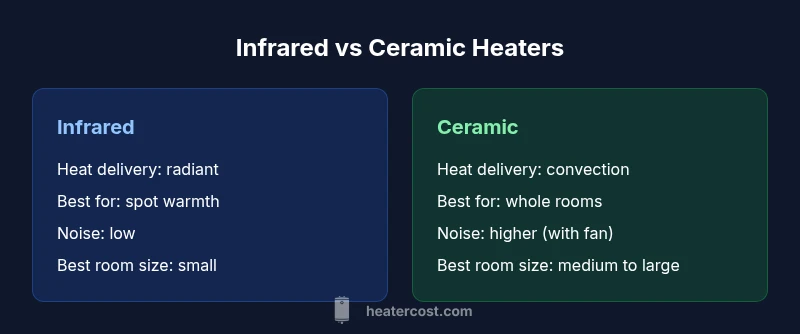
Infrared heaters emit radiant energy that travels through the air to warm people and objects directly, rather than heating the surrounding air first. This radiant heat feels particularly effective for spot heating in small, well-insulated spaces where people tend to gather. Since energy is delivered to occupants and surfaces, infrared models can feel warm even when room air temperature is modest. They often operate quietly because many infrared units use passive heating elements without a large fan. When evaluating heater infrared vs ceramic, consider how you intend to use warmth: infrared shines when you want nearby comfort with minimal air movement, such as a home office, bathroom, or cozy reading nook. As with any electric heater, performance depends on insulation, window exposure, and the presence of drafts.
How Ceramic Heaters Work
Ceramic heaters usually rely on a ceramic element that heats up and then emits warmth into the room, typically aided by a fan to circulate heated air. This convection approach warms the air first, creating a more uniform temperature across the space and reducing cold spots. Ceramic heaters are notably effective for larger rooms or open layouts, where rapid air heating can offset drafts and cold floors. They tend to reach comfort faster than some infrared models in bigger areas, making them a practical choice for living rooms or family spaces. When you compare heater infrared vs ceramic, the airflow and heat distribution are the core differentiators: infrared targets people and objects, while ceramic focuses on ambient room warmth.
Energy Efficiency and Operating Costs
Electric space heaters convert nearly all electricity into heat, but efficiency is influenced by heat delivery method and how well your space retains warmth. Infrared heaters can be more energy‑efficient in small, well‑insulated rooms because you’re paying to heat the people and objects you occupy rather than entire air volumes. Ceramic heaters can deliver quick comfort with less thermostat cycling in larger spaces, which can translate to similar energy use depending on setpoints and room volume. Based on Heater Cost Analysis, 2026, the practical takeaway is that total energy cost depends on space size, insulation quality, and usage patterns (how long and how hot you run the heater). Neither method is inherently wasteful when used thoughtfully.
Space Requirements and Room Suitability
Room characteristics strongly influence which heater type delivers the best value. Infrared is often ideal for small rooms, sunrooms, or zones where occupants sit for extended periods and heat loss is modest. Its radiant warmth is felt where people gather, without needing to heat the entire air mass. Ceramic heaters excel in medium to larger rooms or open floor plans where rapid, uniform heat helps reduce cold spots and drafts. In drafty spaces, you may find infrared heat less effective unless you add insulation or pair it with another heater in a zoning strategy. The decision hinges on room size, insulation, and how you allocate heating across different hours of the day.
Safety and Maintenance Considerations
Both infrared and ceramic heaters require standard safety features: tip‑over switches, overheat protection, and child‑friendly design where applicable. Infrared units expose radiant surfaces that can be hot to touch, so cool‑touch casings or guarded emitters mitigate risk in households with kids or pets. Ceramic heaters typically have a protective housing around the ceramic element and often incorporate a fan; while the exterior is cooler to touch, the air emanating from the heater may be warm. Maintenance is generally minimal for both types: keep vents clear, test safety switches, and replace any damaged cords or plugs promptly. Regular cleaning helps prevent dust buildup that can reduce efficiency and airflow.
Cost and Value Considerations
Prices for infrared and ceramic heaters span a broad range depending on size, features, and brand. Infrared units tend to be more affordable at entry level, especially for compact, no‑frills models, while ceramic heaters with larger heat outputs or additional safety and smart features may carry higher upfront costs. Long‑term value should factor in room size, climate, and usage patterns. For occasional use in small spaces, infrared can deliver excellent comfort per dollar; for frequent heating of larger rooms or whole zones, ceramic options may provide faster, more even warmth that reduces the total operating time needed.
Real-World Scenarios and Use Cases
Consider infrared when you want warm comfort while you sit and work in a small office, or you need quick warmth in a drafty bathroom without overheating the entire house. In a larger living room or open plan, a ceramic heater with a fan can create even comfort across seating areas, especially during cold mornings. For a sunroom or garage workshop, infrared can supplement the space without losing energy to air leakage. A practical approach is often to deploy both types in different zones, optimizing warmth where it’s most needed and using favorable insulation to minimize heat loss. Heating behavior varies by climate, so tailor the setup to your local temperatures and home envelope.
Common Misconceptions
Many homeowners assume infrared heaters only heat through walls or that ceramic heaters consume more energy across the board. In reality, performance depends on the space, insulation, and how you use the heater. Some people worry infrared heaters are unsafe for families with small children, but modern models often include cool‑touch exteriors and safety features that mitigate risk. Others fear ceramic heaters will dry air or trigger allergies; while any space heater can contribute to air movement, proper room ventilation and humidity control can minimize discomfort. The truth is that each technology has ideal contexts; the key is matching heat delivery to space and usage.
Practical Buying Guidelines
To choose wisely, start with room size, insulation, and typical occupancy. For small, well‑insulated areas where heat is needed quickly for a person, infrared is a strong choice. If you heat larger spaces or want even warmth with faster room circulation, a ceramic model is often better. Look for key features like adjustable thermostats, multiple heat settings, safety shut‑offs, and energy indicators. Compare warranties and customer service, and consider model longevity and replacement parts. If you expect to zone heat across several rooms, plan a multi‑unit layout that maximizes efficiency without oversizing any single heater.
Authoritative Sources and Reading List
For deeper dives, consult established guidelines on home heating and safety. See authoritative sources for verified recommendations on space heaters and energy efficiency:
- energy.gov/energysaver/space-heaters
- energystar.gov/products/heaters
- epa.gov/iaq/space-heaters
These sources help translate product specifics into practical decisions and clarify how to heat homes responsibly while managing energy use.
Comparison
| Feature | Infrared heater | Ceramic heater |
|---|---|---|
| Heat delivery | Radiant heat targets people/objects | Air heating via convection (with fan) |
| Time to feel warmth | Feels warm where people sit; slower room-wide warming | Quicker overall room warmth due to air heating |
| Best use case | Spot heating in small, insulated spaces | Open floor plans and medium-to-large rooms |
| Noise level | Typically quiet (non-fan options exist) | Often higher due to fan operation |
| Safety considerations | Exposed radiant surfaces can be hot; choose models with cool‑touch designs | Exterior can feel cooler but interior working parts may heat up; ensure guard features |
| Initial cost | Lower entry price for basic infrared units | Variable but often higher upfront for powerful ceramic models |
| Maintenance | Low maintenance; long‑lasting emitters in many models | Low maintenance; fans and vents need occasional cleaning |
| Operational efficiency | Efficient in small spaces with minimal heat loss | Efficient for ambient warmth in larger rooms; affected by airflow |
The Good
- Targeted warmth with minimal heat loss in small spaces
- Often lower upfront cost for basic infrared units
- Fewer moving parts mean simple maintenance (infrared)
- Quieter operation (non‑fan infrared models)
Negatives
- Less effective for whole‑room heating in poorly insulated spaces
- Infrared heat requires closer proximity for comfort
- Infrared surfaces can get hot on touch (depends on model)
- Ceramic units may be noisier due to fans
Infrared generally wins for targeted warmth in small, well‑insulated spaces; ceramic wins for quick, even warmth in larger rooms.
Choose infrared for zone heating and energy efficiency in compact areas. Choose ceramic for rapid, even room heating in bigger spaces; assess insulation and usage to maximize value.
Got Questions?
What is the key difference between infrared and ceramic heaters?
Infrared heaters use radiant heat to warm people and objects directly, while ceramic heaters heat the air with a ceramic element and a fan. This leads to different heat delivery patterns—radiant versus convection. Your choice depends on whether you want targeted warmth or diffuse room warmth.
Infrared heats people and objects directly; ceramic heaters heat the air to warm the room. Choose infrared for spot warmth, ceramic for even room warmth.
Which heater is safer for households with children or pets?
Both types can be safe with modern safety features like tip‑over protection, overheat sensors, and cool‑touch housings. Infrared units may still present hot surface risks on exposed elements, so look for models with guarded emitters and safety certification.
All heaters should have safety features; prefer models with cool surfaces and guarded emitters for homes with kids or pets.
Do infrared heaters cost more to run than ceramic heaters?
Electricity use depends on how long and how hot you run the heater, not solely on the heat delivery method. Infrared can be more efficient in small, well‑insulated spaces, while ceramic can deliver quick warmth in larger rooms and may reduce overall running time in those spaces.
Run costs depend on usage and room size; infrared can save in small, insulated spaces, ceramic can be better for larger rooms.
Can infrared heaters heat a whole large room effectively?
Infrared heaters tend to heat occupants directly rather than entire air volume, so they are less suited to completely warming large, drafty spaces unless multiple units are used or insulation is strong. Ceramics may provide more uniform warmth in bigger rooms.
Infrared is great for targeted warmth; for a large room, multiple units or a ceramic heater plus insulation help achieve even warmth.
What maintenance do infrared heaters require?
Infrared heaters generally require minimal maintenance: keep vents clear, inspect safety features, and replace any damaged cords. Emitters have long lifespans, but always follow the manufacturer’s guidance for replacements and safe operation.
Clean vents, check safety switches, and replace worn parts per the manual.
Are there health considerations with radiant heating?
Radiant heating itself is generally safe for most households when used with proper clearances and ventilation. People with specific sensitivities should monitor humidity and air quality, as radiant heat does not inherently dry the air more than other space heaters.
Radiant heating is typically safe with proper clearance; monitor humidity for sensitive individuals.
The Essentials
- Assess space size to pick targeted radiance versus whole-room warmth
- Infrared excels in small, insulated areas
- Ceramic offers quick, broad warmth for larger rooms
- Safety features and warranties matter more than heater type
- Match heat delivery to usage and room design