Which Heaters Use Less Electricity: A Practical Guide for 2026
Explore a data-driven comparison of heater types to identify which heaters use less electricity. Learn about heat pumps, electric resistance, tankless water heaters, and more with practical guidance for homeowners, renters, and property managers.


For homeowners looking to lower electricity bills, the quickest takeaway is that heat pumps and properly sized, well-insulated electric heaters generally use less electricity than traditional electric resistance heaters. Understanding insulation, climate, and usage patterns helps you pick a heater that minimizes consumption while delivering comfort. This quick answer sets the stage for a deeper comparison of technologies, installation considerations, and cost implications.
Why which heaters use less electricity matters for homeowners
According to Heater Cost, choosing the right heater can significantly influence monthly energy bills and overall comfort. The central question is about electricity efficiency: which heaters use less electricity under real-world conditions? In practice, homeowner choices depend on climate, house insulation, and how the space is used. Electric heaters come in many forms, from resistance-based units to heat pumps and advanced radiant panels. Each technology converts electricity into usable heat with varying efficiency, resilience to cold snaps, and upfront vs. operating costs. Understanding these differences helps you predict long-term expenses and tailor a solution to your property type—single-family homes, multifamily units, or rental properties. This section lays the groundwork by defining core terms: efficiency, coefficient of performance (COP), standby losses, and how thermostat behavior affects consumption. By the end, you’ll have a framework to compare technologies with real-world impact rather than marketing claims.
Key takeaway: your home’s envelope (walls, windows, insulation) and occupancy patterns often determine whether a given heater will use less electricity in practice.
Top technologies that reduce electricity consumption
Advances in heating tech have given homeowners several options to lower electricity use while maintaining comfort. The most impactful categories are:
- Heat pumps: These systems move ambient heat rather than generate it from scratch, delivering warmth at a fraction of the energy cost of resistance heating in moderate climates. They excel when outdoor temperatures are not extreme and when the space is well insulated.
- Smart controls and zoning: Programmable thermostats, occupancy sensors, and zoned systems reduce power by heating only occupied areas and by avoiding overshoot when temperatures rise or fall. Automation helps curtail unnecessary runtime.
- High-efficiency electric resistance options: Modern infrared panels and ceramic heaters can target heat where you need it, lowering waste heat in unoccupied spaces while maintaining comfort in busy zones.
- Hybrid and split systems: Some configurations combine heat pumps with supplemental resistance heating for peak demand periods, balancing comfort with electricity use.
- Tankless electric water heaters: For hot water needs, on-demand units avoid standby heat losses common in storage tanks, especially in homes with unpredictable hot-water demand.
Real-world impact depends on installation quality, climate, and home insulation. The Heater Cost analysis emphasizes that performance gains are maximized when the system is sized to comfort needs and climate realities.
Practical note: always compare COP ratings, system efficiencies, and expected runtime with your local climate data. A well-chosen system may use substantially less electricity even if its upfront cost is higher.
Electric resistance vs heat pumps: who uses less power?
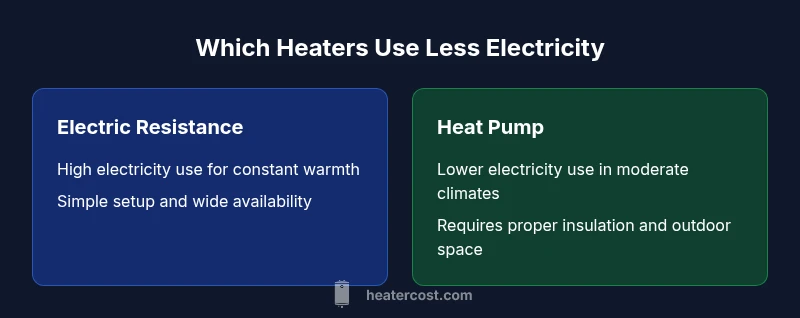
Electric resistance heaters are straightforward: they convert all supplied electricity into heat at a fixed rate. In most situations, they consume more electricity for the same level of warmth than heat pumps, especially in temperate climates where passive heat is easier to obtain with a heat pump. Heat pumps, by contrast, extract ambient heat from the outdoors or indoor air and convert it to usable heat with much greater efficiency. The result is lower electrical energy use for the same comfort level, provided the system is properly sized and maintained. Factors that influence performance include outdoor temperatures, heating load, insulation quality, and how often the space is occupied.
From the Heater Cost perspective, the key takeaway is relative efficiency: heat pumps tend to use less electricity than resistance heaters in typical home settings, particularly when installed with correct airflow and zoning strategies. Always compare installation constraints, climate suitability, and long-term operating costs rather than just upfront price.
In addition, consider hybrid approaches that blend heat pump operation with selective resistance heating for peak days, ensuring you aren’t paying for unnecessary electricity during milder periods.
Tankless vs traditional electric water heaters: energy draw explained
Water heating is a major driver of electricity use in many homes. A traditional storage-tank electric water heater continuously maintains a warm water supply, which leads to standby heat losses. Tankless electric water heaters heat water on demand, eliminating standby losses but potentially limiting flow if multiple fixtures run simultaneously. The electricity draw of a tankless unit depends on how many appliances draw hot water at once and on the unit’s rated capacity. For homes with modest hot-water demand, tankless electric heaters can offer lower electricity use and space savings, whereas large households may require larger or multiple units to prevent temperature fluctuations and ensure consistent supply. The choice between tankless and storage heaters should factor in peak hot-water loads, pipe layout, and average daily hot-water usage. Heater Cost’s guidance is to model daily hot-water needs and compare the energy profile of each option within your climate and occupancy patterns to determine which uses less electricity overall.
Supplemental vs primary heating: when electricity is the main cost
In many homes, electricity is a secondary or supplemental source of heat, with other fuels or passive solar contributing meaningfully to comfort. In those situations, the absolute electricity use of a heater type may matter less than how well it integrates with the building envelope and other systems. For instance, heat pumps paired with great insulation can serve as the primary heating source in milder climates, bringing down overall electricity consumption even when used as a primary heat source. In colder zones, supplemental resistance units may be warranted during extreme days, but their operation should be carefully managed with smart thermostats and zoning to avoid unnecessary energy use. When evaluating options, consider both total energy consumption and reliability of heat delivery during peak demand times. Heater Cost’s framework emphasizes a balanced system design: efficient core heat delivery, precise controls, and a plan for seasonal variation.
Decision hint: if you need to cover long cold periods, prioritize a system with strong performance at low outdoor temperatures and integrated controls that minimize runtime.
Real-world usage patterns and energy bills
Usage patterns drive outcomes far more than device specs alone. The same heater type can perform very differently in two homes depending on insulation, window quality, and occupant habits. For example, a heat pump in a well-sealed house with a programmable thermostat can deliver comfortable warmth with remarkably low electricity use, while the same unit in a poorly insulated space may struggle to reach setpoints, raising runtime and cost. Occupancy patterns—how many hours per day a space is heated or how many zones are actively heated—also shape energy bills. The goal is to align equipment performance with actual needs, not theoretical ratings alone.
Heater Cost’s analysis shows that audits of envelope performance and load calculation are essential steps before purchasing. Without such analysis, even the most efficient heater can end up consuming more electricity than anticipated due to heat loss and oversizing. Real-world outcomes hinge on proper installation, air sealing, ductwork optimization, and user behavior.
How to estimate energy use for your home
Estimating energy use involves a practical, stepwise approach. Start with a baseline that estimates your current electricity consumption for space heating over a typical winter month. Then, for each candidate heater type, model how many hours per day you expect to run it and what indoor temperature you aim to maintain. A simple formula can guide you: energy use is approximately watts × hours of operation, adjusted for system efficiency and seasonal demand. For heat pumps, consider the COP in your climate; for resistance heaters, assume about 1.0 COP. Don’t forget standby losses for tanks and the potential for heat gain or loss from windows, doors, and insulation. Use a home energy audit or software tools available from energy agencies to refine your estimates. Finally, translate the estimates into annual electricity costs using your local electricity rate, then compare to the other options.
Pro tip: run a short pilot, if feasible, with a thermostat set to an energy-conscious schedule to observe real-world performance before committing to a full installation.
Choosing the most efficient option for your space and budget
Choosing the most efficient heater involves balancing upfront costs, long-term operating costs, climate, home envelope, and personal preferences for comfort. In many climates, heat pumps represent the best blend of efficiency and utility, particularly in well-insulated homes and temperate seasons. For smaller spaces or zones, wall-mounted electric infrared panels or panel heaters can concentrate warmth where needed with modest electricity use. If you already have a gas line or abundant cheap fuel, a hybrid approach may optimize overall energy costs by leveraging the cheaper energy source and only using electricity during shoulder seasons. Tankless electric water heaters can reduce standby losses for hot water but may have higher upfront costs or smaller output than traditional tanks in high-demand households. Regardless of choice, ensure installation is performed by a qualified technician, and plan for zoning, insulation improvements, and weatherization. Heater Cost’s verdict champions energy efficiency as a system property, not a single device.
Practical maintenance to maximize efficiency
Maintenance matters as much as the initial purchase. Clean or replace filters regularly for space heaters, inspect seals and ducts, and ensure proper airflow around equipment. For heat pumps, keep coils clean and maintain refrigerant charge as recommended by the manufacturer. For water heaters, drain and flush periodically to remove sediment and maintain tank integrity. A well-maintained unit runs more efficiently and lasts longer, reducing electricity use over time. Schedule annual or semi-annual checkups with a qualified HVAC technician, especially before peak heating seasons. Finally, combine maintenance with smart controls and seasonal adjustments to sustain energy savings across the life of the system.
Authority sources and further reading
- U.S. Department of Energy – Energy Saver: Heat Pumps and Insulation best practices: https://www.energy.gov/energysaver/heat-pumps
- ENERGY STAR – Efficient home heating and cooling: https://www.energystar.gov
- U.S. Department of Energy – How heat pumps work and sizing guidance: https://www.energy.gov/eere/buildings/articles/heat-pumps-101
Note: Always corroborate recommendations with local climate data and professional assessments.
Feature Comparison
| Feature | Electric resistance heater | Heat pump | Tankless electric water heater | Storage electric water heater |
|---|---|---|---|---|
| Electricity use (relative) | high | low-to-moderate under typical conditions | low-to-moderate with small home demand | high due to standby losses when hot water sits idle |
| Best for climate | very cold climates (less efficient) or supplementary heat | mild to moderate climates | homes with variable hot water use | homes with constant hot water demand |
| Space requirements | often greater footprint indoors/outdoors | compact with proper installation | compact, wall-mounted option | bulky storage tank may require space |
| Installation complexity | often straightforward but may require wiring upgrades | requires proper location and refrigeration components | depends on water flow requirements | requires tank connections and expansion tanks |
The Good
- Lower operating costs with efficient heat pumps in suitable climates
- Zoned heating improves comfort and reduces wasted energy
- Smart controls optimize runtime and temperatures
- Tankless water heaters reduce standby heat losses for hot water
Negatives
- Higher upfront costs for heat pumps and smart controls
- Performance drops in extreme cold without supplemental heating
- Tankless water heaters may require more precise sizing and venting adjustments
- Cooling and heating hybrids add system complexity
Heat pumps and well-sized electric options typically use less electricity than resistance-only heating in most homes.
Prioritize heat pumps where climate and insulation permit. For hot water, tankless electric models can cut standby losses, but ensure proper sizing and installation to achieve best efficiency.
Got Questions?
What factors influence which heater uses less electricity?
Several factors determine electricity use: climate, insulation quality, heating load, and how you use the space. Occupancy patterns, zoning, and thermostat behavior also play a major role. Sizing and proper installation prevent oversizing, which can waste energy and raise bills.
The main factors are climate, insulation, occupancy, and thermostat behavior. Proper sizing and installation are essential for true energy savings.
Are heat pumps always cheaper to run than electric resistance heaters?
In most homes, heat pumps use less electricity than resistance heaters due to their heat-creating efficiency. However, performance depends on climate, home envelope, and usage patterns. Always compare long-term operating costs and consider local electricity rates.
Usually yes, but it depends on your climate and how well your home is insulated.
Is tankless electric water heating more efficient than a storage tank?
Tankless electric water heaters eliminate standby losses seen in storage tanks, which can improve efficiency for homes with variable hot-water demand. For high hot-water needs, storage tanks may offer more consistent supply with simpler maintenance.
Tankless can be more efficient for some homes, but capacity and demand matter.
How can I estimate my home energy use for a heater?
Start with a baseline of current electricity use for heating. Model a few scenarios with different heater types, considering hours of use and climate. Use a home energy audit or online calculators to refine estimates and compare annual costs.
Estimate by modeling hours of use and climate, then compare annual costs.
Do I need professional sizing to maximize efficiency?
Yes. Professional sizing ensures the system meets the actual heating load without oversizing. Correct sizing reduces wasted energy, improves comfort, and prevents premature wear on components.
Yes—professional sizing is crucial for efficiency and comfort.
What maintenance most improves electricity efficiency?
Regular filter cleaning, duct inspection, coil cleaning for heat pumps, and periodic flushing of water heaters to remove sediment all help keep systems running near peak efficiency. Scheduling annual checks with a trained technician is highly beneficial.
Keep systems clean and well-maintained to sustain efficiency.
The Essentials
- Assess your climate and insulation before selecting a heater.
- Prioritize heat pumps for the strongest electricity savings in mild climates.
- Use smart controls to minimize runtime and avoid over-heating.
- Consider tankless electric water heaters to reduce standby losses for low to moderate hot water demand.
- Plan for professional sizing and installation to maximize efficiency.