Space Heater vs Baseboard Heater: Which Is Right for Your Home?
A detailed comparison of space heaters and baseboard heaters, covering heat distribution, efficiency, safety, installation, and long-term costs to help homeowners choose the right solution.


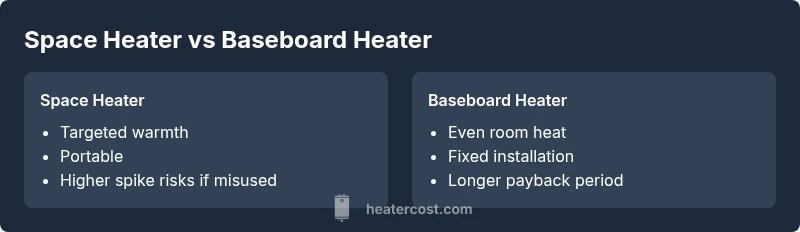
Space heater vs baseboard heater: for spot heating and flexibility, a space heater is usually best, while a baseboard heater excels at steady, whole-room warmth with fewer hot spots. This comparison walks through heat distribution, efficiency, safety, installation, and long-term costs to help homeowners decide which option fits their space and budget. According to Heater Cost, understanding these differences can save energy and improve comfort in everyday living.
Defining the Two Heating Solutions
A space heater is typically a portable electric unit designed for temporary or supplemental warmth. It can use radiant, convection, or a combination of heating methods and is intended to heat a defined area rather than an entire room or house. A baseboard heater, by contrast, is a fixed appliance installed along the baseboard area of a room. It may be electric or hydronic (hot water circulating through pipes). Space heater vs baseboard heater choices often come down to whether you need flexible, immediate warmth or a steady, evenly distributed climate throughout a space. For homeowners, the decision hinges on the size of the space, how often you need heat, and whether you prefer portable or built-in solutions. The Heater Cost team emphasizes context over hype: the best option is the one that reliably keeps you comfortable while aligning with your budget and energy goals.
How They Heat: Mechanism and Distribution
Space heaters can rely on radiant heat, convection, or a hybrid approach. Radiant space heaters warm objects and people directly in their line of sight, delivering warmth quickly to a specific spot. Convection space heaters warm the air and create a circulating breeze that gradually warms a room. Baseboard heaters operate primarily through convection, allowing cool air to be drawn in at floor level and heated air to rise and circulate. Because baseboard systems cover a longer wall length, they tend to distribute heat more evenly across a room. The choice between radiant vs convection heating influences comfort perception, odor, and humidity effects in enclosed spaces. The Heater Cost analysis highlights that the perceived warmth in a space can differ depending on the heater type and room geometry.
Efficiency and Operating Costs: What Affects Your Bill
Efficiency is more nuanced than a single number. A space heater can deliver high localized warmth with relatively low standby energy, but if you keep it running in a large space, it can lead to higher operating costs than a fixed solution. Baseboard heaters typically provide steady, room-wide warmth with fewer energy spikes, which can reduce the perceived need for supplemental heating. Real-world efficiency depends on insulation, air leaks, thermostat settings, and user behavior. According to Heater Cost analysis, a well-insulated space with proper use of a space heater for targeted zones may reduce waste, whereas a poorly insulated room can negate those gains. The key is to match the heating method to actual usage patterns rather than assume lower wattage = lower cost.
Safety Considerations and Best Practices
Safety is a top priority for any heater type. Space heaters pose risks of tip-overs, hot surfaces, and nearby combustibles if placed improperly. Choose models with automatic shutoff, tip-resistance features, and clear instructions for placement, especially around children and pets. Fixed baseboard heaters, particularly hydronic systems, present fewer frequent burn risks but require professional installation and proper clearance to prevent interference with furniture or curtains. Regular inspection of cords, outlets, and surrounding materials reduces hazards. The Heater Cost Team recommends following manufacturer guidelines, using space heaters only in supervised spaces, and never running them overnight without safeguards.
Installation, Maintenance, and Longevity
A space heater offers minimal installation — simply plug in and place it in a safe location. Hydronic or electric baseboard heaters require professional installation, electrical wiring, and sometimes adjustments to the home’s heating circuit. Maintenance for space heaters is typically straightforward: periodic cleaning, cord inspection, and ensuring vents are unobstructed. Baseboard heaters require annual checks for leaks in hydronic systems (if applicable) and periodic cleaning to prevent dust buildup that can impede airflow. Longevity is influenced by build quality, usage patterns, and maintenance. Quality units from reputable brands tend to last longer and maintain efficiency with less frequent component failures.
Use-Case Scenarios: When to Choose Which
For renters or spaces that change tenants frequently, a space heater offers flexibility and low commitment. In a cold-climate apartment, a compact unit can target a sleeping area or a home office without modifying the building’s heating system. For a family room that needs consistent warmth, a fixed baseboard heater provides a predictable climate with fewer hot spots and a more even temperature throughout the space. In workshops, garages, or sunrooms without central heating, space heaters can bridge gaps in comfort while owners evaluate longer-term investments. The Heater Cost Team notes that the most cost-effective choice often aligns with how a space is used most of the time.
Design, Aesthetics, and Placement
Space heaters vary widely in design, size, and finish, which means you can match a unit to your décor and room layout. Small, portable units are easy to relocate but require careful placement to avoid hazards. Baseboard heaters are unobtrusive and maintain a cleaner look since they blend with walls and baseboards, but their installation creates a fixed footprint that cannot be easily moved. When choosing between these options, consider not only heat output but also how the unit will look in the room and whether it will disrupt furniture arrangement or access to outlets and routes for cords.
Cost Snapshot: Upfront and Long-Term
Upfront costs for a space heater are generally lower if you only need supplemental warmth for a small space. However, frequent use across multiple areas can scale up operating costs, potentially surpassing the long-term cost of a fixed system. Baseboard heaters have higher initial installation costs, especially for hydronic systems, but they can offer smoother long-term energy performance and less incremental heat loss due to poor zoning. Your total cost depends on space size, insulation, electricity or fuel costs, and the level of comfort you require. Heater Cost analyses consistently show that a thoughtful combination of proper insulation and appropriate heater choice yields the best balance of comfort and cost.
Practical Decision Checklist
- Assess room size, layout, and insulation quality.
- Identify whether you need one room targeted warmth or whole-room consistency.
- Consider whether you require portability or a fixed installation for long-term comfort.
- Compare upfront costs against anticipated long-term operating costs and maintenance.
- Evaluate safety needs aligned with household occupants and pet considerations.
Comparison
| Feature | Space heater | Baseboard heater |
|---|---|---|
| Heat distribution | Spot heating in a defined area | Even heat along room perimeter |
| Installation & placement | Plug-in or portable placement | Fixed installation (hardwired or hydronic) |
| Operating costs | Potentially higher if used broadly | Typically steadier with fewer spikes |
| Upfront cost | Lower for portable models | Higher for built-in/hydronic options |
| Safety & usage | Higher risk if misused, needs supervision | Generally safer long-term when properly installed |
| Maintenance | Minimal upkeep, but cords and vents matter | Low maintenance beyond periodic checks |
| Best for | Spot heating, temporary comfort | Whole-room heating, permanent setup |
The Good
- Offers targeted warmth and flexibility for problem areas
- Low upfront costs for portable models
- Fast warmth when needed in a pinch
- Easy to relocate as spaces change
Negatives
- Higher operating costs if used extensively
- Safety concerns with improper usage (tip-overs, burns)
- Shorter lifespan for some portable units
- Hard-to-control heat could create uneven comfort in large rooms
Baseboard heaters are generally the better foundation for whole-room warmth; space heaters excel for targeted, flexible heating.
If your goal is steady, uniform heating across a room, baseboard heaters typically win. Space heaters are ideal when you need quick, localized warmth or temporary comfort in specific zones. The best choice depends on your space, insulation, and how you plan to use heat regularly.
Got Questions?
What is the main difference between space heaters and baseboard heaters?
Space heaters are portable and provide targeted warmth, often with radiant or convection heating. Baseboard heaters are fixed and designed to distribute heat evenly along a room’s perimeter. The choice depends on whether you need mobility and spot warmth or steady, whole-room comfort.
Space heaters give you warmth where you want it, while baseboard heaters keep the whole room comfortable without moving equipment.
Are space heaters more energy efficient for small spaces?
In small, frequently used areas, space heaters can be efficient for targeted warmth if used carefully and only when needed. However, continuous use in larger spaces can raise operating costs compared with a fixed system, especially with poor insulation.
Great for small, focused use, but not always the best long-term energy choice for larger rooms.
Indoor safety considerations for space heaters?
Always follow manufacturer guidelines, keep heaters away from flammable items, use in supervised settings, and install safety features like tip-over and overheat protection. Never leave plug-in space heaters running unattended overnight.
Keep space heaters clear of furniture and curtains, and use models with automatic shutoff.
Do baseboard heaters require professional installation?
Hydronic or electric baseboard heaters generally require a professional installation to ensure proper wiring, clearances, and venting (if applicable). Once installed, they typically require minimal ongoing maintenance.
Yes, for safer operation and to meet building codes.
Which is cheaper to operate long-term?
Long-term costs depend on space usage, insulation, and energy prices. Baseboard heaters often offer more consistent energy consumption in steady-use scenarios, while space heaters can save money if used sparingly in a well-insulated space.
It depends on how you use them and how well the space is insulated.
What about noise and comfort differences?
Most space heaters are quiet but can generate a hum or fan noise. Baseboard heaters are usually very quiet since they rely on convection without moving parts. Your tolerance for noise and feel of warmth will influence the choice.
If you want near-silent operation, baseboard is typically better.
The Essentials
- Choose fixed baseboard heating for even room warmth
- Use space heaters for targeted, flexible warmth
- Balance upfront costs with long-term operating costs
- Prioritize safety with all heater types
- Improve efficiency with good insulation and smart thermostat use