Radiator Heater vs Space Heater: A Practical Guide
Compare radiator heaters and space heaters for home heating: efficiency, safety, costs, installation, and best-use scenarios to help homeowners make informed decisions.


Radiator heaters deliver steady, even warmth across rooms when connected to a central boiler, typically with lower long-term running costs in well-insulated homes. Space heaters provide quick, targeted heat and flexible placement, but can incur higher operating costs and safety considerations. This comparison analyzes efficiency, safety, and use cases to help homeowners decide.
Context and Definitions
In most homes, two heating approaches compete for space and comfort: radiator heaters (part of a central heating system) and space heaters (portable units). According to Heater Cost, radiator heaters are typically hydronic or steam-based devices connected to a boiler; they provide heat by circulating hot water or steam through metal radiators, warming rooms gradually and evenly. Space heaters are portable devices that generate heat directly in the room, either by electric coils and convection fans or by burning fuel. They can deliver warmth quickly to a specific area but are less integrated with your home’s overall thermal envelope.
The Heater Cost team found that most homes achieve steady comfort with a mix of fixed and portable heating, but the balance depends on the home’s insulation, boiler capacity, and electrical circuits. If your goal is to maintain a consistent ambient temperature across larger living spaces, radiators often excel due to heat distribution from multiple radiators. If you’re prioritizing flexibility—occasional use in a drafty corner or in a temporary living space—a well-chosen space heater can fill the gap without major remodeling. In this article, we examine efficiency, safety, costs, and practical use cases to help homeowners decide what fits best.
Efficiency and Operating Costs
Efficiency is a function of design, usage, and the building envelope. Radiator heaters that are part of a hydronic or steam system depend on boiler efficiency and insulation. In well-insulated homes with good zoning, these systems can maintain comfortable temperatures with relatively stable energy use, which often translates into lower running costs over time compared to unmanaged spot heating. Space heaters, especially electric models, convert electricity to heat very efficiently at the unit, but overall cost hinges on electricity prices and how long the device runs. Gas-powered space heaters add complexity with venting and fuel costs. The Heater Cost analysis shows that running a space heater in a poorly insulated room can raise energy bills quickly, underscoring the value of insulation, smart thermostats, and limited, purposeful use. Overall, match the heating method to room size, climate, and occupancy patterns to optimize cost effectiveness.
Heat Distribution and Comfort
Radiator heaters provide a broad, even warmth by circulating heated fluid through a network of radiators. This layout reduces hot spots and cold drafts, creating a stable ambient temperature that lingers after the boiler cycles off. Space heaters heat more immediately and locally, making them ideal for quick warmth in a drafty corner or an unheated room. However, their heat decays quickly if you move away from the unit or if doors are opened to adjoining spaces. For overall comfort, most homes benefit from combining a fixed radiator system with strategic usage of portable space heaters for temporary needs or during shoulder seasons. The heated environment you experience depends on air circulation, furniture placement, and ceiling height, all of which influence perceived warmth and comfort.
Safety Considerations
Fixed radiator systems pose fewer immediate safety risks for most households; they are integrated with existing plumbing and electrical systems and have fewer exposed components. Space heaters require careful placement, sturdy surfaces, and clearances from curtains, furniture, and electronics. Common hazards include tip-overs, burns from hot surfaces, and a risk of fire if left unattended or used near flammable materials. Fuel-burning space heaters add the hazard of combustion byproducts and, in some cases, carbon monoxide, so proper ventilation and detectors are essential. Following manufacturer guidelines, using tip-over and overheat protection, and never running heaters unattended reduces risk significantly. For most households, pairing a fixed radiator system with portable space heaters for targeted needs is a prudent approach to manage risk while keeping comfort high.
Installation, Space, and Aesthetics
A radiator system is a fixed component of a home's heating strategy. Installing or upgrading radiators often requires boiler capacity, piping, and potentially contractor work, leading to higher upfront costs but a cleaner, unobtrusive interior once installed. Space heaters are compact and portable, offering flexibility for room-by-room heating and seasonal adaptation; they occupy floor space and contribute to clutter if not managed. Aesthetics favor fixed radiators in interiors designed for long-term comfort, while portable units fit renters or remodel-limited homes. The decision balances upfront disruption with long-term space planning and interior design goals.
Use Cases and Scenarios
If you live in a newly built or well-insulated home with a central boiler, radiator heaters support reliable, uniform warmth with smart zoning. In older homes with limited boiler capacity or in living spaces that require flexible control, space heaters can fill gaps without major structural work. Seasonality matters: in shoulder seasons, a space heater can maintain comfort during milder days, while peak winter may justify investing in radiators if you expect long-term occupancy. In small apartments, a single well-placed space heater or a compact radiator panel can achieve comfort with minimal energy waste. The best approach depends on occupancy patterns, room dimensions, and climate.
Durability, Maintenance, and Longevity
Radiator systems and boilers are designed for long service life and relatively low ongoing maintenance when properly maintained, though periodic servicing of the boiler is common. Radiators themselves typically require little attention beyond occasional bleed screws and inspections. Space heaters have moving parts and filters that may require periodic cleaning and replacement; failure to service can lead to reduced efficiency or safety concerns. Gas-powered space heaters demand venting, fuel management, and annual inspections. Overall, durability favors fixed radiators in the right installation, while space heaters emphasize convenience and adaptability with manageable but ongoing upkeep.
Budgeting and Total Cost of Ownership
Total cost of ownership includes upfront installation, equipment cost, energy consumption, maintenance, and longevity. Radiator systems incur higher upfront costs due to boiler integration and plumber work, but often deliver stable comfort with lower incremental running costs when properly zoned. Space heaters offer lower initial costs and great flexibility, but long-term energy use can be higher if used extensively in large or uninsulated spaces. A smart strategy combines both: fixed radiators for core living areas and portable heaters for occasional, targeted heating. The Heater Cost framework emphasizes planning for insulation upgrades, thermostat strategies, and seasonal usage to maximize return on investment.
Comparison
| Feature | Radiator heater | Space heater |
|---|---|---|
| Heat Source | Fixed hydronic or steam radiator linked to boiler | Portable electric or fuel-burning unit |
| Typical Coverage | Whole-room or multi-room zones (depends on system) | Single room or small area (portable) |
| Heat Distribution | Even ambient warmth from distributed radiators | Direct heat near the unit with possible drafts |
| Running Costs (qualitative) | Potentially lower with good zoning and insulation | Higher if used extensively in uninsulated spaces |
| Installation/Setup | Permanent installation; requires boiler and plumbing | Plug-in or vented setup; relocatable |
| Safety & Maintenance | Low exposed-risk; boiler safety and valve checks | Cord, tip-over and venting considerations; regular inspection needed |
| Best For | Whole-home comfort with fixed heat distribution | Spot heating, portable warmth in rooms or drafts |
The Good
- Provides even, stable warmth across larger areas
- Potentially lower long-term running costs with proper zoning
- Low ongoing maintenance for fixed radiator systems
- Seamless integration with existing home infrastructure (boiler-based)
Negatives
- Higher upfront installation costs and possible remodeling
- Limited portability and flexibility compared to space heaters
- Space heaters require vigilant safety practices and can raise energy bills if misused
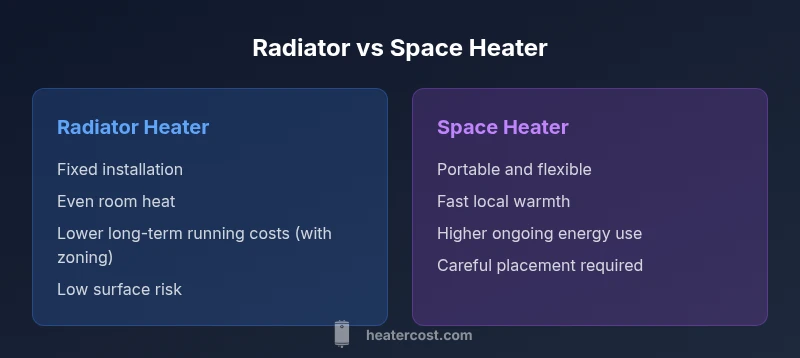
Radiator heaters win for steady warmth and potential long-term cost efficiency; space heaters win for flexibility and rapid, targeted heat
Choose radiator heating when you value consistent ambient warmth and plan a longer-term installation. Opt for space heaters when you need quick warmth in specific rooms or when you rent and cannot modify the building’s heating system. For many homes, a hybrid approach offers the best balance of comfort and cost control.
Got Questions?
What is the main difference between radiator heaters and space heaters?
Radiator heaters are fixed, part of a central system that provides uniform warmth across spaces. Space heaters are portable devices for quick, localized heat. The best option depends on whether you prioritize fixed comfort or flexibility.
Radiator heaters are built into the home and stay in place, while space heaters move with you and heat the immediate area.
Can space heaters be used as a primary heat source?
In many homes, space heaters should supplement a main heating system rather than replace it. They are effective for quick warmth in one room but are less efficient for whole-home comfort and can raise costs if used long-term in large spaces.
Space heaters work best as a supplemental heat source, not the main one for most homes.
Are radiator heaters more energy-efficient than space heaters?
Radiator systems can be more energy-efficient when properly zoned and insulated, since heat is distributed across rooms with a central boiler. Electric space heaters are highly efficient at the unit level, but total cost depends on usage and electricity prices.
Radiators can be more efficient overall in well-insulated homes; space heaters are efficient per device but can cost more to run long.
What safety concerns should I consider?
Space heaters require careful placement and supervision due to burn, fire, and tipping hazards. Gas or fuel-burning units need ventilation and carbon monoxide precautions. Radiators, being fixed, generally pose fewer immediate safety risks beyond standard boiler maintenance.
Space heaters need careful placement; radiators are typically safer when properly maintained.
How do installation costs compare?
Radiator installations involve boiler capacity, plumbing, and professional labor, resulting in higher upfront costs. Space heaters have low initial costs and can be installed by homeowners, but ongoing energy costs may rise if used extensively.
Radiator installation costs are higher due to plumbing and boiler work; space heaters are cheaper upfront but may cost more over time.
What maintenance is required for each?
Radiator systems require periodic boiler servicing and occasional radiator bleed/inspection. Space heaters need regular cleaning, filter checks (for electric units that have them), and safety inspections, especially for gas models.
Boiler maintenance for radiators, and cleaning and safety checks for space heaters.
The Essentials
- Assess insulation before choosing fixed vs portable heating.
- Radiators excel in even heat distribution and long-term efficiency.
- Space heaters offer portability and fast warmth for targeted needs.
- Safety, clearance, and ventilation are critical considerations.
- Plan for future upgrades and zoning to optimize total cost of ownership.