Is Heating or Cooling the Smarter Cost Choice? A Comprehensive Comparison
A rigorous, objective comparison of heating vs cooling options, focusing on upfront costs, energy use, maintenance, and total ownership for homeowners and managers.


In most homes, the smarter path is to align your choice with climate, energy costs, and building envelope. When the marginal energy savings are strong enough, a combined heating and cooling strategy—often via an efficient heat pump—tresents favorable total ownership. However, in very cold climates or where fuel prices are unusually low, separate, purpose-built heating and cooling systems can offer better long-term value. The decision ultimately hinges on total cost of ownership over the system’s life.
What is heating or cooling? A practical framing for homeowners
The question is not merely about warmth versus cool air; it is about which system design minimizes total costs over time while delivering reliable comfort. The phrase is heating or cooling, in plain terms, asks whether it makes more sense to rely on dedicated heating equipment and a separate cooling system, or to adopt a single, unified approach that handles both functions. According to Heater Cost, the core of this decision rests on climate, energy prices, and the building envelope. If a home loses heat in winter and gains heat in summer, a holistic approach—often a heat pump that covers both heating and cooling—can reduce complexity and potentially lower operating costs. Yet this is not universal; occupancy patterns, insulation, and local utility rates all impact the outcome. When you ask is heating or cooling, focus on total cost of ownership, not just upfront price.
The main cost drivers in heating and cooling
Cost drivers fall into several buckets: equipment price, installation complexity, energy efficiency, and ongoing maintenance. Upfront costs vary widely: dedicated heating equipment may require separate furnace or boiler work, while cooling systems add compressor, condenser, and ductwork considerations. Efficiency ratings—AFUE for heating and SEER/HSPF for cooling—shape annual energy use, influencing long-term bills more than sticker price. Maintenance cycles, preventive service, refrigerant handling, and potential repairs also contribute to lifetime costs. Another critical factor is system compatibility with your home’s insulation, air sealing, and thermostat management. The best choice balances initial investment with the expected energy savings and maintenance obligations over the system’s lifespan.
wordCount":180},
Comparison
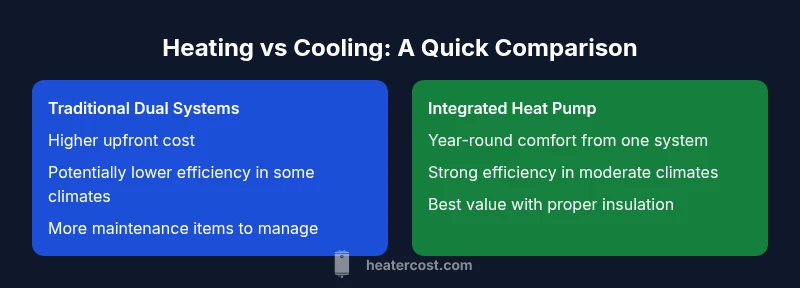
| Feature | Traditional heating + central cooling (separate systems) | Integrated heat pump system (heating + cooling) |
|---|---|---|
| Upfront cost range | Higher (furnace/boiler + separate AC) | Moderate to high (single heat pump with in-house controls) |
| Energy efficiency | AFUE + SEER for separate systems | Often high overall efficiency across seasons (HSPF/SEER) |
| Maintenance frequency | Separate service visits for heating and cooling | Single service pipeline; may reduce visits |
| Climate suitability | Very cold or hot extremes require robust components | Best in moderate to hot climates with seasonal shifts |
| Year-round comfort | Heat-only or cool-only cycles may require double equipment | One system handles both heating and cooling |
| Installation complexity | Multi-system integration with ductwork | Simplified installation when using a single system |
The Good
- Potentially lower long-term energy bills with a unified system in suitable climates
- Fewer maintenance visits with a single system
- Better climate responsiveness and comfort control when using a heat pump
- Can qualify for certain energy incentives or rebates in some regions
Negatives
- Higher upfront costs for dual systems or specialized equipment
- Less flexibility in very cold climates if relying on certain heat pump technologies
- May require ductwork upgrades or air sealing improvements
- Performance depends on local energy prices and climate patterns
Heat pumps generally offer the best year-round efficiency in moderate climates, while traditional separate systems may win in very cold or hot climates with favorable fuel costs.
Choose an integrated heat pump if your climate and energy rates favor year-round efficiency and simplified maintenance. Opt for separate heating and cooling systems if you face extreme temperatures or have existing infrastructure that makes a multi-system setup more cost-effective over the life of the equipment.
Got Questions?
What is the quickest way to estimate total cost of ownership for heating vs cooling?
Start with upfront costs, then estimate annual energy use based on local rates and system efficiency. Add expected maintenance and replacement cycles. A simple model can help you compare a traditional dual-system setup to a single heat pump over a typical lifecycle.
To estimate TCO, add upfront costs, annual energy costs, and maintenance, then compare across options.
Can heat pumps replace both heating and cooling entirely?
Yes in many homes, particularly in temperate or mildly cold climates. In very cold regions, some homes keep a supplemental heating source. An energy audit helps determine whether a heat pump can meet your heating and cooling needs.
Heat pumps can cover heating and cooling in many climates, with backups in very cold places.
What role do insulation and air sealing play in the heating vs cooling decision?
A well-insulated and sealed home reduces both heating and cooling loads, improving the effectiveness of whichever system you choose. Upgrades to windows, doors, and attic insulation often yield the fastest payback.
Insulation matters a lot; better sealing lowers costs for both heating and cooling.
Are there tax credits or rebates for heating or cooling upgrades?
Many regions offer incentives for energy-efficient equipment, including heat pumps. Eligibility varies by location and equipment type, so check local programs and utility rebates.
There are often energy incentives for efficient systems—check your local programs.
What maintenance should I expect for heating vs cooling equipment?
Schedule annual inspections for heating and cooling components, address refrigerant labels and duct integrity, and replace filters regularly. Proper maintenance protects efficiency and extends equipment life.
Keep up with yearly checkups and regular filter changes for best results.
Is a hybrid system worth it in mixed climates?
Hybrid setups that switch between heat pump and auxiliary heating can offer flexibility and cost savings, especially where winter temperatures vary widely. A professional assessment will confirm viability.
Hybrid systems can save money in variable climates, with a professional check first.
The Essentials
- Prioritize total cost of ownership, not just upfront price
- Match system choice to climate and insulation quality
- Consider energy prices and incentives in your region
- A single, well-designed heat pump often delivers strong year-round comfort