Heat Pumps vs AC: A Comprehensive Comparison for 2026
A thorough, objective comparison of heat pumps and traditional AC, focusing on efficiency, costs, climate performance, and long-term value for homeowners in 2026.


Heat pumps generally deliver higher energy efficiency, cleaner heating and cooling, and lower lifecycle costs than traditional air conditioners. For many homes, a heat pump can replace both heating and cooling, delivering year‑round comfort with lower energy bills. The more you compare, the clearer it becomes that a heat pump often offers superior value over a standard AC, especially in temperate to mild climates.
Why are heat pumps better than ac
The central question in this comparison is why are heat pumps better than ac, and the answer hinges on efficiency, year‑round comfort, and long‑term value. Heat pumps move heat rather than generate it, an approach that typically uses less energy to achieve the same level of warmth in winter and cooling in summer. This fundamental difference drives the economics of ownership and shapes how homeowners experience climate control. According to Heater Cost, the one‑system model can reduce the number of devices installed, minimize space usage, and simplify maintenance, all of which contribute to lower lifetime costs when correctly sized and installed. The Heater Cost team emphasizes that, in many homes, the savings compound over time as bills decline while temperatures remain steady, especially during shoulder seasons when weather swings are common but demand is moderate. Beyond the economics, heat pumps offer environmental benefits by reducing fossil‑fuel use and allowing a shift toward electricity‑powered solutions that can be paired with renewables. Yet the fit is not universal: climate, home insulation, duct design, and electrical service all influence performance. In this guide we will examine the physics, the practical implications, and real‑world outcomes to help you decide if the claim why are heat pumps better than ac is true for your residence. Expect clear takeaways, not hype, built on system design, measured performance, and owner experiences.
How heat pumps work vs traditional AC
To understand the contrast, start with the basic operating principles. An air‑source heat pump uses the same refrigeration cycle as an air conditioner, but with a reversible valve that allows the system to transfer heat from outside to inside during cold weather and reverse during warm weather. In cooling mode, the indoor evaporator absorbs heat from the living space and releases it outside through the outdoor condenser; in heating mode, the cycle reverses, extracting heat from outdoor air (even when it’s cold) and delivering it indoors. This dual capability underpins the core advantage in the comparison between heat pumps and AC. A traditional central air system cools only; heating is supplied by a separate furnace or boiler. The result is a split in equipment responsibilities and energy sources, which complicates maintenance and can raise lifecycle costs. Modern heat pumps employ advanced refrigerants, variable‑speed compressors, and smart thermostats to modulate output to the occupancy, humidity, and outdoor temperature. In practice, that means less wasteful cycling, more precise temperature control, and improved dehumidification during summer. When comparing the two technologies, it’s essential to consider the home’s ductwork, insulation quality, and the availability of electricity with adequate capacity. In many cases, pairing a heat pump with a well‑insulated envelope is more effective than relying on the cooling system alone.
Energy efficiency and operating costs
Energy efficiency is central to the comparison of heat pumps vs AC. Heat pumps typically achieve higher coefficients of performance (COP) in heating mode and higher seasonal energy efficiency ratios (SEER) in cooling mode. The COP compares heat delivered to electricity consumed; a higher COP means lower operating costs per unit of heat. In practice, this translates to lower monthly energy bills, especially in shoulder seasons when temperatures are moderate and the system runs more frequently than a simple on/off AC. However, efficiency is climate‑dependent. In very cold climates, heat pumps may rely on supplemental electric resistance or gas heating; in milder climates, they can deliver most or all heating with heat pump operation alone. Price signals from the grid also matter; if electricity prices are high, the benefit may be smaller, while if a utility offers time‑of‑use rates or rebates, operating costs can drop further. The Heater Cost analysis shows that the long‑term savings of a heat pump can outweigh the higher upfront cost for many homeowners, particularly those who currently pay for both heating and cooling with separate systems. Tax credits and utility incentives exist in many regions, which further improve the economics. Maintenance costs also play a role; refrigerant needs are rare but repairs can be more expensive if DIY lacks skill, so professional service is essential.
Climate performance and comfort
Climate performance and comfort are central to the decision. Heat pumps excel in temperate climates where outdoor temperatures rarely plunge below freezing for extended periods; with advances in refrigerants, variable‑speed compressors, and colder‑climate models, they now provide reliable heating in many regions that previously relied on gas furnaces. For summer comfort, heat pumps deliver efficient cooling with humidity control, which improves perceived comfort more consistently than many older AC systems. The system’s performance depends on proper sizing, duct design, and installation quality. In humid regions, dehumidification is a notable benefit; in dry climates, precise humidity management also matters. The design choice—air‑source vs ground‑source—affects efficiency in extreme temperatures. Ground‑source heat pumps (geothermal) generally offer higher efficiency because they draw heat from stable ground temperatures, but their installation is more invasive and costly. Urban settings may require outdoor unit placement careful planning to minimize noise and visual impact, while rural homes might benefit from longer pipe runs for ground systems. The key takeaway is that climate‑specific performance matters; a heat pump’s advantages multiply when matched with building envelope improvements and proper equipment selection.
Installation costs, maintenance, and lifecycle value
Upfront installation costs for a heat pump can be higher than a conventional central AC system because you often install an outdoor unit, indoor coil, and possibly a new or modified duct network or an air handler. The final price is influenced by home size, existing ductwork, and local labor rates. In many homes, the incremental cost over a basic AC install is offset over time by lower energy use and combined heating/cooling functionality. Maintenance requirements for heat pumps are similar to other forced‑air systems, with annual professional service recommended to check refrigerant levels, electrical connections, and defrost controls. The presence of a heat pump shifts some maintenance duties from heating and cooling to a single technician who handles both aspects. Refrigerant leaks, thermostat calibration, and system heat routing are common service topics; most homeowners find that routine filter changes and coil cleaning suffice in between professional visits. Lifecycle value improves when you select high‑efficiency models, ensure proper duct sealing, and coordinate with a smart thermostat to optimize run times. A well‑designed installation may also increase home resale value, particularly in markets prioritizing energy efficiency. The bottom line is total cost of ownership; longer‑term savings reduce payback time and improve return on investment.
Real-world scenarios: homes by size and climate
Consider three typical scenarios to illustrate how this choice plays out in practice. A small, well‑insulated bungalow in a temperate climate may achieve substantial savings with a heat pump, delivering year‑round comfort with minimal supplemental heating. A mid‑sized family home in a mixed climate could realize strong seasonal savings, particularly if the system is paired with a programmable thermostat and good insulation. A large, older home in a harsh winter climate may require additional strategies, such as supplemental heat or a high‑efficiency heat pump model, to maintain comfort and cost effectiveness. In each case, careful sizing, proper ductwork, and a thorough energy audit help avoid common pitfalls like short‑cycling or under‑ventilated spaces. The key factor is aligning the equipment with building performance and occupant behavior; a heat pump is not a one‑size‑fits‑all solution. This holistic approach yields the best return on investment while maintaining comfort across seasons.
Common myths and misconceptions
Several myths persist about heat pumps. One is that heat pumps cannot heat a home in cold weather; newer models have improved cold‑weather performance, though winters still affect output and may require supplemental heat. Another misconception is that heat pumps are always the cheapest option; while long‑term savings are common, upfront costs and installation challenges can vary by region. Some homeowners worry about noise; in practice, outdoor units are engineered for quiet operation and siting can mitigate concerns. Finally, some assume heat pumps are only good in mild climates; the reality is that climate‑appropriate designs, proper sizing, and geothermal options extend their viability much farther than earlier generations. Debunking these myths requires looking at system specifications, local climate data, and credible performance metrics from manufacturers and independent testing.
Practical decision framework and step-by-step checklist
Use this framework to decide whether to install a heat pump or keep a traditional AC approach. Step 1: Assess climate and energy costs using local electricity rates and weather patterns. Step 2: Conduct a home energy audit to identify insulation, duct leakage, and humidity control needs. Step 3: Compare heat pump models based on SEER, HSPF, COP, and climate rating; consider cold‑climate variants for colder zones. Step 4: Evaluate installation feasibility, including ductwork, space for outdoor units, and electrical service capacity. Step 5: Price out total cost of ownership with installation, maintenance, and potential incentives. Step 6: Plan for integration with smart thermostats and home automation. Step 7: Consult a qualified installer to verify sizing and equipment choices. Step 8: Review incentives, warranties, and service options. The frame helps you avoid common pitfalls and ensure the system you choose meets your comfort and budget goals. For more technical details, refer to the official guidance from the Heater Cost team and the sources listed below.
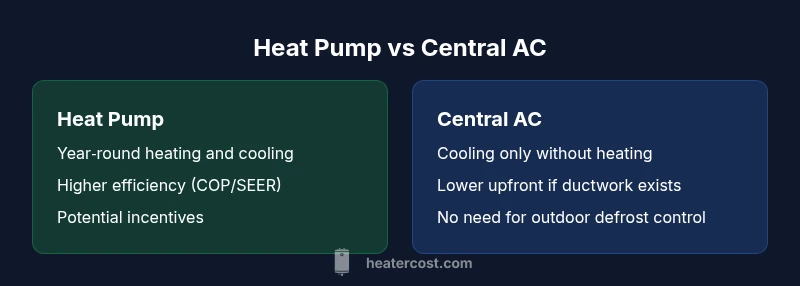
Comparison
| Feature | Heat pump (air-source) | Traditional central AC |
|---|---|---|
| Year-round heating capability | Yes (via reverse cycle) | No (heating provided by separate furnace) |
| Energy efficiency | Typically higher COP/SEER with heat pumps | Dependent on furnace and system efficiency |
| Upfront cost | Moderate to high (equipment + ductwork) | Lower upfront (ductwork often existing) |
| Operating costs | Lower overall with efficient electricity | Depends on fuel and electricity price |
| Climate suitability | Excellent in mild to moderate climates; cold-climate models extend range | Best in hot climates with gas furnace complement |
| Maintenance | Integrated service for heating/cooling | Separate system maintenance for furnace and AC |
The Good
- Lower long-term energy costs due to higher efficiency
- Year-round heating and cooling from a single system
- Reduced refrigerant emissions and improved indoor comfort
- Potential eligibility for tax credits and incentives
- Quieter operation in many installations
Negatives
- Higher upfront installation cost
- Performance depends on climate and electricity prices
- Complex installation may require outdoor unit placement and electrical work
Heat pumps generally offer better long-term value when climate, electricity costs, and installation are well matched.
Choose heat pumps for year‑round comfort and potential energy savings; ensure proper sizing and installation. Consider incentives and warranty terms to maximize value.
Got Questions?
Is a heat pump always cheaper to run than a traditional AC with a furnace?
Not always; it depends on electricity prices, efficiency ratings, and the heating source. In many cases, heat pumps are cheaper to operate for both heating and cooling, especially with favorable electricity rates and efficient models.
Usually yes, but it varies by climate and rates.
Can a heat pump replace both heating and cooling in very cold climates?
Many cold‑climate heat pumps can handle most winter needs, but in some severe conditions, a supplemental heat source may be desirable. Check model ratings for your outdoor temperatures and consider backup options.
Often viable with cold‑climate models and backups.
What maintenance does a heat pump require?
Annual professional service is recommended to inspect refrigerant, electrical connections, and defrost controls. Regular filter changes and coil cleaning help maintain efficiency between visits.
Annual service plus routine filters keep it efficient.
Do heat pumps make a lot of noise outdoors?
Modern units are designed to operate quietly; proper placement and vibration isolation reduce audible impact. Check decibel ratings when selecting a model.
Most are quiet; proper placement helps a lot.
Are there incentives or tax credits for heat pumps?
Many regions offer rebates, tax credits, or utility incentives for heat pumps. Availability varies by location, so check local programs before purchasing.
Yes, check local programs and rebates.
How does size affect performance?
Improper sizing reduces efficiency and comfort. A professional energy audit helps determine the right size and configuration for your home.
Size matters; get a pro assessment.
The Essentials
- Assess climate and home efficiency before choosing a system
- Compare performance metrics (SEER/HSPF/COP) across models
- Include installation and incentives in the total cost of ownership
- Plan for proper ductwork and envelope improvements
- Consult a qualified installer for accurate sizing