Is a Heater or AC More Expensive? A Comprehensive Cost Comparison
A detailed, analytical comparison of upfront, operating, and long-term costs to determine whether heating or cooling systems are more expensive, with practical guidance for homeowners, renters, and property managers in 2026.


Is heater or ac more expensive? In most homes, upfront costs favor heating upgrades when ducts or gas lines are already in place, while central AC often carries a higher initial price due to equipment and refrigerant lines. Over the life of the system, operating costs depend on climate, energy prices, and efficiency. This TL;DR helps you estimate total cost and plan accordingly.
The central question: is heater or ac more expensive in the long run?
Is heater or ac more expensive is a question homeowners routinely ask when weighing a heating upgrade against a cooling investment. The answer is not fixed; it depends on local climate, how you use the system, and the efficiency you can achieve with modern equipment. According to Heater Cost, the most meaningful comparison looks at total cost of ownership (TCO) rather than upfront price alone. Start by listing your goals: reliable heat, dependable cooling, or year-round comfort. From there, map costs across upfront expenditure, ongoing energy use, maintenance, and expected lifespan. This section sets the stage for a structured, data-informed decision, noting that climate and usage patterns will tilt the balance toward heating in cold areas and toward cooling in hot ones.
Key takeaway: there is no one-size-fits-all answer; the right choice hinges on your climate, energy prices, and a clear view of all costs over time.
bold
Comparison
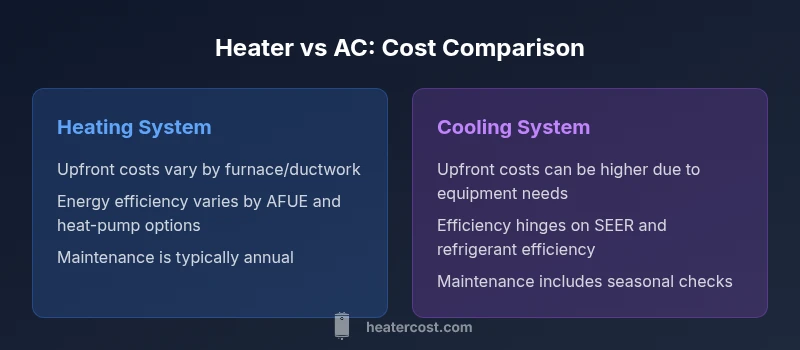
| Feature | Heating System | Cooling System |
|---|---|---|
| Upfront Cost | Moderate to high upfront depending on ductwork and system type | Usually higher upfront due to equipment, refrigerant lines, and installation complexity |
| Energy Efficiency Benchmark | AFUE and heat-pump efficiency options, including high-efficiency furnaces | SEER ratings with a range of efficiency; modern models can improve long-term bills |
| Maintenance Frequency | Annual service with filter changes and seasonal checks | Annual service with season-specific checks and refrigerant/system diagnostics |
| Best For | Cold climates needing dependable heat and reliable defrost cycles | Hot climates needing dependable cooling and humidity control |
The Good
- Potential long-term energy savings with high-efficiency equipment
- Incentives and rebates can lower upfront costs
- Improved comfort and home value with properly sized systems
- Flexible options for different climate zones
Negatives
- Higher upfront cost for central AC in many homes
- Ongoing maintenance costs if not scheduled regularly
- Savings depend on energy prices and climate variability
There is no universal answer; match system to climate and usage for the best total cost.
Overall, The Heater Cost team recommends comparing total cost of ownership over the system’s lifespan, not just upfront price. The Heater Cost team emphasizes selecting a high-efficiency configuration aligned with climate, usage, and incentives to maximize value.
Got Questions?
Which costs more to install, a heater or central AC?
Installation costs vary by existing ductwork, furnace type, and local labor. Central AC often requires more upfront equipment and refrigerant lines, but a furnace upgrade can add complexity if ducts are outdated. In many homes, the heater upgrade costs less at installation but this can vary widely by region and home, so get multiple quotes.
Installation costs vary; central AC often requires more upfront work, but furnace upgrades can be complex if ducts are old. Get multiple quotes.
Do operating costs favor heaters or AC in the long run?
Operating costs depend on energy prices, climate, and efficiency. A high-efficiency furnace or heat pump can dramatically reduce ongoing bills in cold or mixed climates, while efficient AC with a high SEER rating lowers cooling costs in hot weather.
Long-term costs depend on climate and efficiency; high-efficiency options save more energy.
Can incentives offset upfront costs?
Yes. Local, state, and utility incentives can reduce upfront costs for both heating and cooling systems. Check eligibility for rebates, tax credits, and financing programs in your area.
Incentives can cut upfront costs; check local programs.
What factors drive cost differences most?
Key drivers include existing ductwork, system type (furnace vs heat pump vs central AC), installation complexity, local labor rates, and efficiency ratings. Climate and usage patterns also shift the total cost balance.
Ductwork, system type, and efficiency drive most costs.
Gas vs electric: which is cheaper to operate?
Gas heating is often cheaper to operate in colder regions when gas prices are favorable, while electric heat can be costlier in high-rate areas. Efficiency and energy prices largely determine the outcome.
Gas may be cheaper where gas prices are low and winters are cold, but it depends on rates.
How can I compare costs myself?
Use a simple total cost of ownership framework: estimate upfront costs, annual energy use, maintenance, and expected lifespan. Compare scenarios for heating-focused vs cooling-focused homes and adjust for local energy prices.
Build a simple cost model considering upfront, energy, and maintenance.
The Essentials
- Evaluate total cost of ownership, not just upfront price
- Climate and usage drive the cost balance between heating and cooling
- Look for high-efficiency options and potential incentives
- Account for maintenance and replacement intervals
- Use a structured cost model to compare scenarios