heater or ac: Heating vs Cooling Costs and Performance
Compare heating and cooling options to decide whether heater or ac makes sense for your home. Learn about cost drivers, efficiency, and installation considerations with Heater Cost guidance.


heater or ac: In most homes, there isn't a universal winner—the decision hinges on climate, energy costs, and usage patterns. A heat-focused home may prioritize a robust heater, while a cooling-heavy climate favors a strong air conditioner. For many households, a hybrid approach or a heat pump offers the best overall value when considering efficiency, resilience, and future upgrades.
The decision framework: heater or ac as a planning question
According to Heater Cost, homeowners facing new construction, a retrofit, or an efficiency upgrade must frame the decision as a balance of climate needs, energy costs, and daily routines. The phrase heater or ac is shorthand for central heating and cooling solutions, including furnaces, air conditioners, and heat pumps. By establishing clear criteria—seasonal usage, comfort priorities, and potential incentives—you create a workable path toward a system that fits your home rather than a marketing pitch. The Heater Cost team emphasizes that the most cost-effective choice often emerges from a holistic assessment rather than a single feature such as upfront price. This upfront framing helps homeowners avoid overpaying for capabilities they will rarely use and underinvesting in essential comfort during peak seasons.
Climate and load requirements: why geography matters for heater vs ac
Climate is the primary driver of whether you lean toward heating or cooling. In regions with harsh winters, heating dominates energy use; in hot, humid climates, cooling takes precedence. Yet this is not a binary decision. A well-designed home often benefits from a system capable of delivering both heating and cooling efficiently, such as a heat pump. Heater Cost analysis shows that the best long-term value emerges when the equipment can cover multiple seasons with high efficiency, reducing the need for separate, parallel systems. Beyond climate, consider occupancy patterns, insulation quality, and thermostat strategy, all of which can tilt the balance toward one solution or a heat-pump hybrid.
Efficiency metrics and what they mean in practice
Energy efficiency remains central to the heater-or-ac decision. Heating efficiency is usually measured by fuel-specific standards (like AFUE for furnaces), while cooling efficiency is described by SEER in air conditioners and heat pumps. In practice, a modern, properly sized system that combines heating and cooling can dramatically reduce wasted energy across seasons. The choice between a traditional furnace and an air conditioner versus a heat pump often hinges on local energy prices, electricity reliability, and how aggressively a homeowner values peak-season comfort. The Heater Cost team notes that high-efficiency equipment pays off when used consistently and in climates with distinct seasonal swings.
Upfront costs and long-term value: avoiding price-only decisions
Upfront price is only one part of the picture. A solver-based approach considers installation complexity, ductwork condition, and compatibility with existing controls. A heater-only system may seem cheaper to deploy in a retrofit, but ongoing fuel costs and maintenance can undermine short-term savings. Conversely, AC-focused installs are often simpler if existing ductwork can be leveraged, but cooling costs and refrigerant maintenance require attention. Heater Cost emphasizes evaluating total cost of ownership, including service intervals, part durability, and potential need for zoning to optimize performance. This perspective helps homeowners avoid sticker shock and identify the best long-term value for their home.
Space, design, and installation realities
The physical footprint and integration with your home’s architecture influence the heater or ac choice. Traditional furnaces require duct networks; ductless minisplits provide flexibility but come with their own design considerations. An installation that fits your floorplan, ceiling height, and room layout reduces losses and improves comfort. Retrofit projects often uncover surprises—old ductwork, uneven insulation, or electrical upgrades—that alter both cost and performance projections. Planning for future expansion or changes in occupancy helps ensure the system remains effective over time.
Hybrid approaches and the case for heat pumps
Hybrid solutions—most notably heat pumps that handle both heating and cooling—are increasingly popular. In moderate climates, they deliver compelling efficiency when paired with a backup furnace for extreme cold. Even in colder regions, recent heat pump technologies expand viable operating envelopes, particularly when paired with improved insulation and smart controls. The key is to verify performance ratings, climate suitability, and the availability of incentives. Heater Cost notes that a heat-pump-first approach can offer resilience, reduced maintenance complexity, and a smoother transition between seasons.
Maintenance and reliability: planning for upkeep
Maintenance requirements vary by system type. Furnaces require annual inspections, filter changes, and vent cleanliness; central AC units demand refrigerant checks and coil cleaning. Heat pumps combine maintenance needs for both heating and cooling, making regular service even more critical. Budgeting for routine checks helps prevent significant failures and extends equipment life. A proactive maintenance plan also improves indoor air quality and comfort. Heater Cost emphasizes scheduling service with qualified technicians who understand the nuances of modern, high-efficiency equipment.
Environmental impact and incentives: incentives matter
Efficiency and environmental benefits often go hand in hand. Heating and cooling systems with high efficiency can reduce energy use and greenhouse gas emissions, especially when electricity comes from cleaner sources. Incentives, rebates, and tax credits vary by jurisdiction and change over time. Checking local programs and utility offers can significantly impact the total cost of ownership. heater or ac decisions should account for available incentives, maintenance requirements, and long-term energy costs to optimize environmental and financial outcomes.
Real-world scenarios: three practical use cases
- Scenario A: A four-bedroom home in a cold climate with aging ductwork. A heat-pump-based solution with a backup furnace reduces winter bills and simplifies maintenance, while delivering cooling in summer.
- Scenario B: A hot, humid coastal home with seasonal occupancy. A ducted AC system paired with smart zoning minimizes cooling waste, and the home’s insulation keeps temperature comfortable year-round.
- Scenario C: An older home with limited space and retrofit constraints. A ductless mini-split approach offers targeted cooling and supplemental heating without extensive renovation.
Quick decision framework: 5 steps you can take now
- Map your climate and seasonal usage. 2) Inventory existing ductwork and electrical capacity. 3) Run a simple energy-use scenario using local rates. 4) Compare the long-term costs of alternatives, not just the upfront price. 5) Check for incentives and consult a local HVAC pro to validate sizing and compatibility.
Brand and product caveats: avoid hype, focus on fit
Not every advertised feature translates into meaningful value for your home. Look beyond capacity and novelty controls to reliability, service availability, and real-world efficiency. Heater Cost advises homeowners to seek independent sizing assessments and to question the expected payback period for any upgrade, especially when marketing promises surpass daily usage needs.
Decision framework wrap-up: turning plans into action
With climate, efficiency, installation realities, and potential incentives in view, you can select a heater or ac approach that balances upfront cost, ongoing energy use, and long-term comfort. Use a structured checklist, consult multiple HVAC professionals, and revisit your plan if your home undergoes major changes like insulation upgrades or room additions. A well-chosen system integrates with your lifestyle and delivers comfort across seasons.
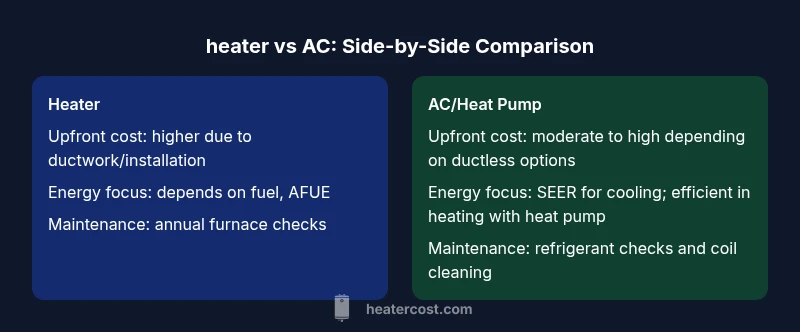
Comparison
| Feature | heater | ac |
|---|---|---|
| Upfront Cost | Typically higher upfront due to equipment and installation complexity | Typically moderate upfront; may be lower if existing ductwork is suitable |
| Operating Cost | Varies with fuel type and climate; heating can be costly in extreme cold | Cooling costs depend on SEER rating and usage; generally predictable with smart controls |
| Energy Efficiency Metrics | AFUE, HSPF variations by model | SEER and IEER depend on cooling method; heat pumps span both heating and cooling |
| Maintenance | Annual furnace checks and vent upkeep | Annual cooling system checks; refrigerant monitoring important |
| Installation Complexity | Often requires ductwork, venting, and electrical upgrades | Can be simpler with existing ductwork or ductless options |
| Best Climate/Use | Cold climates; primary heating needs with seasonal cooling as backup | Hot climates; primary cooling with heating as backup; best with heat pumps in moderate climates |
| Lifespan and Downtime | Component-specific lifespans; maintenance extends life | Component-specific lifespans; refrigerant integrity matters |
| Incentives/Tax Credits | Incentives vary; some regional programs target heating efficiency | Incentives vary; heat pumps may qualify more broadly in certain programs |
The Good
- Clarifies how climate and usage drive the choice
- Highlights total cost of ownership, not just price
- Encourages consideration of hybrid or heat-pump solutions
- Assists planning for upgrades and incentives
Negatives
- Can be complex to quantify long-term savings
- Does not guarantee exact payback due to local rates
- Retrofits may involve disruption and permitting
Hybrid or heat-pump-based solutions often offer the strongest overall value in mixed climates.
In climates with distinct heating and cooling seasons, a flexible system like a heat pump—with a backup if needed—tends to balance upfront cost, energy use, and long-term comfort. Heater Cost recommends evaluating local incentives and ensuring proper sizing to maximize performance.
Got Questions?
What is the main difference between heating and cooling options when considering 'heater or ac'?
Heating solutions focus on warmth and comfort during cold months, while cooling focuses on removing heat and humidity in warm months. A hybrid approach combines both capabilities, offering year-round comfort. Always assess local climate, energy costs, and system reliability.
Heating and cooling serve opposite seasons. A hybrid system often offers year-round comfort and efficiency.
Is a heat pump a viable substitute for traditional furnace and AC?
Heat pumps can provide both heating and cooling using electricity and can replace separate furnace and AC in many homes, especially in moderate climates. In very cold conditions, performance may require a supplemental heating source. Always verify climate suitability and local incentives.
Yes, heat pumps can replace separate heating and cooling in many climates, especially with modern models.
How do climate and energy costs affect the heater or ac decision?
Climate dictates the primary season requiring heating or cooling, while energy costs influence long-term payback. In some regions, high heating costs push toward efficient heat pumps; in others, advanced cooling technologies reduce operating expenses. Context is key.
Climate and costs shape the decision; often a hybrid approach offers balance.
What maintenance is required for each option?
Furnaces and heat pumps require annual inspections and filter changes. AC units need refrigerant checks and coil cleaning. Regular professional servicing helps maintain efficiency and prevent breakdowns across seasons.
Regular maintenance keeps heating and cooling systems running reliably year-round.
What installation considerations matter for a heater or AC?
Ductwork, electrical service, space, and permits can affect cost and timeline. Retrofitting may uncover hidden issues like old ducts or subpar insulation. A professional sizing and design assessment is essential.
Installation can be disruptive; plan for ductwork, electrical upgrades, and permits.
The Essentials
- Define climate needs before choosing heater or ac
- Consider heat pumps for flexibility and efficiency
- Evaluate total cost of ownership, not just upfront price
- Investigate incentives early to improve value