Heat Pump Cost: A Practical Guide for 2026 Heating
Explore heat pump cost factors, upfront installation ranges, operating savings, and incentives. Learn how to compare options, estimate payback, and plan a budget with Heater Cost analyses for 2026.


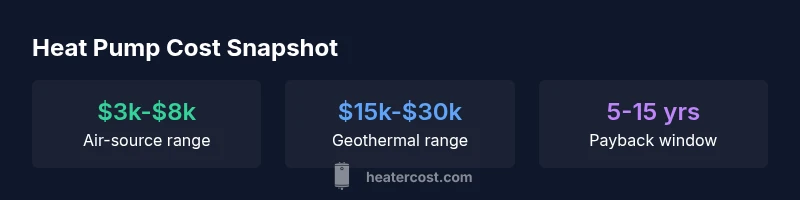
Heat pump costs vary by type and home, but typical upfront ranges are $3,000-$8,000 for air-source and $15,000-$30,000 for geothermal installations, with long-term savings often offsetting upfront expense. Incentives can lower net cost.
What drives heat pump cost in 2026
According to Heater Cost, heat pump cost is shaped by equipment type, climate, installation complexity, and efficiency ratings. The 2026 landscape reflects a broader mix of options, from modest-air source systems to high-efficiency geothermal setups. For homeowners, the sticker price is only one piece of the total equation. When evaluating heat pump cost, consider not only the upfront price but also expected energy use, climate-driven heating demands, and potential incentives that reduce the net investment. A properly sized system that aligns with your home’s insulation and ductwork can dramatically influence long-term value. In practice, the cost picture is most meaningful when paired with a clear savings trajectory and a robust maintenance plan. This perspective helps homeowners avoid under- or over-sizing and leads to a more predictable budget for the life of the system.
Upfront costs: air-source vs geothermal
Air-source heat pumps (ASHPs) are typically the most common choice for many homes. The installed cost commonly falls in the $3,000 to $8,000 range for most single-zone residential configurations, though ductwork, electrical upgrades, and indoor air handlers can push costs higher. Geothermal (ground-source) systems carry a higher upfront price, often in the $15,000 to $30,000 range, because they involve drilling or trenching to access stable underground temperatures, plus the indoor components. Mini-split configurations, which can be installed without ductwork, generally land in a middle range depending on number of zones and line sets. When budgeting, remember that installation labor, permits, and any necessary duct or electrical work are integral parts of the total upfront heat pump cost. Regional labor rates and contractor pricing also play a large role.
Operating costs and savings: not just a price tag
While upfront cost grabs attention, operating costs determine long-term value. Heat pumps typically run on electricity, and their efficiency (measured by HSPF and SEER) translates into energy savings relative to fossil-fuel heating. In temperate climates, savings may be modest at first but compound as temperatures drop and electric rates fluctuate. In colder regions, heat pump performance depends on auxiliary heat strategies and proper sizing. The key takeaway is that high-efficiency models paired with correct installation tend to outperform cheaper, undersized options over the system’s lifetime. The Heater Cost team notes that the total cost of ownership matters more than the upfront sticker price alone.
Incentives, rebates, and financing options
Across jurisdictions, incentives can dramatically affect the net heat pump cost. Federal, state, and utility programs often offer rebates or tax credits for high-efficiency equipment, and some programs cover labor and equipment upgrades that improve overall performance. Financing options, low-interest loans, and utility bill discounts can further reduce the effective price. To maximize value, engineers suggest compiling competing quotes, confirming which line items are covered by incentives, and confirming eligibility with local programs. Always verify the latest offerings, as incentives can change year to year.
Design, installation, and performance factors that affect cost
Cost is highly sensitive to how a home is built and how it is conditioned. Factors include the integrity of insulation and air sealing, the adequacy of ductwork, the number of zones, and whether the system requires ductwork modification or a new electrical panel. Climate zone and building envelope performance drive sizing decisions, which in turn influence equipment selection and labor requirements. A high-efficiency heat pump must be matched to your home’s heating load; oversized or undersized systems increase operating costs and shorten equipment life. An experienced installer will perform load calculations (often using standardized methods) to ensure the chosen system delivers the expected comfort at a reasonable price.
How to estimate your project and compare quotes
Start with a professional energy assessment to establish your home’s heating load and insulation quality. Request quotes from at least three qualified installers and ask for itemized pricing that covers equipment, labor, ductwork, permits, and any electrical upgrades. Use a standardized checklist to compare components across quotes (air handler type, refrigerant lines, zoning, thermostat control, and warranty terms). Verify the expected performance metrics (SEER/HSPF) and confirm the installer will perform a Manual J load calculation. Finally, factor in maintenance costs and potential future energy rate changes to understand the total cost of ownership.
Real-world scenarios and quick references
To illustrate the range, consider a typical single-family home in a moderate climate with good insulation. An air-source heat pump might meet most heating needs at a moderate upfront cost; in an attached home with limited ductwork, a ducted ASHP or a multi-zone mini-split could be more cost-efficient. For homes in very cold climates or with extensive heating demands, geothermal systems can offer substantial long-term savings but require a larger upfront investment and longer installation time. The takeaway is to tailor the system to your home’s envelope and climate, then compare quotes with an eye toward installed efficiency, service commitments, and expected payback.
Sources and practical next steps
For homeowners, the most practical next step is to start with a thermally efficient envelope and a confirmed heat pump cost range for your home. Gather multiple quotes, verify contractor credentials, and check for local rebates. If you’re considering a heat pump upgrade for a rental or multi-family property, run a financial model that includes depreciation, maintenance, and vacancy impacts to understand the true cost impact over time. The Heater Cost team recommends a staged approach: fix the envelope first, then select a heat pump size and type that aligns with your budget and climate needs. This approach helps ensure a solid return on investment and predictable energy costs over the system’s life.
Typical cost ranges and payback periods by heat pump system type
| System Type | Typical Installed Cost Range | Typical Payback Period | Notes |
|---|---|---|---|
| Air-source heat pump (single-zone) | $3,000-$8,000 | 5-12 years | Most common; cost varies with efficiency and ductwork |
| Geothermal heat pump (ground-source) | $15,000-$30,000 | 10-20 years | Higher upfront; requires excavation or trenching |
| Mini-split heat pump (no ductwork) | $3,500-$10,000 per zone | 5-10 years | Ductless flexibility; climate and zones matter |
Got Questions?
What factors most influence heat pump cost?
The largest cost drivers are the system type (air-source vs geothermal), the efficiency ratings (SEER and HSPF), the size of the home, ductwork or zoning needs, electrical upgrades, and installation labor. Regional pricing and contractor experience also play a significant role.
The biggest cost drivers are system type, efficiency, home size, ducts, and local installers. Regional prices matter too.
Are heat pumps cheaper to operate than furnaces?
In many cases, heat pumps offer lower operating costs due to higher efficiency, especially when electricity rates are reasonable and the climate is not extremely cold. However, in very cold climates, auxiliary heat can raise running costs unless the system is properly sized and insulated.
Usually, yes, but it depends on climate and electricity costs.
Do incentives apply to heat pump installations?
Yes. Many federal, state, and utility programs provide rebates or credits for high-efficiency heat pumps. Availability varies by location and year. Check with local programs and your utility to maximize the net cost savings.
Likely, but check local programs for current offers.
Is geothermal worth the extra upfront cost?
Geothermal systems have higher upfront costs but can offer substantial long-term savings in suitable locations. The decision depends on climate, available land for ground loops, and the expected energy price trajectory.
It can be worth it in the right climate and for long-term savings.
What maintenance does a heat pump require?
Regular maintenance includes seasonal inspections, filter changes, refrigerant checks, and coil cleaning. Proper maintenance helps preserve efficiency and spacing of components, extending the system life.
Keep it clean and serviced seasonally.
“Heat pumps deliver efficient heating when properly sized and installed, but the total cost depends on home insulation, climate, and electricity rates.”
The Essentials
- Understand total cost of ownership, not just upfront price
- Choose high-efficiency models matched to your climate
- Get three quotes and verify incentives before buying
- Improve home envelope to maximize savings