What Size Water Heater for 5 Adults: A Practical Sizing Guide
Discover how to size a water heater for a family of five. This guide covers recommended tank sizes, tankless options, peak-demand calculations, and practical steps to ensure reliable hot water for five adults.


Why sizing matters for a five-adult household
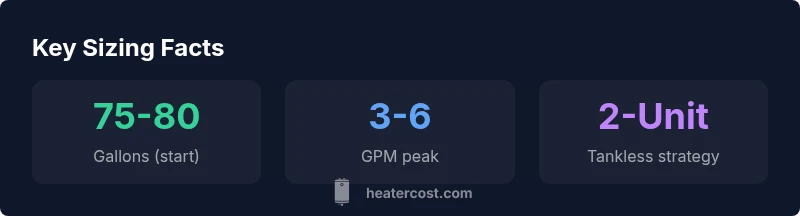
Sizing a water heater correctly is not a luxury—it's a performance and energy-cost decision for a family of five. With five active residents, daily patterns such as morning showers, shared baths, laundry cycles, and dishwasher use create a distinct demand curve. If the unit is too small, you’ll see cold-water bursts during peak times; if it’s oversized, you’ll pay higher standby losses and lose energy efficiency. The Heater Cost team found that most five-adult homes perform best with a starting point around a 75-80 gallon tank, but your actual needs will hinge on your routines, climate, and how many fixtures run at once. In this section, we’ll unpack how to translate daily habits into a sizing plan and reduce the risk of undersizing or oversizing your heater.
Estimating daily hot-water demand for five people
To size accurately, break down demand into a few simple categories: showers, baths, laundry, dishwasher, and miscellaneous usage. A typical shower uses about 2-3 gallons per minute, and a 10-minute shower consumes roughly 20-30 gallons. With five adults, even modest showering can add up quickly. Add laundry and dishwashing, which can consume 15-25 gallons per cycle, and you begin to see why peak-hour demand matters more than average daily usage. Use a per-person daily estimate of 12-20 gallons, then multiply by five and add a 10-20% safety margin for cold-water surprises or unusually long showers. Heater Cost's analysis emphasizes planning for peak hours as much as average daily use.
Tank sizes by usage patterns (moderate vs high demand)
- Moderate daily use (five adults, two showers plus typical laundry/dishwashing): 75–80 gallons.
- High simultaneous use (three showers, laundry, dishwasher happening together): 100–120 gallons.
- Very high demand (extra-long showers or frequent simultaneous appliances): 120+ gallons or a multi-unit/tankless setup with high-flow rates.
Tank vs tankless for a 5-person household
Traditional tanks (75–80 gallons) are simple and reliable for most five-adult households. Tankless systems shine when you have irregular usage or limited space, but achieving the same peak-hour flow often requires multiple units or very high-flow models. If you anticipate frequent simultaneous demand (two showers, laundry, and a dishwasher at once), a hybrid approach—one large tank plus a secondary heater or an advanced tankless configuration—can minimize cold-water shocks while controlling energy wastage.
How to size using your home's data
- Inventory fixtures: Count showers, faucets, baths, laundry, and dishwasher. Get flow rates (GPM) for each fixture: typical showers are 2-3 GPM, kitchen faucets around 1.5-2.5 GPM, and laundries higher during cycles. 2) Estimate concurrent use: Decide how many fixtures are likely in use at the same time during peak hours (e.g., 2 showers + 1 laundry). 3) Calculate peak demand: Add the GPM of all active fixtures and multiply by 60 to estimate gallons per hour. 4) Match to hot-water delivery: Choose a water heater whose first-hour rating (FHR) or GPM at temperature rise meets or exceeds the peak-hour demand. 5) Add a margin: Add 10–20% to account for weather, incoming water temperature, and aging equipment. 6) Factor future needs: If you expect more occupants or changes in routines, size up modestly.
Practical installation considerations
Insulation on the tank and pipes reduces standby losses, which is especially valuable for larger tanks. Position the heater in a heated space to minimize heat loss. Install an expansion tank if your system is closed, especially when using a high-capacity unit. For tankless setups, ensure proper venting and consider water heater sizing for thermostatic control and flow rate, as undersized units can lead to temperature fluctuations. Regular maintenance—flushing and checking anode rods—extends life and preserves efficiency.
Final sizing tips and common mistakes
Avoid the temptation to simply choose the largest available unit. Oversizing wastes energy and increases cost. Conversely, undersizing is frustrating—cold water during morning routines is a sign you’ve misjudged demand. Always tailor the size to peak-hour patterns, not just average daily use, and consider future changes in occupancy or habits. When in doubt, consult a pro, and compare options between traditional, hybrid, and tankless systems to find the best balance of comfort and cost.
Conclusion you can act on
Sizing for a family of five should balance comfort with energy efficiency. A practical starting point is a 75–80 gallon tank, scaling up to 100–120 gallons with higher simultaneous-use needs or two-unit configurations. Tankless can work well for some homes, but often require more planning and higher upfront cost to meet peak demand. Use the step-by-step method outlined above and Heater Cost’s guidelines to tailor the choice to your household.