How Big Water Heater for Family of 4: A Sizing Guide
Learn how to choose the right water heater size for a family of four with practical sizing rules, real-world examples, and energy considerations. Includes step-by-step methods, cost insights, and tips to balance comfort and efficiency.


For a family of four, start with a 40-50 gallon water heater. If you regularly run two showers or a washer and dishwasher at once, size up to 50-75 gallons. For tighter spaces or energy savings, consider a tankless or dual-tank setup. Your exact size depends on peak demand, shower length, and appliance use.
Understanding sizing for a family of 4
Sizing a water heater for a household of four hinges on peak demand, shower duration, laundry patterns, and whether you have multiple bathrooms. According to Heater Cost, accurate sizing begins with predicting how many hot-water events occur simultaneously during peak times and how long each event lasts. Household behavior—such as tight morning schedules or extended showers—can push demand well above the daily average. By documenting typical daily patterns and listing all hot-water uses (showers, dishwashing, laundry, and faucet usage), you create a reliable data foundation for choosing the right tank size. This section helps you translate daily habits into a practical gallon range and explain why two households with the same number of people can need different sizes. The goal is to balance comfort with energy efficiency, avoiding the cost of oversized equipment while ensuring you don’t exhaust hot water during peak usage. Heater Cost’s guidance emphasizes that sizing should be driven by actual usage, not just a rough headcount, to minimize energy waste and ensure reliable hot water delivery.
noteDetailsViewersOnly”:null},{
Key sizing rules and what they mean in practice
Most single-family homes managed by a typical four-person household operate comfortably with a 40-50 gallon tank under standard water pressure and average shower times. If your home has three bathrooms or if you frequently run a high-flow shower alongside a washing machine and dishwasher, you may benefit from a larger 50-75 gallon unit. For households with very high simultaneous demand (two or more showers at once, frequent laundry, and dishwasher cycles during peak hours), 75-100 gallons or a tankless setup paired with storage options may be warranted. It’s important to account for recovery rate—the heater’s ability to reheat water after consumption. A unit with a higher recovery rate will minimize temperature drops when multiple demands occur in sequence. When comparing electric and gas models, consider both the capacity and the energy source’s recovery characteristics, as these factors influence how quickly hot water becomes available again.
noteDetailsViewersOnly”:null},{
How to estimate hot water usage in real homes
To estimate usage, start by recording: average shower length, number of daily showers, loads per laundry cycle, and dishwasher runs per day. A typical shower can use approximately 1.5-2.0 gallons per minute, depending on the flow rate. A standard dishwasher or washing machine adds roughly 1-2 gallons per minute during active cycles, though this varies by model. Convert these figures into a rough daily and weekly demand, then apply a safety margin (around 10-20%) to cover unusually high-demand days. If you have a secondary bathroom or guest bathroom, factor in its usage as well. Use a simple worksheet or online calculator to translate minutes of hot-water use into gallons per week, then map that to a tank size range. This approach aligns with energy guidance from Heater Cost and provides a clear path from daily habits to a confidently chosen tank size.
noteDetailsViewersOnly”:null},{
Gas vs electric: How type affects size and performance
Gas and electric water heaters differ in both installation requirements and performance characteristics. Gas models typically recover heat faster, which can support larger households with higher peak demands, but require venting and gas line considerations. Electric models are easier to install in many homes and often have lower upfront costs, but recovery rates may be slower, especially in colder climates or with longer pipe runs. The size you choose should reflect the typical peak demand and the recovery rate you need. In regions with hard water or high mineral content, consider a unit with excellent corrosion resistance and a robust anode rod system to extend life. Electricity costs, natural gas prices, and climate all influence total operating costs, so compare energy factors (EF) and first-hour rating (FHR) to gauge long-term performance.
noteDetailsViewersOnly”:null},{
Real-world scenarios: sizing guidance for different homes
Scenario A: One bathroom, two adults and two children with moderate shower lengths and regular laundry. A 40-50 gallon model is commonly sufficient, assuming typical daily usage. Scenario B: Two full bathrooms, frequent showers in the morning, and daily laundry. A 50-75 gallon system is more comfortable and reduces the chance of running out of hot water. Scenario C: Large family with three bathrooms and a high flow rate from multiple fixtures. A 75-100 gallon system or a tankless setup with proper configuration is often the most reliable solution. Each scenario demonstrates how peak demand and recovery rate drive size decisions, not merely the number of occupants. Modern guidance from Heater Cost suggests this tiered approach helps you balance initial cost with ongoing operating expenses.
noteDetailsViewersOnly”:null},{
Final considerations when selecting a model
In addition to gallons, look at recovery rate, energy-factor ratings, insulation quality, and warranty. If you are space-constrained or want on-demand heating, a tankless system or a hybrid option can be compelling—but ensure you have adequate gas lines, venting, or electrical capacity to support the upgrade. Pro tip: choose a unit with a higher first-hour rating to ensure consistent hot-water delivery during peak times. If you’re unsure, start with a conservative size and verify performance after a few months of typical use. The Heater Cost team recommends working with a licensed installer to ensure code compliance and safe venting where required.
noteDetailsViewersOnly”:null},{
Common mistakes and how to avoid them
A common mistake is oversizing to hedge against possible future needs, which leads to higher standby losses and wasted energy. Another pitfall is underestimating simultaneous demand, especially when adding a new bathroom or a second laundry line. Don’t forget to account for climate and water temperature; colder water requires more energy to reach the same hot-water temperature. Finally, skip the temptation to rely solely on per-person rules—always validate with actual usage data and professional sizing guidance from a trusted source such as Heater Cost.
noteDetailsViewersOnly”:null},{
Authoritative sources (for further reading)
- https://www.energy.gov/eere/buildings/water-heating
- https://www.epa.gov/energy/star
- https://www.energy.gov/energysaver/design/space-heating-water-heating
These sources provide official guidance on water heating efficiency, sizing considerations, and energy impact to complement your household assessment.
noteDetailsViewersOnly”:null},
Tools & Materials
- Water usage diary or spreadsheet(Log average shower length, number of showers, laundry cycles, and dishwasher use for 1-2 weeks)
- Current water heater specification sheet(Model, capacity (gal), energy source, recovery rate)
- Calculators or worksheets for sizing(Use gallons-per-minute and peak-demand estimates)
- Pen and notebook(Jot down notes and comparisons)
- Access to energy cost data (optional)(Helps compare operating costs across options)
- Installer contact information (optional)(For final sizing confirmation and installation quotes)
Steps
Estimated time: 30-60 minutes
- 1
Gather usage data
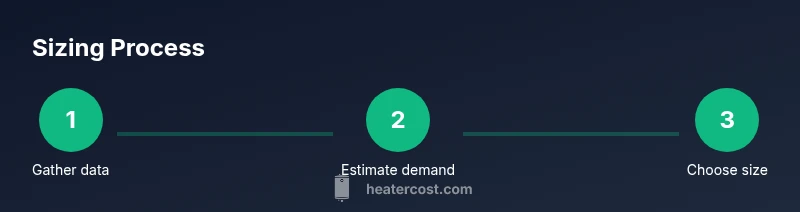
Collect information on daily hot-water activities: showers, laundry, and dishwashing. Record average shower length and the number of hot-water events per day for 1–2 weeks.
Tip: Ask all household members to participate for an accurate picture. - 2
Estimate peak demand
Identify how many hot-water events could occur concurrently during peak hours (e.g., mornings with two showers and a laundry load pulling hot water).
Tip: Plan for the worst reasonable scenario, not the average day. - 3
Convert usage to gallons per minute and hour
Use typical flow rates (about 1.5–2.0 gal/min for a shower) and multiply by duration to estimate hourly demand.
Tip: Remember that longer showers dramatically increase gallons used. - 4
Check your current heater’s performance
Review the existing unit’s capacity, energy source, and recovery rate to establish a baseline for improvement.
Tip: A higher recovery rate reduces wait times for hot water. - 5
Apply sizing guidelines with a safety margin
Using your calculated demand, map to common tank sizes (e.g., 40–50, 50–75, 75–100 gallons) and add 10–20% for peak days.
Tip: Do not rely on a single number—consider real-world variability. - 6
Consider future needs and space constraints
Factor in potential family growth, additional bathrooms, or installation space limitations when finalizing your choice.
Tip: If in doubt, choose a larger model with scalable options.
Got Questions?
What size water heater do I need for a family of four?
A common starting point is a 40-50 gallon unit. If you have two bathrooms or frequent high-demand use, 50-75 gallons may be more comfortable. Use peak-demand planning to choose the final size.
For a family of four, start with 40 to 50 gallons and adjust for peak demand or extra bathrooms.
How do I estimate hot water usage at my home?
Track daily routines for 1–2 weeks, noting shower times, laundry, and dishwasher use. Use a simple calculator to convert this into daily gallons.
Record your daily hot-water activities and use a calculator to estimate gallons.
Is a tankless water heater right for my family?
Tankless heaters save space and can be cheaper to operate, but may require multiple units for very high demand. Size carefully based on peak usage.
Tankless can be a good choice if you plan around peak use and have space for proper installation.
What about energy efficiency and operating costs?
Choose units with high energy efficiency ratings (EF) and compare estimated operating costs based on your local energy prices.
Look for high-efficiency models to save on energy bills.
Do I need a permit to install a new water heater?
Permit requirements vary by location and system type. Check with your local authority and hire a licensed professional.
Permits are often required; verify with local codes before installing.
How accurate are per-person sizing guidelines?
Per-person rules are rough; real needs depend on peak usage and appliances’ efficiency. Use calculators and pro sizing for accuracy.
Per-person rules are a starting point but not perfect—double-check with usage data.
Watch Video
The Essentials
- Identify peak demand, not just headcount
- Aim for 40-50 gallons for 2 bathrooms under typical usage
- Increase to 50-75 gallons if multiple high-demand uses occur simultaneously
- Gas vs electric affects recovery rate and installation needs
- Consult a licensed installer to confirm final size and code compliance