What Size Water Heater Should You Use for 3 Adults?
Learn how to size a water heater for a 3-person household, with practical ranges, usage estimates, and guidance for homeowners, renters, and property managers.


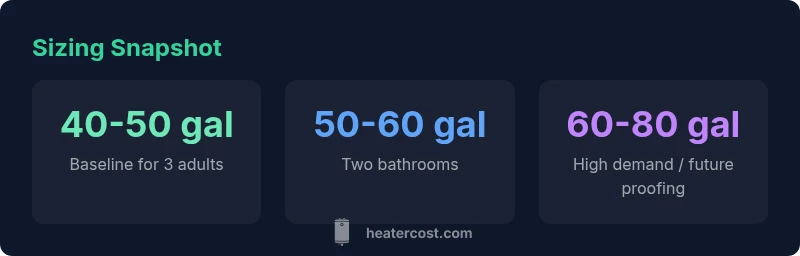
According to Heater Cost, most three-adult households start with a 40-50 gallon water heater, with 50-60 gallons if you have two bathrooms or frequent simultaneous hot-water use. For households with high demand, a 60-80 gallon unit may be worth considering. Always confirm with your usage patterns and space constraints. Remember to account for appliances like dishwashers and laundry machines.
Understanding the basics of water heater sizing
Sizing a water heater is not about chasing the newest model or the hottest efficiency claim. It is about meeting peak hot-water demand without paying for unused capacity. For most homes with three adults, the size decision hinges on two core concepts: tank capacity and recovery rate. Tank capacity determines how much hot water is stored at any moment, while the recovery rate—how quickly the heater reheats water after it’s used—determines how well you can handle bursts of demand. When you’re sizing for a family of three, the goal is to balance sufficient hot-water supply during peak moments (like morning showers or evening laundry) with energy efficiency over the rest of the day. In addition, both electric and gas models differ in how they deliver that recovery, impacting the practical “size” you actually need. As you plan, consider not only the number of occupants but also the number of bathrooms, appliances that use hot water, and how often you run them concurrently. This framing helps avoid oversizing for a household that rarely uses hot water in parallel, while also avoiding undersizing for households with multiple simultaneous draws.
In terms of the type of system, most homes in the three-adult range rely on a traditional tank for reliability and cost predictability. However, if your space is tight or you want to maximize energy savings, a tankless unit or a high-efficiency model could be worth evaluating. Tankless water heaters heat water on demand, eliminating standby heat loss but requiring higher flow rates to support simultaneous usage. Conversely, a conventional storage tank has standby losses but provides a straightforward, predictable supply for typical daily patterns. For a household concerned with long-term energy costs, comparing the first-hour rating (FHR) of a tank or the GPM rating of a tankless unit is more informative than sticker energy efficiencies alone.
From a practical standpoint, your sizing decision should be anchored in a realistic picture of your daily routine, how many bathrooms are in use at once, and whether you expect future changes like a home office, additional occupants, or upgraded appliances. The takeaway is that size should reflect maximum expected draw, not just average daily usage.
Sizing guidelines by usage scenario
| Scenario | Tank Size (gallons) | Notes |
|---|---|---|
| 3 adults, 1 bathroom, moderate usage | 40-50 | Baseline sizing for standard showers and dishwasher usage |
| 3 adults, 2 bathrooms, morning overlap | 50-60 | Better for concurrent showers and laundry |
| 3 adults, two baths, high demand | 60-80 | Safe for high daily use or future needs |
| Compact space, limited footprint | 30-40 | Smaller tank may suffice in low-usage scenarios |
Got Questions?
What size water heater do I need for three adults?
For many households with three adults, a 40-50 gallon tank is a reasonable baseline. If you have two bathrooms or frequent simultaneous use, 50-60 gallons is common. In homes with very high demand or future expansion, 60-80 gallons may be appropriate.
Most three-adult homes start with a 40-50 gallon tank; upgrade to 50-60 if there are two bathrooms or frequent simultaneous use.
Can a tankless water heater work for 3 adults?
Yes. Tankless systems can supply hot water on demand with high efficiency. The key is ensuring the unit’s flow rate (GPM) meets your concurrent usage. For three adults, a tankless model typically needs a higher GPM rating and potentially multiple units or a staged setup to handle simultaneous draws.
Tankless can work for three adults, but you’ll want a higher GPM rating to support multiple showers at once.
What happens if the water heater is undersized?
An undersized heater may run out of hot water during peak usage, leading to cold showers. It can also increase wear as the unit runs more frequently to meet demand, reducing efficiency and shortening the unit’s life.
If undersized, you’ll run out of hot water during peak times and waste energy trying to catch up.
Should I oversize to future-proof?
Over-sizing can waste energy and increase up-front cost. If you anticipate future needs like an additional occupant or a second bathroom, lean toward the upper end of your current range or consider a system with better recovery or multiple units.
Oversizing is not always best; consider near-term needs and potential changes before committing.
“Sizing a water heater is about matching peak usage, not just average daily use. A thoughtful size ensures comfort without waste.”
The Essentials
- Size for peak usage, not average daily use
- 40-50 gallons is a common baseline for 3 adults; 50-60 gallons if you have two bathrooms
- Two bathrooms or high concurrent use often pushes sizing toward 60 gallons or more
- Tankless options offer space and efficiency, but check flow needs for multiple simultaneous draws