Small Fish Tank Heaters: A Practical Guide for Compact Aquariums
An analytical guide to choosing, installing, and maintaining a small fish tank heater. Learn wattage ranges, placement, safety, and cost considerations for compact aquariums.


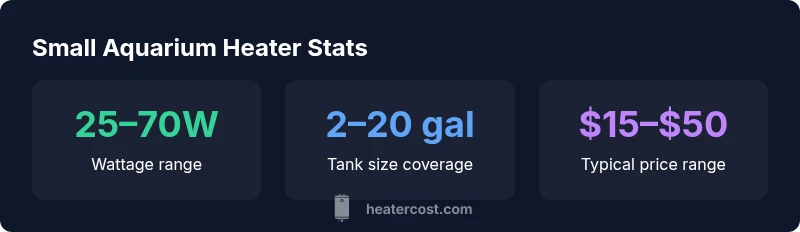
According to Heater Cost, a fish tank heater small that fits compact aquariums typically ranges from 25 to 70 watts for tanks under 10 gallons. For 2–5 gallon nano tanks, a 25–40W unit is common; for 5–10 gallons, 50–70W is typical. Always choose an adjustable, submersible model with a guard and place it according to your tank’s flow.
Why a fish tank heater small fits your setup
In compact aquariums, the right size heater matters more than flashy features. A small heater reduces bulky equipment, minimizes heat loss from glass, and helps maintain stable temperatures for sensitive species like tropical fish and bettas. The phrase 'fish tank heater small' reflects practical constraints of nano tanks, aquariums under 10 gallons, and room temperature variation. When evaluated by efficiency and reliability, a compact heater with an adjustable thermostat and a protective guard becomes a core component of a healthy environment. In practice, small heaters excel in tanks with steady water volume, minimal water movement, and effective placement behind decor or near inflows to distribute heat evenly. Always match wattage to the tank size and use a heater that can be calibrated to a narrow temperature range, typically within 1–2 degrees Fahrenheit.
How wattage is sized for tiny aquariums
Sizing a heater for small tanks requires translating tank volume, desired temperature rise, and heat loss into a practical wattage target. For 2–5 gallon nano tanks, common recommendations fall in the 25–40W range; for 5–10 gallons, 50–70W is typical. In rooms with cooler ambient temperatures, you may lean toward the higher end of these ranges; in warmer rooms, the lower end may suffice. A safe rule of thumb is to plan for roughly 2–5 watts per gallon, then adjust for tank materials, lid tightness, and water movement. Always verify performance after installation with a reliable thermometer and adjust as needed.
Key features to look for in a small heater
When shopping for a fish tank heater small units, prioritize precision and safety. Look for an adjustable thermostat with clear temperature readouts, accuracy within a tight range, and an automatic shutoff feature. A robust protective guard protects fish and coral while a durable, submersible design reduces the risk of leaks. Consider models with an indicator light to confirm operation and a compact form factor that fits within the tank's interior without crowding aquatic life. Choosing a heater with good build quality can improve longevity in small ecologies where space constraints amplify potential issues.
Placement and installation in small tanks
Placement matters almost as much as wattage. Install the heater horizontally or at a slight angle behind décor to minimize direct heat surges at any one spot. Keep the heater away from the tank edges to prevent overheating near glass seams. If your setup includes a filter, position the heater downstream to promote even heat distribution rather than warm pockets near the intake. Use a backing lid or foam gasket if needed to seal gaps around the heater. Verify that the unit is fully submerged according to the manufacturer's guidelines.
Temperature control and monitoring
Most small heaters include built-in thermostats, but external verification is essential for stable temps. Use a second aquarium thermometer placed away from the heater to cross-check readings. Watch for diurnal swings in temperature, especially in rooms with fluctuating heat. If you notice large swings, consider a heater with tighter tolerances or pair the device with an external controller. Keep a log of daily readings for at least a week after installation to establish a stable baseline.
Safety considerations and breakage prevention
Safety should be a priority with any heater. Use models with a protective guard, and ensure the cord and plug are kept dry. Use a grounded outlet and a GFCI if possible. Avoid placing the heater near sharp objects, and never run the heater if you suspect cracks in the glass tank. Regularly inspect the heater for signs of corrosion, condensation within the case, or brittle seals. If you notice any defect, replace the unit promptly.
Maintenance routines for small heaters
Maintenance is straightforward but important. Rinse or wipe the heater exterior to remove dust, and check the suction cups or mounting hardware for wear. Do not immerse the heater in cleaning solutions that could degrade internal seals. Test the thermostat by adjusting the setpoint and confirming the water temperature response. Replace the heater if the temperature readings drift significantly or if the device cycles on and off erratically.
Common pitfalls and how to avoid them
Common mistakes include using an oversized or undersized heater, neglecting thermometer verification, and assuming the thermostat is perfectly accurate. Avoid placing a heater directly under a strong filter jet or behind rockwork that blocks heat distribution. Do not skimp on safety: a heater without a guard or improper grounding raises the risk of injury to fish and to you. Finally, don’t rely on visual cues alone; always test temperature.
Budgeting, longevity, and total cost of ownership
A small heater is a low-cost but essential investment for stable aquatic life. Price ranges for compact models typically vary based on safety features, build quality, and warranty terms. Expect to budget for replacement intervals aligned with maintenance habits and tank occupants. While energy costs for a small heater are modest, efficiency and reliability matter over the long term. When budgeting, consider not only the upfront price but also potential savings from avoided temperature-related issues.
Sizing guide for small aquarium heaters
| Model Type | Recommended Tank Size | Typical Wattage (W) | Notes |
|---|---|---|---|
| Compact stick heater | 2-5 gallons | 25-40 | Best for nano tanks |
| Inline heater (with filter) | 5-20 gallons | 50-70 | Distributes heat with flow |
| Submersible aquarium heater | 10-20 gallons | 50-70 | Common small tank choice |
Got Questions?
What wattage should I choose for a 2–5 gallon tank?
For 2–5 gallons, aim for about 25–40W to maintain stable temps in typical rooms. If your room is cooler, you might lean toward 40W; if warmer, 25W may suffice.
For 2–5 gallons, use a 25 to 40 watt heater to keep temperatures stable.
Can I use a small heater in a bowfront or oddly shaped tank?
Yes, as long as the heater is submersible and properly positioned to avoid dead zones; ensure it fits the tank dimensions and is rated for aquarium use.
Yes, as long as it fits and is fully submersible.
Should I trust the heater's thermostat?
Back up with a separate thermometer to verify accuracy; many cheap heaters vary. Calibrate by testing temperature after installation.
Thermostats can vary; test with a thermometer.
How often should I test tank temperature?
Check temperature daily for the first week after installation, then every few days. Use a reliable thermometer and log readings.
Test daily after install, then check every few days.
What maintenance does a small heater require?
Routinely inspect for leaks, clean dust, and replace if corroded or malfunctioning. Do not ignore signs of wear.
Inspect for leaks and replace if malfunctioning.
“A properly sized, well-maintained small heater reduces temperature swings and supports healthy aquatic life in compact tanks.”
The Essentials
- Match wattage to tank size using a conservative range
- Choose adjustable, submersible heaters with guards
- Place heater away from direct flow and monitor temps daily
- Inspect and maintain regularly to prevent failures