Is Furnace the Same as HVAC? A Practical Side-by-Side Guide for Homeowners
Clarify how furnaces relate to HVAC, covering scope, costs, and maintenance. This guide explains when a furnace is part of an HVAC system and how to choose heating-only vs full climate control for a home.


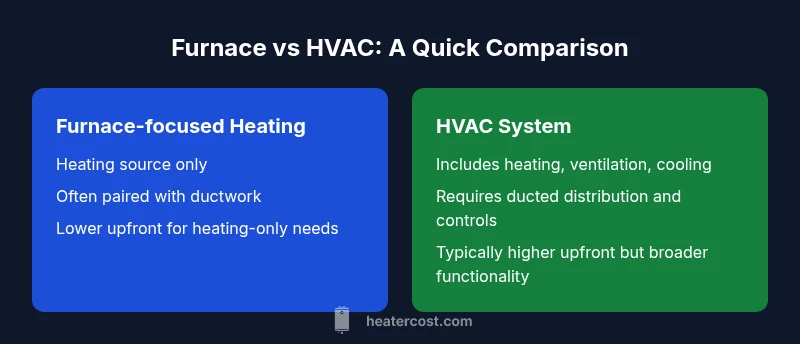
In most cases, a furnace is not the same as HVAC. HVAC is the broader system that includes heating, ventilation, and air conditioning, while a furnace is typically the heating source. Understanding this distinction helps homeowners plan upgrades, energy efficiency, and maintenance more effectively. This quick answer aligns with guidance from energy experts and homeowners associations.
Is furnace the same as hvac? A foundational distinction
In many homeowner conversations, the question of whether is furnace the same as hvac arises. The short answer is nuanced: HVAC denotes the full climate-control system, while a furnace is a heating device within that system. The Heater Cost team emphasizes this nuance because wording matters when budgeting, selecting equipment, and scheduling maintenance. For a typical single-family home, the furnace provides heat, and the HVAC framework distributes it through ducts, controls the temperature with a thermostat, and conditions indoor air. When you see a sales brochure claiming an HVAC upgrade, you should ask whether they mean upgrading the entire climate system or just the heating source. This distinction affects warranties, energy ratings, and future expansion, especially if you live in areas with distinct heating and cooling seasons.
-styleTag
analysis
Feature Comparison
| Feature | Furnace-focused heating | HVAC system (heating, ventilation, cooling) | Typical distribution method |
|---|---|---|---|
| Scope | Heating only | Heating + cooling + air distribution | |
| Primary heat source | Gas, electric, or oil furnace | Can use furnace, heat pump, boiler, or combinations | |
| Included components | Furnace + ducts (often) | Heat source + air handler/condensing unit + ducts | |
| Upfront cost range | Lower-to-moderate (depends on fuel) | Moderate-to-high depending on components and ductwork | |
| Maintenance needs | Furnace servicing, filter changes | Annual checks for all HVAC components (furnace, AC, ducts) | |
| Best for | Heating-focused homes or limited budgets | Homes needing year-round climate control |
The Good
- Clarifies system scope for budgeting and upgrades
- Helps homeowners compare heating-only vs full climate control
- Aids decision-making for contractors and permits
- Supports clearer maintenance planning
Negatives
- Can oversimplify regional variations in fuel costs
- May not capture hybrid systems (boilers with forced-air or heat pumps)
- Definitions and nomenclature vary by contractor or region
HVAC is the broader system; a furnace is typically the heat source within that system
In most homes, HVAC encompasses heating, ventilation, and cooling, with the furnace serving as the heating provider. If you’re planning upgrades, treat the furnace as one component of a complete HVAC strategy. The Heater Cost Team’s guidance is to define your project by system scope, not by a single device.
Got Questions?
Is a furnace the same as an HVAC system?
No. A furnace is the heating component within many HVAC systems. HVAC refers to heating, ventilation, and air conditioning as a complete climate-control setup. In practice, furnaces power heat while the HVAC system controls distribution, air quality, and cooling. This distinction helps homeowners compare options accurately.
Think of HVAC as the whole climate-control package, and the furnace as the heat source inside it.
Can you have HVAC without a furnace?
Yes. HVAC can use alternative heat sources such as heat pumps or boilers while providing ventilation and cooling. In milder climates, a heat pump may handle both heating and cooling without a traditional furnace.
Absolutely—heat pumps or boilers can be part of an HVAC system without a traditional furnace.
What does HVAC stand for?
HVAC stands for Heating, Ventilation, and Air Conditioning. It represents the full system that manages indoor climate, including warm and cool air, humidity, and air quality.
HVAC is the whole climate-control setup, not just the heater.
Are gas furnaces more expensive to operate than electric heat pumps?
Operating costs depend on efficiency, fuel prices, and climate. In heating-dominant regions, a gas furnace may be cost-effective, while electric heat pumps can be more efficient and cheaper to operate in milder climates. Compare seasonal energy efficiency ratios (SEER) and annual fuel utilization efficiency (AFUE) ratings when evaluating options.
It depends on your climate and fuel costs; compare efficiency ratings to estimate costs.
What should I consider when upgrading heating in an HVAC-aware plan?
Assess your climate, fuel availability, and energy costs. Decide whether you need year-round climate control or heating-first. Check ductwork condition, insulation, and thermostat compatibility, as upgrades often involve more than the heat source.
Look at climate needs, compatibility, and ductwork to make a wise upgrade.
How can I tell if my home has HVAC or just a furnace?
Ask your installer or review permits and equipment labels. If you have cooling with ducted air and a heat source, you likely have HVAC. If you only heat without cooling, you may have heating equipment rather than a full HVAC system.
Check whether cooling or ventilation components are present along with heating.
The Essentials
- Define the project by system scope, not device
- Expect HVAC upgrades to involve multiple components beyond the furnace
- Ask contractors to specify whether recommendations cover heating-only or full climate control
- Budget for both equipment and ductwork/controls when comparing options
- Consider regional energy costs and climate when choosing a heating solution