Heater vs Boiler: A Practical Guide to Home Heating
A detailed, objective comparison of heaters and boilers for home heating, covering upfront costs, efficiency, installation, and long-term value for homeowners evaluating total cost of ownership.


heater vs boiler: which is better for home heating depends on your climate, fuel availability, and how you want to heat spaces. Boilers excel in whole-house, hydronic systems and steady cold-weather comfort, while standalone heaters offer lower upfront costs, faster zoning, and simpler installation. Heater Cost's analysis helps homeowners compare upfront costs, energy use, and long-term value to decide.
What is a heater vs boiler?
In home heating terms, a 'heater' typically refers to space heating devices (like furnaces, electric baseboard heaters, or heat pumps used for single rooms or zones), while a 'boiler' refers to a hydronic system that heats water (or steam) to distribute heat through radiators, radiants, or underfloor systems. The difference matters for installation, fuel choice, and how you experience comfort. According to Heater Cost, many homeowners confuse the two, leading to mismatched expectations when comparing energy bills and maintenance needs. Understanding these categories sets the stage for a practical comparison of costs, efficiency, and long-term value.
How the technology behind heaters and boilers differs
A heater, especially a furnace or electric baseboard, converts energy directly into warm air or heat at the point of use. A boiler, by contrast, heats water or steam and distributes it through a closed loop to radiators or underfloor tubing. This fundamental distinction shapes installation requirements, zoning capabilities, and maintenance needs. Boilers tend to rely on hydronic distribution, which provides steady, whole-house warmth but requires piping, a circulator pump, and expansion tanks. Heaters—particularly electric units or heat pumps—often offer quicker, localized heating and can be easier to install in existing spaces. Understanding these mechanisms helps homeowners plan around comfort priorities and energy usage.
Cost considerations: upfront and long-term ownership
Upfront costs for heating equipment vary widely by type and complexity. A standalone heater or space-heating system can be substantially less expensive to purchase and install than a full boiler-based hydronic system, especially in retrofit scenarios. For boilers, the cost includes not just the boiler unit but also radiators or underfloor systems, piping, and a circulator. Ongoing expenses depend on fuel prices, efficiency, and how well the system is sized for your home. Based on Heater Cost analysis, the economics of each option hinge on climate, insulation, and electricity or gas prices in your area. Homeowners should run a simple total-cost-of-ownership exercise that covers purchase, installation, maintenance, and expected lifespan.
Energy efficiency and performance metrics
Efficiency metrics differ between heating modalities. Boilers are typically evaluated by annual fuel utilization efficiency (AFUE) for gas/oil boilers and by overall system efficiency for condensing models. Heaters use metrics like SEER (for heat pumps) or COP (coefficient of performance) for electric resistance vs. heat pump options. In hydronic systems, the efficiency of heat transfer, boiler sizing, piping layout, and radiator efficiency all impact comfort and energy bills. The key takeaway is that a well-sized boiler paired with efficient distribution often delivers even warmth with lower peak demand, while a high-efficiency space heater or heat pump can provide spot heating with lower installed costs.
Space, footprint, and zoning considerations
Boilers and their hydronic networks require space for the boiler, pump, expansion tank, and piping. The footprint can be larger, but zoning becomes a major advantage: you can heat living spaces independently with radiators or radiant floors. Heaters and space-heating devices excel at zoning because they can be added in rooms or areas where heat is most needed, without extending a full hydronic network. For homes with open floor plans, a boiler system can maintain uniform comfort, while for apartments or smaller spaces, dedicated heaters offer flexibility and quick warmth where it’s desired most.
Maintenance, reliability, and lifecycle expectations
Boilers tend to have longer service lives if properly installed and maintained, often with periodic servicing to prevent corrosion and efficiency loss. Hydronic systems may require regular checks of expansion tanks, pumps, and boilers’ internal components. Space heaters can be lower-maintenance on a per-unit basis, but their reliability depends on usage patterns and electrical/system quality. A hybrid approach—an efficient boiler for core heating and selective space heaters for peak loads—can balance reliability with flexibility, though it adds maintenance considerations for multiple systems.
Installation considerations and permitting
Installing a boiler with hydronic distribution generally involves more complex work: piping, venting, pressure testing, and potentially building permits. Retrofit projects may require significant space modification and professional expertise. Space heaters and smaller heating devices typically present fewer installation hurdles and shorter timelines. Always verify local permit requirements and utility connections before starting, and consider professional assessment to determine if a boiler upgrade or a heat-pump-based approach best suits your home.
Climate, fuel availability, and home type implications
Your climate and available fuels strongly influence the heater vs boiler decision. In cold climates with high heating demand, a boiler can deliver steady warmth more efficiently and evenly. In milder climates or where electricity is cheap, high-efficiency electric heaters or heat pumps can be a strong option. For apartment dwellers or small homes, space heaters or compact heat pumps may be the most practical solution. A careful audit of insulation, air leakage, and current energy usage will guide the most cost-effective choice.
Real-world scenarios: apartments, single-family homes, and new builds
In apartments, a compact electric heater or a mini-split heat pump system may be ideal due to space constraints and retrofit simplicity. In single-family homes with good insulation, a boiler can provide uniform heat, improve comfort, and potentially lower long-term energy costs, especially with gas or condensing boilers. For new constructions, integrating a boiler with hydronic radiant flooring or panel radiators can optimize comfort and efficiency, while a modern heat-pump-based system may offer lower upfront cost and rapid comfort in milder shoulder seasons.
How to compare options: a practical decision checklist
Start with a needs assessment: number of zones, desired comfort level, and climate. Compare upfront costs including installation, plus operating costs based on local fuel prices and system efficiency. Consider space constraints and future needs (resale value, potential for expansion). Finally, request a professional load calculation and an energy audit to quantify expected performance. Use this checklist to guide discussions with contractors and to align choices with your budget and goals.
Comparison
| Feature | Heater | Boiler |
|---|---|---|
| Upfront cost (rough ranges) | $300–$3,000 for basic space-heating options | $4,000–$12,000+ for full hydronic boiler + distribution |
| Installation complexity | Simple and quick for standalone heaters | More complex with piping, vents, and radiators |
| Operating cost (fuel/electricity) | Depends on unit type; electric options can be higher per kWh | Boilers can be very efficient with condensing designs |
| Space requirements | Typically compact or portable units | Requires mechanical room or dedicated space for boiler and piping |
| Heat distribution | Localized or zoned heat (rooms/areas) | Even, whole-house heat via radiators/underfloor or steam |
| Maintenance needs | Low to moderate; depends on device | Moderate to high; includes boiler and distribution checks |
| Best for | Zoned heating and flexible layouts | Whole-house comfort in cold climates with hydronic systems |
The Good
- Lower upfront costs for many heater options
- Faster installation and zoning flexibility
- Less invasive retrofit in small spaces
- Wide range of fuel choices and devices
Negatives
- Higher long-term operating costs if climate is cold or inefficient
- Boilers deliver steady heat but require more space and plumbing
- Maintenance complexity with hydronic systems
- Potentially longer payback period without incentives
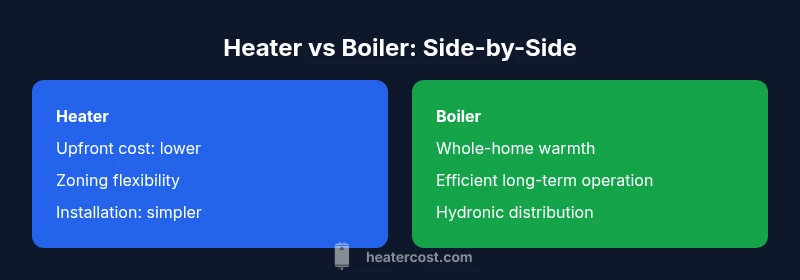
Boiler systems win for whole-house, steady warmth; heaters win for flexibility and lower initial costs
Choose a boiler when you need uniform heat across the home and plan to maximize long-term efficiency. Opt for a heater when you want cost-conscious startup, zoning versatility, and quicker installation. Evaluate your climate and energy prices to decide which path minimizes total cost of ownership.
Got Questions?
What is the primary difference between a heater and a boiler?
A heater generally provides space heating directly, while a boiler heats water to distribute heat through radiators, underfloor systems, or hydronic radiators. The two serve different comfort strategies and installation requirements, impacting cost and energy use.
A heater warms spaces directly, and a boiler heats water for distribution through your home. The choice affects installation and ongoing energy costs.
Which option is more energy efficient overall?
Efficiency depends on the system and climate. Boilers can be highly efficient, especially condensing models, but modern space-heating options like heat pumps can be very efficient in appropriate conditions. The best choice balances efficiency with your heating needs.
Efficiency depends on the system and climate; boilers can be very efficient, while heat pumps may excel in milder conditions.
Are boilers better for new home builds?
Boilers are commonly installed in new builds when hydronic heating or radiant floors are planned. They provide uniform warmth but require space and careful design. If space or upfront cost is a constraint, alternative systems may be considered.
Boilers are often chosen for new builds with radiant heating, but consider space and cost implications.
Can I retrofit a boiler into an existing house easily?
Retrofit feasibility depends on existing piping, venting, and space. In some homes, a boiler retrofit is straightforward; in others, significant updating of the distribution network is required. A professional load assessment is essential.
Retrofitting a boiler depends on your current setup; a professional assessment is essential.
What are typical installation costs?
Costs vary widely by system and home, but expect boilers with distribution to be more expensive upfront than standalone heaters. Always factor in installation complexity, permits, and potential system upgrades.
Costs vary; boilers tend to be pricier upfront due to distribution work, permits, and space needs.
Which should I choose for a small apartment?
For small apartments, a compact heater or an efficient mini-split/heat pump often provides cost-effective, flexible warmth. Boilers are typically unnecessary unless hydronic heating is already planned for the building.
In small apartments, compact heaters or heat pumps are usually best; boilers are less common unless hydronic systems are already planned.
The Essentials
- Assess climate and insulation before deciding
- Account for total cost of ownership, not just upfront price
- Boilers suit whole-home hydronic heating; heaters fit zoning needs
- Get a professional load calculation to guide sizing
- Consider future home plans and potential upgrades