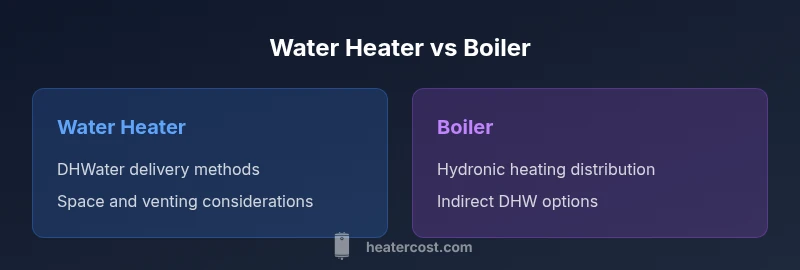
Water Heater vs Boiler: A Practical Comparison for Homes
Explore water heater vs boiler: how they work, costs, efficiency, space needs, and maintenance to help homeowners choose the right heating solution.


For homeowners weighing water heater vs boiler, the answer hinges on your fuel, space, and efficiency priorities. Boilers excel for radiant heating and longer lifespan when paired with modern controls, while traditional water heaters are simpler, cheaper upfront, and faster to install. The Heater Cost analysis shows a cost-versus-effort trade-off depending on your home.
What water heater vs boiler mean for homeowners
The terms water heater and boiler are often used interchangeably, but they describe different types of equipment with distinct purposes. According to Heater Cost, many households confuse the two, risking a mismatch between expected hot water and space heating needs. The Heater Cost team found that the decision often hinges on your home's heating load, space, fuel availability, and long-term energy costs. In this guide, we compare water heater vs boiler across design, performance, and total cost of ownership to help you choose with confidence. water heater vs boiler is not a one-size-fits-all choice; understanding the fundamentals helps homeowners optimize comfort and efficiency.
How a water heater works
A water heater is designed primarily to supply domestic hot water for showers, sinks, and appliances. Traditional storage water heaters rely on a tank that holds heated water, typically using gas or electricity as a heat source. Tankless water heaters, sometimes called on-demand units, heat water as it flows through the unit, delivering hot water with minimal standby energy loss. In some homes, a single boiler or combined system handles both space heating and hot water, but most households separate DHW (domestic hot water) needs from space heating. The choice between tanked and tankless affects installation, standby energy use, and the maximum flow rate. The Heater Cost team emphasizes that the right DHW approach should align with your daily hot water demand profile and household size.
How a boiler works
A boiler is a central piece in many homes that rely on hydronic (water-based) heating. In a typical boiler system, a heat source (gas, oil, or electricity) heats water that travels through radiators or underfloor tubing to emit warmth. When a boiler is paired with a control system and a water heater or an indirect hot water coil, it can supply both space heating and domestic hot water. Modern condensing boilers extract extra energy from exhaust gases, improving efficiency, but they require proper venting and regular maintenance. In climate zones with cold winters, boilers often excel as the backbone of a whole-home heating solution.
Key differences in operation, efficiency, and cost
- Primary purpose: A water heater focuses on delivering hot water for daily use, while a boiler primarily provides space heating and may heat water for domestic use via indirect methods.
- System integration: Water heaters are standalone DHW devices or paired with simple controls; boilers integrate with radiators, underfloor heat, and sometimes indirect hot water systems.
- Efficiency envelope: Water heater efficiency varies by model (tank vs tankless), with modern tankless units offering high efficiency when water usage is steady. Boilers, especially condensing models, often achieve high efficiency through advanced combustion and heat-recovery features.
- Space and installation: Water heaters generally require less space and simpler venting than boilers; boilers may demand additional space for radiators, piping, and venting.
- Long-term costs: Boiler systems can be costlier upfront but may reduce fuel use in larger homes with radiant systems. Water heaters usually have lower upfront costs but can incur higher standby losses if not optimized.
- Maintenance needs: Both systems benefit from annual checkups, but boilers may require more regular servicing due to enclosed hydronic loops and radiators.
The takeaways above are consistent with industry guidance and reflect general trends in efficiency and cost. The Heater Cost analysis notes that the best choice depends on your home’s heating load, climate, and how much you value space heating versus domestic hot water.
Energy costs and efficiency considerations
When evaluating energy costs, it helps to separate the metrics that describe DHW efficiency from those that describe space heating efficiency. Water heater efficiency is often described by an energy factor (EF) or energy efficiency rating, with tankless DHW units typically offering higher instantaneous efficiency for intermittent use. Boilers are evaluated with Annual Fuel Utilization Efficiency (AFUE) and, in the case of condensing models, can achieve high efficiency by reclaiming heat from exhaust gases. As a rule of thumb, compact homes or apartments with modest hot water needs may benefit from a well-sized water heater, while larger homes with extensive radiant heating may justify a high-efficiency boiler. Based on Heater Cost research, the total cost of ownership should weigh upfront price against expected energy savings over time, factoring in climate, fuel type, and usage patterns. Regular maintenance and proper sizing significantly influence real-world efficiency outcomes.
Space, installation, and maintenance considerations
Choosing between a water heater and boiler also turns on physical space and the complexity of installation. A storage water heater typically occupies less floor space and requires simpler venting, making it a common choice for retrofit projects. Tankless water heaters save wall space and offer near-infinite supply of hot water for many households, but installation can be more complex and may require upgrades to gas lines or electrical circuits. Boilers demand adequate space for the boiler unit, associated piping, and heat emitters like radiators or underfloor systems. Venting requirements vary by fuel type and model; a boiler may need a dedicated venting path, while modern high-efficiency water heaters may have more flexible venting options. Ongoing maintenance includes annual checks of valves, pressure, heat exchangers, and circulator pumps, with boilers often requiring more attention due to hydronic circuits.
Choosing the right system for your home
The decision should reflect your home’s heating load, climate, and comfort priorities. If your goal is reliable domestic hot water with modest energy use and simpler installation, a well-sized storage water heater or a tankless DHW option can be ideal. For homes with central heating needs, a boiler (gas or pellet, condensing where possible) paired with an indirect water heater or a coil can provide efficient space heating and a steady DHW supply. Smaller homes or apartments where space is at a premium may benefit from a compact boiler with radiant heating or a high-output tankless water heater. In any case, work with a qualified installer to perform a load calculation and determine the optimal unit size, fuel type, and venting requirements. The Heater Cost team recommends staged budgeting: estimate upfront costs, maintenance needs, and energy-use patterns before committing.
Practical steps to move from decision to installation
- Conduct a household load assessment to determine hot water demand and heating requirements. 2) Compare upfront costs, installation complexity, and local energy rates. 3) Obtain multiple quotes from licensed contractors and verify permit requirements. 4) Choose a unit with appropriate efficiency features (condensing where possible) and ensure proper venting and combustion safety. 5) Plan for regular maintenance visits and system flushing to maximize lifespan and efficiency. 6) Monitor energy usage after installation to confirm the expected savings and adjust thermostat settings for comfort and efficiency. The Heater Cost team emphasizes that thorough planning reduces surprises during installation and helps maintain system reliability over time.
Final considerations and next steps
As you move toward a decision, remember that the choice between water heater vs boiler has implications for comfort, energy bills, and maintenance. A boiler-based system can deliver robust home heating and DHW through indirect methods, but requires investment in space, venting, and controls. A DHW-focused water heater keeps initial costs down and simplifies retrofits, yet may not meet central heating demands without additional equipment. For most homes, the optimal route balances performance with total ownership costs and aligns with your climate and lifestyle. The Heater Cost team recommends consulting an energy advisor or licensed plumber to validate sizing and configuration before purchase.
Comparison
| Feature | Water heater | Boiler |
|---|---|---|
| Primary purpose | Domestic hot water (DHW) for taps, showers, appliances | Space heating via radiators/underfloor + optional DHW indirect heat |
| Upfront cost | Usually lower upfront for standard DHW setups | Often higher upfront due to radiators, piping, and venting |
| Energy efficiency | Tank or tankless DHW efficiency varies by model; tankless can offer high on-demand efficiency | Condensing boilers deliver high efficiency; overall performance depends on system design |
| Space requirements | Smaller footprint, especially with wall-mounted or compact tank units | Requires space for boiler, piping, and heat emitters; venting common |
| Fuel sources | Gas or electric (and hybrid options for DHW) | Gas, oil, or electricity; many setups use gas with indirect DHW |
| Maintenance | Moderate; annual service and anode replacement for tanks | Moderate to high; hydrostatic tests, vent checks, and circulator maintenance |
| Lifespan & reliability | Typically shorter lifespan for standard tanks; tankless VARIES | Often longer lifespan with regular maintenance and high-quality components |
| Best for | Small to mid-sized homes with modest hot water needs | Homes with central heating and radiant systems seeking efficiency |
The Good
- Lower upfront costs for common DHW setups
- Simpler installation and serviceability
- Tankless water heaters save wall space in tight homes
- A boiler system supports whole-home heating with scalable upgrades
Negatives
- Boilers require space for radiators or piping and venting
- Water heaters can waste standby energy if not sized correctly
- Boilers may have higher maintenance needs due to hydronic loops
- Tankless DHW options can have higher upfront costs or installation complexity
Boiler systems win for homes needing comprehensive space heating; water heaters win for simpler, cost-conscious DHW needs.
If your home requires robust central heating, a boiler with efficient components is the pragmatic choice. For modest hot water demand and lower upfront costs, a well-sized water heater (tank or tankless) is often the better fit.
Got Questions?
What is the main difference between a water heater and a boiler?
The main difference is function: water heaters primarily supply domestic hot water, while boilers provide space heating and can heat water for domestic use indirectly. Many homes combine both, depending on heating strategy and layout.
A water heater mainly makes hot water for taps and appliances, whereas a boiler heats your home and can also supply hot water via indirect systems. Some homes use both for optimal comfort.
Can a boiler heat domestic hot water as well?
Yes, a boiler can heat domestic hot water by using an indirect coil or a separate DHW storage tank. In many installations, the boiler is the primary heater for space, while the indirect system handles DHW.
A boiler can heat hot water for taps when paired with an indirect coil or a separate DHW heater.
Which is more energy efficient, a water heater or boiler?
Efficiency depends on model and system design. Condensing boilers are highly efficient for space heating, while tankless water heaters can save on standby energy for DHW. Real-world efficiency hinges on sizing, venting, and usage patterns.
Efficiency varies by model and use; boilers can be very efficient, and tankless water heaters save standby energy when hot water use is intermittent.
Does space play a big role in choosing?
Yes. Water heaters generally require less space, though tankless DHW and compact models help in tight spaces. Boilers and radiators demand more room for the unit and distribution components. Consider available footprint and ventilation when deciding.
Space matters: boilers need room for equipment and radiators, while compact DHW options fit smaller areas.
How long do these systems last and when should I replace them?
Lifespan varies by model, maintenance, and usage. Boilers often provide long service life with proper care, while water heaters may require more frequent replacement depending on their type and water quality. Regular maintenance extends both systems’ life.
With regular maintenance, boilers tend to last longer; water heaters' lifespan depends on type and usage.
What maintenance should I plan for annually?
Expect annual checks: pressures, venting, heat exchangers, and circulation pumps for boilers; for water heaters, inspect the tank, anode rod, and scaling controls, and flush the tank if needed. Servicing prevents common failures and improves efficiency.
Annual service involves checking valves, venting, and heat exchangers, plus tank maintenance for water heaters.
The Essentials
- Assess hot water demand before deciding.
- Compare upfront costs against long-term energy use.
- Consider space, venting, and installation complexity.
- Match system to your climate and heating needs.
- Plan maintenance to maximize lifespan.