Difference Between Heater and Boiler: A Practical Guide
Explore the difference between heater and boiler, how each works, typical costs, maintenance, and which option fits homes, apartments, or rentals. Clear guidance for homeowners and property managers.


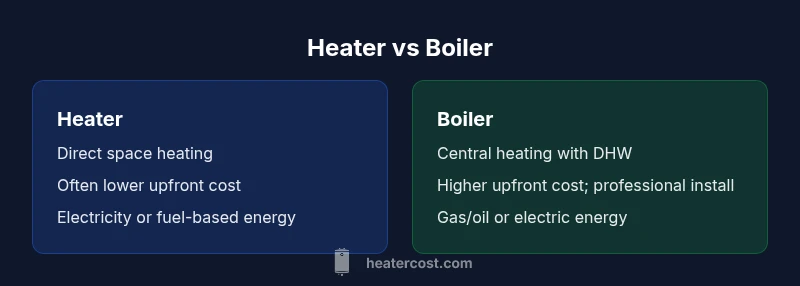
The difference between heater and boiler is foundational: heaters provide space heat for individual rooms, while boilers heat water that travels through pipes to radiators or taps. In many homes, boilers also supply domestic hot water. This quick comparison highlights the core functions, typical uses, and what that means for operating costs and maintenance, per Heater Cost Analysis, 2026.
What 'heater' and 'boiler' mean in home heating
At a high level, a 'heater' is any device that provides heat to a space. In residential settings, heaters can be portable electric units, baseboard heaters, or wall-mounted panels. A 'boiler', by contrast, heats water (or steam) inside a sealed vessel and distributes that heat through pipes to radiators, radiant floors, or taps for hot water. The distinction matters for how heat is delivered, how you heat your home, and what energy is used. Understanding the difference between heater and boiler helps homeowners decide.
According to Heater Cost, the most common confusion arises from using 'heater' as a catch-all term. In practice, if your system is designed to warm rooms directly (space heating), it is typically categorized as a heater. If your system is designed to heat water that then travels through a network of pipes to heat spaces and supply hot water, it is a boiler. This basic split drives decisions about installation complexity, running costs, and long-term value. The Heater Cost team emphasizes precision here because the wrong label can lead to either overpaying or under-sizing. The terminology does matter when evaluating energy costs, maintenance schedules, and potential incentives.
How they work: heat transfer principles
Heat moves in three common ways: conduction, convection, and radiant transfer. A space heater primarily relies on electric resistance elements or combustion to warm the surrounding air, using convection currents to distribute heat or radiant elements to warm nearby objects. In contrast, a boiler heats water in a closed loop. The hot water or steam then travels through a network of pipes to radiators, baseboard units, or underfloor heating mats, distributing heat through convection and radiation. This fundamental difference shapes performance in real homes.
Electric space heaters respond quickly, delivering warmth within minutes, but their output is usually limited to the room they occupy. Boilers, especially gas or oil-fired models, can deliver consistent heat across many rooms but require a properly sized distribution system. Because boilers rely on heat carryover via water, heat losses in pipes, corrosion risks, and pump performance can influence efficiency. In addition, boilers with modern controls — such as outdoor reset, zoning, and modulating burners — can improve efficiency substantially, though these features require professional installation and maintenance.
The key takeaway is that the physics of heat transfer drives how heat is delivered, how comfortable a space becomes, and how you calculate energy costs over a heating season.
Primary uses and typical installations
Heaters are often chosen for supplemental or space-specific heating. Portable electric heaters are common in bedrooms, living rooms, or apartments where a central system is absent or impractical. Wall-mounted panels or baseboard heaters expand zoning flexibility, allowing precise temperature control in individual rooms. Boilers are central to home heating and hot water delivery. In single-family homes, a boiler may serve the whole house through radiators or towel warmers and, in many cases, supply domestic hot water as well via a boiler-and-taux indirect water heater or similar configuration.
The installation footprint differs accordingly. A space heater usually requires minimal setup and can be moved or stored. A boiler requires a dedicated mechanical room, venting, and a network of pipes. In rental properties or smaller apartments, a portable heater can reduce initial expenses but may lead to higher ongoing energy costs if heating needs are extensive. For homeowners, a boiler system offers a more integrated solution with better long-term comfort and convenience when sized appropriately.
Energy sources and efficiency considerations
Energy source choice is a major factor in deciding between a heater and a boiler. Heaters frequently run on electricity, natural gas, or propane, depending on the device. Electric space heaters convert nearly all input energy into heat but are often less economical in colder climates due to electricity costs. Boilers provide central heat and often domestic hot water; a gas-fired boiler is common, but oil-fired and electric boilers exist. Efficiency for boilers is typically described with efficiency ratings like AFUE (annual fuel utilization efficiency), and modern boilers use condensing technology to reclaim energy from exhaust.
For homes with rising electricity prices or limited natural gas access, a high-efficiency boiler can still offer strong overall efficiency, particularly when paired with good insulation and a well-designed distribution system. Conversely, when climate is milder or space is limited, a plug-in electric heater or a wall-mounted panel may deliver warmth with lower upfront costs. Heater Cost analysis indicates that energy cost and climate are frequently the deciding factors in long-term value.
Cost considerations and long-term value
Upfront costs and installation logistics differ dramatically. Space heaters typically have the lowest initial price, with units ranging from modest to moderate, and installation is minimal. Boilers involve higher upfront costs due to equipment, a professional installation, venting, and potential system upgrades (pumps, expansion tanks, piping). Operating costs depend heavily on local energy prices and usage patterns. In cold climates, electric space heating can be expensive to run; a boiler system using gas can be cheaper per BTU but may require regular maintenance.
From a long-term perspective, boilers often offer greater value if you need consistent whole-house heating and domestic hot water. It's essential to compare not just purchase price but total cost of ownership, including maintenance and potential repairs, energy efficiency gains, and system longevity. Well-insulated homes with properly designed distribution will see the largest value from the most efficient boiler or a modern electric heating strategy, depending on energy costs.
Maintenance, safety, and reliability
Space heaters require less routine professional maintenance but demand careful placement to avoid fire hazards. Regular cleaning, outlet checks, and ensuring cords are not overloaded is prudent. Boilers require periodic professional service to maintain safety and efficiency: check venting, pressure, water quality, and corrosion. Regular inspection helps prevent leaks, failures, and breakdowns that can disrupt comfort. In addition, both systems benefit from proper carbon monoxide monitoring and safe clearances around heating equipment. Reliability depends on proper installation, system sizing, and maintenance discipline. For homeowners and landlords, predictable performance across seasons matters more than initial cost savings, making a well-maintained boiler a compelling long-term choice in many homes.
Sizing, installation, and space requirements
Size matters for both options. A space heater must consider the target room size, insulation, and window performance to avoid overheating or under-heating. A boiler system requires careful load calculations for overall house heating and domestic hot water needs. Proper pipe routing, radiator placement, and zoning impact comfort and efficiency. Installation considerations include venting, gas lines or electrical service upgrades, and compliance with building codes or HOA rules. In many cases, an energy audit or consultation with a Heating, Ventilation, and Air Conditioning (HVAC) professional helps determine the right approach. Budget for future expansion when planning a boiler, especially if you anticipate adding living spaces or upgrading insulation.
Practical scenarios: when to choose a heater vs boiler
- Small apartment or seasonal space: a portable electric heater or wall panel is often the most practical choice, offering flexibility and low upfront cost.
- Whole-house heating with reliable domestic hot water: a boiler system becomes more compelling, particularly in colder climates with high demand.
- Budget-constrained renovations: modular options like baseboard heaters paired with a dedicated water heater can offer a staged approach, allowing you to spread costs while preserving comfort.
- Energy-conscious buyers: compare overall energy costs, insulation quality, and potential rebates. Boiler efficiency gains combined with smart controls can offset higher upfront costs over time.
Common myths and real-world pitfalls
- Myth: A single space heater can replace a boiler for whole-home heating. Reality: Space heaters are unsuitable for comprehensive home heating and pose safety risks if used as a primary heat source.
- Myth: Boilers are always expensive to install. Reality: Costs vary with existing ductwork, radiators, and local labor; in some cases, retrofits are reasonable.
- Myth: Electric boilers are the same as space heaters. Reality: Electric boilers can provide centralized heat and hot water, but they operate differently and must be sized correctly.
- Pitfall: Skipping insulation improvements. A poorly insulated home will waste energy regardless of heating method.
How to evaluate options for your home
- Start with an energy audit and climate assessment.
- Determine whether you need space heating only or central heating with hot water.
- Compare installed costs, operating costs, and potential rebates.
- Consult a local HVAC professional to size equipment and verify venting or electrical requirements.
- Use a long-term cost approach: consider maintenance, replacements, and energy efficiency improvements.
Final notes on energy resilience and future-proofing
As homes become better insulated and weather patterns shift, the choice between a heater and boiler may hinge on your ability to adapt. Consider hybrid approaches, zoning, and smart controls that optimize energy use. The best choice aligns with climate, energy prices, and your plans for home upgrades. The Heater Cost team emphasizes balancing initial cost with long-term reliability and energy efficiency to maximize value over time.
Step-by-step quick-start checklist
- Identify whether you need space heat or central hot water.
- Check insulation, windows, and drafts to understand heat loss.
- List energy sources available (electricity, gas, oil) and compare costs.
- Consult an HVAC professional to size equipment and design a system.
- Review installation requirements and permit needs before purchasing.
Comparison
| Feature | heater | boiler |
|---|---|---|
| Energy source | Electricity or fuel-based (space heaters, baseboard) | Gas, oil, or electricity (central boilers) |
| Heat delivery method | Direct heat to a single space; localized warmth | Distributes heat via water/steam through a building network |
| Primary use | Standalone room heating or supplemental heat | Whole-house heating + domestic hot water (DHW) |
| Installation complexity | Portable or wall-mounted; minimal setup | Professional installation; venting and piping required |
| Efficiency potential | Depends on device and room; often limited by space | High efficiency possible with modern central systems |
| Maintenance needs | Low ongoing maintenance; safety checks as needed | Regular professional service; venting and water quality checks |
| Operating costs | Electricity costs; may be higher in cold climates | Gas/oil costs vary by region; electricity costs for DHW depend on usage |
| Hot water production | Does not provide DHW unless integrated model exists | Typically provides DHW; some systems are DHW-ready or combi-style |
| Space requirements | Compact, portable units; minimal dedicated space | Requires boiler room or dedicated mechanical space |
| Lifespan | Shorter lifespan for portable units; replacements common | Longer life with proper maintenance and professional care |
The Good
- Clarifies options to avoid overpaying for heat
- Highlights long-term operating and maintenance considerations
- Helps match system to home size and climate
- Supports energy-efficiency planning
Negatives
- Can oversimplify complex HVAC networks
- Regional energy prices affect conclusions
- Boiler installation may be expensive upfront in some homes
Boiler-based systems offer more comprehensive heating; space heaters are best for flexible, supplemental heat
For whole-home warmth and hot water, boilers are typically the stronger choice. Space heaters excel as cost-effective, flexible options for targeted heat or temporary needs. The Heater Cost team recommends sizing, insulation, and energy-price considerations to determine the best fit.
Got Questions?
What is the difference between heater and boiler?
A heater heats air for space warming, while a boiler heats water that circulates to radiators or taps. In many homes, boilers also provide domestic hot water. The distinction affects installation, costs, and maintenance.
A heater warms the air in a room; a boiler heats water for radiators and hot taps. Boilers often also provide hot water for your home.
Can a single heater replace a boiler for whole-house heating?
Not effectively in most homes. Heaters are designed for individual spaces, while boilers provide centralized heat to multiple rooms and hot water. Relying on space heaters for entire-home heating is inefficient and unsafe in harsh climates.
Space heaters aren’t meant to heat an entire house; a boiler system is designed for whole-home warmth and hot water.
Are boilers always more expensive to install than heaters?
Typically yes, because boilers require professional installation, venting, piping, and sometimes upgrades to the fuel source. However, long-term operating costs and comfort can justify the initial investment in many homes.
Boiler installations usually cost more upfront, but they can pay off with better comfort and efficiency over time.
Do boilers also provide domestic hot water (DHW)?
Most central boilers either provide DHW directly or via an indirect storage tank. Some systems, like combi boilers, supply hot water on demand for taps. Check with an HVAC pro to confirm the configuration for your home.
Most boilers can supply hot water, but configurations vary. A combi boiler provides hot water on demand.
What maintenance do each require?
Space heaters require regular cleaning and safety checks to prevent fire hazards. Boilers need periodic professional service to inspect venting, pressure, and water quality. Regular maintenance helps preserve safety and efficiency.
Space heaters need cleaning and safety checks; boilers need professional servicing to keep them safe and efficient.
The Essentials
- Identify whether you need space heat or central hot water
- Consider energy source and local costs before deciding
- Account for installation, maintenance, and space needs
- Evaluate long-term value with energy efficiency in mind