Integrated vs Separate Heater & Humidifier: A Comprehensive Comparison
Objective guidance comparing integrated heater-humidifier units with separate heater and humidifier setups. Learn about installation, maintenance, energy use, humidity control, and long-term value for homes in 2026.


For most homes, an integrated heater with a built-in humidifier offers simpler setup and coordinated humidity control, while separate heater and humidifier setups give flexibility and potentially lower upfront costs. This comparison examines installation, maintenance, energy use, and long-term value to help you decide which path fits your budget and climate in 2026.
Why pairing a heater with a humidifier matters
In many homes, the combination of a heating system and a humidification device is not just about warmth, but about indoor air comfort and overall health. A heater can dry air during cold months, exacerbating skin irritation, nasal congestion, and static electricity. A properly chosen humidification strategy helps maintain ideal relative humidity levels, typically between 30% and 50%, which supports respiratory comfort and can protect wood furniture and musical instruments. The decision to pair a heater with a humidifier—whether through an integrated unit or separate devices—depends on climate, home size, insulation quality, and how aggressively you want to manage indoor humidity. According to Heater Cost, the right pairing reduces energy waste and improves perceived warmth, delivering comfort with potential cost savings over time.
This guide is intended for homeowners, renters, and property managers evaluating installation and maintenance options in 2026. It emphasizes practical decisions, not just price, so you can balance upfront costs with long-term value and reliability. We’ll explore the core differences, practical installation considerations, and the scenarios where each configuration shines.
Integrated heater with built-in humidifier: advantages and limits
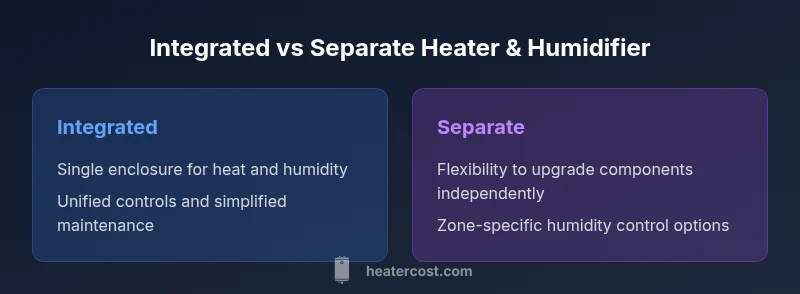
An integrated heater-humidifier unit combines both climate control elements into a single enclosure, often sharing a common control interface and air distribution path. The key advantage is simplicity: fewer installation steps, a single maintenance schedule, and a unified control experience. For homes with limited space or where ease of use matters, integration reduces clutter and potential mismatch between heating and humidity levels. Integrated systems are especially appealing in milder climates or in smaller homes where a compact footprint helps maintain living space without sacrificing humidity control. However, limits exist: fewer brands and models to choose from, potential compromises in humidification capacity, and if the unit fails, the entire system may require more extensive service. When climate is steady and space is at a premium, integration often offers the best balance between performance and convenience. Heater Cost’s analysis highlights that homeowners who prioritize streamlined operation tend to favor integrated solutions for 2026.
Separate heater and humidifier: benefits and trade-offs
Separating the heater and humidifier components creates flexibility and scalability. You can tailor each device to unique room needs, add humidity control to specific zones, and mix-and-match brands based on performance, warranty, or maintenance preferences. This setup shines in larger homes, spaces with variable occupancy, or climates with more pronounced humidity swings, where independent devices can be upgraded or repaired without affecting the other system. On the downside, two devices mean more installation complexity, separate maintenance tasks, and additional space consumption. Control systems may require a more capable interface to synchronize heating and humidity, which can add to initial setup costs. Overall, separation often suits homeowners who value customization and future expansion opportunities, even if it means higher upfront effort and planning. Heater Cost’s 2026 review notes that long-term flexibility is a common driver for choosing this path.
Factors that influence choice: climate, space, and usage patterns
Your climate profile significantly shapes which approach works best. In consistently cold and dry winters, humidity control becomes crucial to comfort; integrated units can provide consistent humidity with less fuss, while separate devices may allow targeted humidification where needed most. Space constraints also matter: a single compact unit can fit more easily in tight mechanical rooms, whereas a separate setup can better utilize crawl spaces or basements if layout permits. Usage patterns—such as people spending more time in living areas or running humidity in bedrooms at night—can determine control strategy. Consider insulation quality, airflow, and existing ductwork. A well-insulated home reduces moisture loss and improves the effectiveness of either configuration. The right choice balances climate realities with available space and preferred control complexity.
Humidity control mechanics and control options
Humidity control relies on accurate sensing and responsive actuation. Integrated units typically offer a single integrated humidistat and a compatible thermostat, which can simplify calibration and reduce drift between heating and humidity. Separate systems allow you to place humidistats in strategic zones for more precise control in those spaces, which can be advantageous in multi-story homes. Smart controls and humidity buffers further enhance performance, enabling scheduling and adaptive humidity management based on occupancy and external weather patterns. Regardless of configuration, aim for a control strategy that maintains comfort without overworking the system, and ensure that humidification is compatible with your existing ventilation and filtration setup. Heater Cost’s guidance emphasizes choosing controls that align with your comfort goals and energy use priorities.
Energy efficiency and thermal dynamics
Energy efficiency in heater and humidifier configurations depends on load matching, control strategies, and the overall efficiency of the equipment. Integrated units can optimize heat and moisture delivery in a coordinated way, potentially reducing cycling and standby losses. Separate devices allow you to operate only the components you need, which can save energy in some scenarios, especially when humidity needs are seasonal or room-specific. In both cases, proper maintenance—clean filters, clean humidifier pads, and leak prevention—preserves efficiency and prevents hidden energy waste. The decision should weigh the annual energy cost implications, projected humidity needs, and how well each setup integrates with existing HVAC equipment. Heater Cost’s 2026 perspective suggests that efficiency gains come from system cohesion and disciplined operation rather than from isolated component performance.
Installation considerations and compatibility with existing systems
Installing a heater-humidifier setup requires matching electrical and HVAC capacities, compatibility with ducts or space, and ensuring safe operation with moisture-rich environments. Integrated units simplify wiring and duct connections but may demand more significant upfront planning to fit within existing spaces. Separate devices require careful coordination of airflow, humidity distribution, and control integration, which can involve more steps but offers installment flexibility. Check compatibility with your current furnace or heat pump, available space, and accessibility for maintenance. If retrofitting, plan for potential upgrades to wiring, outlets, drainage lines for the humidifier, and controls. A thoughtful assessment of installation constraints helps avoid future bottlenecks and service interruptions.
Maintenance planning and longevity expectations
Maintenance for heater and humidifier configurations focuses on regular inspection, cleaning, and component replacement. Integrated units consolidate maintenance into a single service cycle, which can simplify scheduling but concentrates potential downtime. Separate devices typically require two maintenance routines: one for the heater and one for the humidifier, potentially increasing the time and cost of upkeep but allowing targeted attention to each device’s wear patterns. Longevity depends on material quality, water quality, and how consistently units are serviced. Schedule filter changes, humidifier pad replacements, and system flushing as recommended by manufacturers, and keep an eye on unusual noises, temperature fluctuations, or humidity drifts that signal performance issues.
Real-world scenarios: when each option shines
In a compact, energy-conscious home with a stable climate, an integrated heater-humidifier often provides the best blend of simplicity, space efficiency, and consistent humidity control. For larger homes with variable occupancy or zones where humidity needs differ, a separate heater and humidifier can deliver precise control and easier phased upgrades. For rental properties seeking ease of maintenance and predictable performance, an integrated solution may reduce management complexity, while property managers needing flexibility across units might lean toward separate devices. Always consider your HVAC contractor’s recommendations, the building envelope, and the expected occupancy pattern when weighing options. The Heater Cost framework suggests aligning your choice with the most critical performance factor—comfort or control flexibility—and evaluating long-term maintenance implications.
Sizing, controls, and user guidance
Sizing is about meeting peak winter loads without oversizing, which would waste energy. When pairing a heater with a humidifier, ensure the equipment capacity accounts for both temperature and humidity requirements. Controls should be intuitive and reliable, ideally offering remote or smart home integration for monitoring and scheduling. For integrated units, test the balance between heat output and moisture delivery across typical winter days. For separate devices, verify that humidification works in concert with the heating cycle to avoid condensation or overly damp conditions. A well-configured system uses humidity targets to support comfort without triggering excessive dryness or dampness. Heater Cost emphasizes a measured approach: size for comfort, not merely for warmth, and implement controls that you will actually use.
Maintenance, troubleshooting, and service planning
Effective maintenance hinges on a proactive schedule and accessible service plans. For integrated units, establish a single service appointment focused on both heating and humidification subsystems. For separate devices, coordinate visits to cover both units, ensuring compatibility in documentation and warranty. Common issues include clogged humidifier pads, dirty filters, and sensor drift. Addressing these problems promptly preserves performance and prevents larger failures. Create a simple maintenance calendar and use manufacturer-approved parts to maximize longevity. If you notice persistent humidity imbalance or strange noises, consult a professional rather than attempting risky DIY fixes, as moisture-laden components can pose safety concerns.
Making the decision: a practical framework
To decide between an integrated unit and separate devices, start by listing your priorities: space, maintenance, cost, and control precision. Next, evaluate your climate data and seasonal humidity needs. Then assess installation constraints, available wall or mechanical space, and compatibility with your current HVAC system. If ease and compactness are top priorities, lean toward integration; if you value customization and zone-specific control, separate devices may be better. Finally, obtain quotes from reputable installers, compare warranty terms, and consider long-term service costs. The decision should balance upfront effort with ongoing comfort and reliability, guided by practical factors rather than curiosity alone.
Comparison
| Feature | Integrated heater with built-in humidifier | Separate heater + standalone humidifier |
|---|---|---|
| Installation complexity | Lower (single enclosure and ducting) | Higher (two devices, potential zoning) |
| Maintenance requirements | One maintenance cycle | Two maintenance cycles (heater + humidifier) |
| Energy efficiency | Coordinated control can reduce cycling | Depends on matching components; potential for high efficiency with proper controls |
| Humidity control precision | Coordinated humidity with heat | Zone-specific humidity possible; may require complex controls |
| Space required | Compact footprint | More space due to two units |
| Initial cost | Typically higher for integrated unit | Typically lower per device but may be higher total |
| Long-term cost | Can be lower due to fewer parts | Potentially higher due to two devices and servicing |
| Warranty coverage | Single-wystem warranty | Separate warranties per device |
The Good
- Simplified control with a single interface
- Coordinated humidity and temperature management
- Space-efficient for small homes
- Lower maintenance points with a single unit
- Unified warranty and service streamlines support
Negatives
- Higher upfront cost for integrated units
- Limited brand/model options for integrated solutions
- If the unit fails, both heating and humidification are affected
- Repairs may require replacing the entire integrated unit
Integrated heater-humidifier units generally offer the best balance of simplicity and coordinated climate control, especially in smaller homes or where space is limited.
For homes prioritizing ease of use and compact design, integrated solutions work well. If you need zone-specific humidity or plan to scale over time, separate devices provide flexibility and expansion potential.
Got Questions?
What is the main difference between an integrated heater-humidifier and separate devices?
An integrated unit combines heating and humidification in one enclosure with a single control interface, while separate devices use two independent units, potentially offering more flexibility but requiring more complex installation and maintenance.
Integrated units combine both functions in one box with one control, while separate devices use two units that you manage separately.
Is an integrated unit more energy-efficient than separate devices?
Efficiency depends on system design and controls. Integrated units can reduce cycling by coordinating humidity and heat, while well-matched separate devices can achieve high efficiency as well. Both benefit from modern, high-efficiency components and good maintenance.
It depends on how well the system is matched and controlled; integrated units can reduce cycling, which helps efficiency.
Can I retrofit a humidifier to an existing heater?
Yes, many heaters can support a retrofit humidifier kit or an add-on humidifier. Compatibility depends on your furnace model, airflow, and available wiring. A professional assessment ensures safe installation and proper integration with controls.
Yes, but you’ll need to check compatibility with your furnace and ensure safe installation.
Do homes always need humidification in winter?
Not every home needs humidification. If indoor air feels dry, causes discomfort, or if woodwork and photos show shrinkage, humidification can improve comfort. Humidity targets should balance comfort with mold prevention and energy efficiency.
Not always, but dry air can cause discomfort and damage; humidification helps when humidity dips too low.
What maintenance tasks are common to both setups?
Regular filter changes, cleaning of humidifier pads, checking for leaks, and ensuring sensors and controls function properly are common tasks. Annual professional inspections help preserve efficiency and safety.
Keep filters clean, check humidifier pads, and have an annual check to keep everything running safely.
How do I choose the right size for heater and humidifier?
Sizing depends on home size, insulation, climate, and desired humidity targets. A professional can perform load calculations and recommend a unit with appropriate capacity to meet both heating and humidity goals.
Get a professional to calculate needed capacity based on your home and climate.
The Essentials
- Prioritize your climate needs and space constraints.
- Integrated units simplify maintenance and control.
- Separate devices offer customization and scalability.
- Consider long-term maintenance costs, not just upfront price.
- Ensure compatibility with existing HVAC and smart controls.