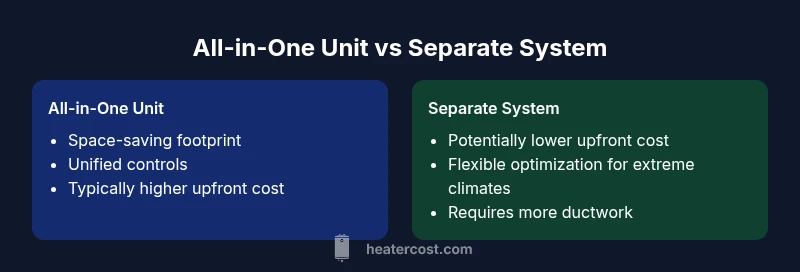
Heater and Air Conditioner in One Unit: A Comprehensive Comparison
Compare all-in-one HVAC units to traditional separate systems. Explore performance, installation, costs, and practical guidance to decide if a heater and AC in one unit fits your home.


According to Heater Cost, an all-in-one heater and air conditioner (often a heat pump) combines heating and cooling in a single unit to simplify space conditioning. It can save space and reduce ductwork, offering year-round comfort, but may entail higher upfront costs and climate-dependent performance. The Heater Cost team emphasizes weighing climate, home size, and service options before choosing.
What is a heater and air conditioner in one unit?
A heater and air conditioner in one unit is typically an all-in-one HVAC system, most commonly a heat pump that handles both heating and cooling from a single, integrated device. In practice, these systems come in two main flavors: air-source heat pumps (the most common all-in-one units for homes) and ducted versus ductless configurations. Ductless mini-split versions are common in retrofits and small spaces, while traditional ducted systems offer centralized distribution. The core advantage is simplicity — one equipment footprint, one set of controls, and a single service pathway. In milder climates, these systems can deliver robust year-round comfort with high efficiency; in very cold climates, performance can dip unless the unit includes auxiliary heat or a hybrid strategy. From a homeowner perspective, the appeal is clear: fewer rooms to monitor, less space taken by equipment, and the potential reduction in installation complexity. The Heater Cost team notes that the value proposition hinges on climate, insulation quality, and how well the unit is matched to the home’s heating and cooling load. For readers evaluating this option, it’s essential to understand how all-in-one units differ from conventional furnaces with separate air conditioners and whether your home’s ductwork or lack thereof will support efficient operation.
DoNotWrapTitleForJsonTextOnlyBlockCommentButEnsureThisBlockExhibitsMarkdownContent
descriptionAbsent
Comparison
| Feature | All-in-One Unit | Separate System (Furnace + Central AC) |
|---|---|---|
| Installation complexity | Moderate to high (integrated system and refrigerant lines) | Lower to moderate (two dedicated systems or a typical furnace and central AC) |
| Space requirements | Compact footprint; may reduce duct requirements in retrofits | Requires space for furnace, air handler/coil, and central ducting |
| Energy efficiency options | High efficiency when properly matched; inverter-driven compressors common | High efficiency options available, but performance depends on separate components and grid efficiency |
| Climate suitability | Strong in moderate climates; cold-weather performance depends on auxiliary heat | Broadly suitable, with strong cold-weather options when paired with backup heat |
| Initial cost (upfront) | Often higher upfront due to integrated design | Typically lower upfront for separate components, but multiple costs apply |
| Maintenance & repair | Single service path; specialized technicians needed | Multiple service paths for furnace and AC; potentially broader availability |
| Control & zoning | Unified controls; easy to run day-to-day | Separate controls; zoning can be more flexible but more complex |
| Lifespan & reliability | Comparable lifespan with regular maintenance | Depends on two systems; may offer redundancy between two units |
| Best for | Smaller homes, retrofits, denser spaces | Larger homes, extreme climates, or existing ducted layouts |
The Good
- Space-saving installation reduces footprint and ductwork needs
- Unified controls simplify operation and scheduling
- Year-round comfort from a single, centralized system
- Potentially lower retrofit costs for compact homes
- Quieter operation due to compact design and fewer indoor units
Negatives
- Higher upfront cost compared with some separate systems
- Performance can dip in very cold climates without auxiliary heat
- Limited installer availability in certain regions
- Repairs may require specialized technicians with specific training
All-in-one units are a strong choice for compact homes in moderate climates and for retrofits where ductwork is limited.
If climate is moderate and space is at a premium, an all-in-one heater and air conditioner can deliver convenient, energy-efficient comfort with simplified maintenance. In very cold or very hot environments, assess whether auxiliary heating or hybrid configurations are available. The decision should balance installation practicality, climate needs, and service options.
Got Questions?
What is meant by a heater and air conditioner in one unit, and how does it work?
An all-in-one unit combines heating and cooling in a single appliance, typically a heat pump. It shifts refrigerant between indoor and outdoor coils to provide warmth in winter and cool air in summer, with a single control interface for both functions. Efficiency depends on the model, climate, and installation quality.
An all-in-one HVAC is a single device that heats and cools your home, usually a heat pump with one control for both modes.
How does all-in-one compare with a separate furnace and central AC in efficiency?
Efficiency depends on the unit’s rating and climate match. All-in-one systems can be highly efficient when correctly sized and installed, but in extreme temperatures, a separate system with dedicated components may outperform it. Energy costs hinge on climate and usage patterns.
It depends on climate and sizing; all-in-one can be very efficient if well-matched, but separate systems can win in extreme weather.
Can all-in-one units handle very cold winters?
Many all-in-one units perform well in milder winters, especially with auxiliary heat or hybrid configurations. In regions with severe cold, some homeowners prefer a backup heater or a traditional furnace for reliability.
In very cold climates, you’ll want auxiliary heat or a hybrid setup for reliability.
What should I ask a contractor when considering one all-in-one unit?
Ask about climate suitability, recommended SEER/HSPF ratings, ductwork needs, electrical requirements, warranty terms, service network, and whether a hybrid approach is advised for your home.
Ask about climate fit, efficiency ratings, ductwork, and warranty.
Are all-in-one units ducted or ductless, and does that affect installation?
All-in-one units can be ducted or ductless (mini-splits). Ducted setups integrate with existing ductwork; ductless options are common in retrofits and smaller spaces, offering flexibility but requiring careful refrigerant line routing.
They can be either ducted or ductless, with ductless usually easier for retrofits.
What is the typical lifespan and maintenance requirement?
Lifespan generally mirrors traditional HVAC components when properly maintained. Regular filter changes, coil cleaning, and professional servicing every few years help sustain performance; refrigerant checks are critical for efficiency.
With good maintenance, expect a long life similar to other HVAC systems.
The Essentials
- Assess climate suitability before buying
- Prioritize models with inverter-driven compressors for efficiency
- Plan ductwork and electrical needs with a licensed pro
- Compare total ownership costs, not just upfront price
- Ask installers about hybrid or backup heating options