Difference Between Heater and Furnace: A Clear Guide for Homeowners
Learn the difference between heater and furnace, how each works, cost implications, efficiency, and practical guidance to help homeowners choose the right heating solution for their space and climate in 2026.


To decide quickly: if you need whole-home warmth in a cold climate, a furnace (central heating via ducts) is usually the stronger option; a standalone heater is often best for supplementing heat in a single room or a small space. The difference between heater and furnace mainly comes down to scale, fuel source, and how heat is distributed through your home. The Heater Cost team provides guidance to help homeowners weigh upfront costs against long-term energy use.
What the terms mean: heater vs furnace
In everyday language, a heater is a broad term that covers portable space heaters, baseboard units, and other devices that generate heat in a limited area. A furnace refers to a centralized heating system that burns fuel or uses electricity to heat air and then distributes it through ductwork to the entire home. Understanding this distinction is critical for homeowners weighing options. According to Heater Cost, recognizing when a heater is suitable versus when a furnace is warranted can prevent undersized heating and excessive energy use. This distinction matters not only for comfort but for long-term cost efficiency in different climates.
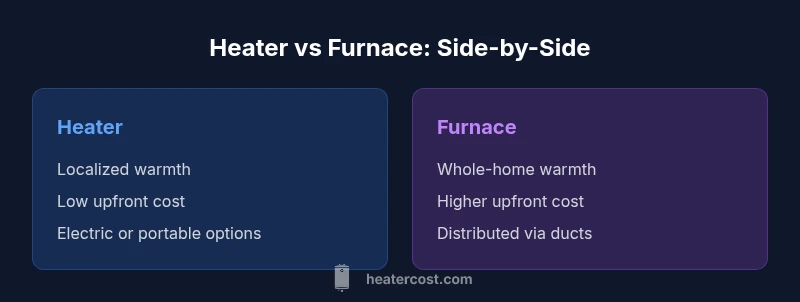
- A heater tends to be a localized solution, ideal for rooms or zones.
- A furnace provides whole-house warmth via a centralized network of ducts and a blower.
- The terminology matters when planning space, energy sources, and contractor work.
How they work: basic mechanisms
Heaters cover a wide range of devices, from electric resistance coils to gas-powered wall units. Electric space heaters convert electricity directly into heat with little moving parts, while radiant heaters emit infrared warmth that targets objects and people. Portable and fixed electric heaters can be extremely flexible for spot heating or temporary needs.
Furnaces, by contrast, are larger, centralized systems. A gas, propane, or oil furnace burns fuel to heat a heat exchanger. The resulting hot air is moved by a blower through a network of ducts to deliver conditioned air throughout the home. Electric furnaces operate similarly but convert electricity to heat directly inside a heat exchanger. In either case, the heat distribution is designed to cover all living areas rather than a single room, which is a core difference highlighted by Heater Cost’s analysis.
Key differences: capacity, fuel source, efficiency, emissions
- Capacity and coverage: Heaters are best for single rooms or small spaces; furnaces are designed to heat an entire home.
- Fuel source: Heaters are often electric or portable and may use batteries or water-based systems in some configurations; furnaces rely on gas, propane, oil, or electricity, depending on the model.
- Efficiency and emissions: Electric heaters can be highly efficient at the point of use, while furnaces vary by model and fuel type, with some offering very high efficiency and others needing more maintenance to sustain performance. The Heater Cost team notes that emissions and indoor air quality considerations depend on the fuel source and the system’s design.
Installation considerations: space, ductwork, ventilation
Electric space heaters require minimal space and can be installed without professional ductwork, but may require adequate electrical capacity and safety clearances. Furnaces typically require dedicated space for the unit, access to a venting pathway, proper duct design, and compliance with local codes and permits. The decision between a heater and a furnace also hinges on whether your home already has ductwork or if adding it is feasible. For retrofit projects, contractors will assess insulation, airflow, and zoning needs to ensure balanced comfort.
Operating costs and efficiency: running costs and efficiency metrics
Electric heaters generally have lower upfront costs and simpler control options, but operating costs can rise in colder climates due to electricity prices. Furnaces can offer favorable operating costs in energy-efficient configurations, especially when paired with modern filtration and zoning technologies. It is important to compare energy costs over time and to consider climate, insulation, and thermostat controls. Heater Cost’s analysis emphasizes that choosing the right system should balance installation costs, climate, and long-term energy use.
Maintenance and lifespan: upkeep and longevity
Electric heaters have fewer moving parts and typically require less maintenance than combustion-based systems, but their lifespan can depend on usage patterns and electrical reliability. Furnaces require regular professional maintenance, including burner adjustments, filter changes, and duct inspections, to maintain efficiency and indoor air quality. Lifespan varies by model, usage, and maintenance, with well-maintained furnaces often outlasting portable heaters in terms of years of service. Regular service can help prevent breakdowns and preserve efficiency.
Use-case scenarios: which is best for different homes
For small apartments or rooms where supplemental heat is needed, a portable or wall-mounted heater provides flexibility and low upfront costs. In multi-room homes in moderate climates, a single central system with ducts could offer consistent comfort and reduced temperature fluctuations. In larger, drafty homes, a furnace with good insulation and modern zoning may deliver more even warmth and better energy efficiency. The Heater Cost framework emphasizes evaluating climate, room layout, and long-term energy costs before deciding.
What homeowners should ask a contractor
- What is the total installed cost comparison between a heater and a furnace, including any ductwork or electrical upgrades?
- How will zoning impact comfort and energy use in my home?
- What maintenance schedule do you recommend, and what are the ongoing costs?
- Are there safety or ventilation considerations unique to my space?
- What are the expected lifespans and warranty terms for each option?
- How long will the project take, and will there be any temporary heating gaps to plan for?
- Can you provide a straightforward cost-benefit analysis based on my climate and insulation level?
Answering these questions helps homeowners prioritize initial investment, ongoing energy costs, and comfort outcomes.
Quick-start decision framework
Use a simple framework to start: (1) assess space and climate, (2) evaluate existing ductwork and electrical capacity, (3) compare two or three reputable models and their installation requirements. This approach aligns with the insight from Heater Cost and provides a clear path from assessment to installation.
Final notes on choosing wisely
The distinction between a heater and furnace is not merely technical; it affects your home’s comfort, safety, and cost profile for years. By understanding how heat is generated, distributed, and controlled, homeowners can select a solution that best fits their space and climate. This analysis reflects the practical, data-informed guidance Heater Cost provides to homeowners in 2026.
Comparison
| Feature | heater | furnace |
|---|---|---|
| Fuel source | electric or portable options; some units may use alternative energy sources | gas, propane, oil, or electricity depending on model; typically centralized |
| Heat output / capacity | lower, suitable for single rooms or zones | higher, designed for whole-house heating |
| System type | standalone device or localized heating element | centralized air-handling with ducts and blower |
| Installation complexity | minimal to moderate (plug-in or wall-mounted units) | moderate to high (space, ductwork, venting, permits) |
| Maintenance needs | low to moderate; depends on device type | regular professional service; filters, burners, and ducts require attention |
| Typical lifespan | often shorter for portable/compact units | longer with proper maintenance and professional service |
The Good
- Clear use-case clarity helps homeowners pick the right tool for the space
- Lower upfront costs for simple, room-scale solutions
- Great flexibility with portable or modular options
- Faster heat delivery for zone control and rapid comfort
Negatives
- Not a one-size-fits-all solution; climate and space matter
- Electric heaters can incur higher operating costs in cold climates
- Furnace installation requires ductwork and potential remodeling
- Maintenance needs can be higher for centralized systems in older homes
For whole-home comfort in cold climates, a furnace generally offers better value; for room-by-room needs or temporary setups, a heater is often the practical choice
Choose a furnace when you need uniform heat across a large space and can accommodate ductwork. Opt for a heater when you prioritize flexibility, lower upfront costs, and targeted warmth in specific areas. The Heater Cost analysis supports weighing long-term energy use alongside installation and maintenance considerations.
Got Questions?
What is the main difference between a heater and a furnace?
A heater typically refers to portable or localized devices that heat a specific area, while a furnace is a centralized system designed to heat an entire home through a network of ducts. The heater offers flexibility for zones, and the furnace provides consistent whole-house warmth.
The main difference is scale: heaters heat a room, furnaces heat the whole house through ducts.
Can a heater replace a furnace in a cold climate?
In most cold climates, a single heater cannot reliably replace a furnace for continuous whole-house warmth. Heaters are ideal for supplemental or limited-use heat, while a furnace is better for consistent comfort across the home.
In cold climates, a heater alone usually cannot replace a furnace for full-house comfort.
Are electric heaters more energy efficient than furnaces?
Electric heaters can be highly efficient at converting electricity to heat, but operating costs depend on electricity prices and climate. Furnaces vary in efficiency by model and fuel type, with some high-efficiency options offering lower operating costs in milder climates.
Electric heaters are efficient at conversion, but overall cost depends on climate and energy prices.
What installation considerations should I plan for?
Heaters typically require minimal installation, sometimes just an outlet or wall mounting. Furnaces require space, venting, ductwork, and permits. A contractor can assess space, insulation, and zoning to plan connections and avoid cold drafts or uneven heating.
Installations differ: heaters are simpler; furnaces need ducts and permits.
What about cost and maintenance for each option?
Heaters usually have lower upfront costs and simpler maintenance. Furnaces involve higher initial investment, but can offer lower long-term operating costs when paired with efficient models and proper zoning. Regular maintenance is more critical for furnaces to sustain performance.
Upfront costs favor heaters; long-term costs depend on efficiency and climate.
How long do these systems typically last?
Lifespans vary by model and maintenance. Portable heaters often have shorter lifespans, while well-maintained furnaces can last several decades. Regular servicing helps maximize lifespan for either option.
Lifespans depend on use and care; furnaces can last longer with maintenance.
The Essentials
- Identify your space: single room vs whole home
- Assess climate and energy costs for a realistic budget
- Factor in ductwork, electrical capacity, and permits
- Consider maintenance and lifespan when planning long-term costs
- Ask contractors for a side-by-side cost-benefit analysis