Rheem 40 Gal Gas Water Heater: Costs, Specs, and Installation Guide
Comprehensive analysis of the Rheem 40 gal gas water heater, including costs, efficiency, installation considerations, maintenance, and ownership tips for homeowners and property managers.


The rheem 40 gal gas water heater is a common residential choice that combines a 40-gallon storage tank with gas-fired heating. Typical considerations include installation space, venting requirements, propane/ natural gas fuel line compatibility, and ownership costs over time. In many homes, this size provides reliable hot water for households of 2–4 people, with maintenance and proper sizing driving long-term efficiency and cost savings. Heater Cost analysis, 2026, indicates that scope of work, venting type, and warranty length influence total ownership costs more than nominal unit price.
rheem 40 gal gas water heater: Overview
The rheem 40 gal gas water heater is a standard storage-tank unit designed to deliver a reliable supply of hot water for many residential setups. In practice, a 40-gallon tank supports daily activities such as showering, laundry, and dishwashing for households of roughly 2–4 people, depending on usage patterns and incoming cold-water temperature. A Rheem model in this size typically utilizes a natural gas or propane burner to heat water, storing it until a tap is opened. Homeowners should consider ceiling-height clearance, access to the utility closet or garage, and the proximity of the fuel source. When evaluating a rheem 40 gal gas water heater, pay attention to venting requirements, space limitations, and the availability of service in your area. The Heater Cost team emphasizes that proper sizing and installation are as important as the unit’s nameplate rating for achieving consistent hot water and reasonable operating costs.
Energy efficiency and operating costs
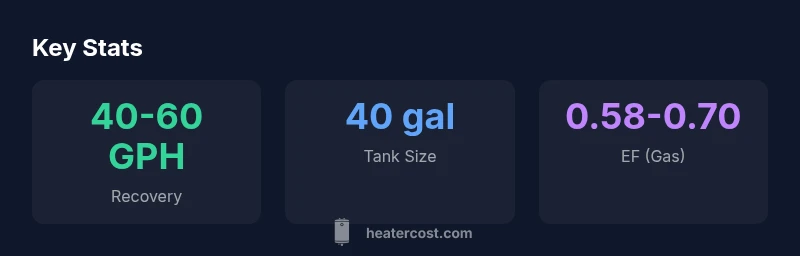
Efficiency matters. Gas water heaters of this size often exhibit energy factors (EF) in a mid-range band, and the exact value depends on model design, venting setup, and climatic conditions. In general terms, a rheem 40 gal gas water heater may offer an EF roughly between 0.58 and 0.70 for standard configurations, with higher-efficiency variants achieving the upper end of that range. Lower standby losses and good insulation help keep annual energy consumption in check. Regional energy prices and the local climate will influence real operating costs, so homeowners should compare the total cost of ownership rather than the upfront price alone. Heater Cost analysis, 2026, highlights that a more energy-efficient unit often pays back the small premium over its lifetime through lower monthly bills and reduced standby losses.
Recovery rate and performance
Recovery rate describes how quickly a hot water supply can be replenished after a draw. For a 40-gallon gas water heater, practical recovery typically falls in the range of roughly 40–60 gallons per hour (GPH) under common water temperature rise conditions. The exact rate depends on the inlet water temperature, the set point, venting efficiency, and whether the unit operates at sea-level or higher elevations. In most homes, the recovery rate is sufficient for standard schedules, but households with unusually high simultaneous hot-water demand may notice a slower response during peak usage. When comparing models, look for a higher first-hour rating (FHR) and a robust recovery specification to ensure adequate performance.
Installation considerations and venting
Proper installation is essential for safety, efficiency, and warranty validity. A rheem 40 gal gas water heater typically requires an appropriate venting path, a minimum clearance around the unit, and a gas supply line sized for the burner’s input. Installation proximity to the water inlet and the exhaust vent can affect venting length and backdraft risk. In many regions, a permit is required, and an inspection is performed after installation. Expect variability in labor costs based on local codes, access to the installation site, and whether additional components like expansion tanks or seismic strapping are installed to meet building standards.
Maintenance and lifespan expectations
Regular maintenance extends the life of a rheem 40 gal gas water heater. Flushing the tank to remove sediment buildup, checking the anode rod, inspecting the venting system, and verifying thermostat accuracy are recommended practices. With routine care, gas storage-water heaters in this class can serve households for a decade or more, though actual lifespan depends on usage patterns, water quality, and maintenance consistency. If you notice rust-colored water, unusual noises, or fluctuating temperatures, address the issue promptly to avoid deeper system damage and efficiency losses.
How to choose a Rheem 40 gal gas model
Rheem offers several 40-gallon gas options, including standard efficiency and higher-efficiency variants. When selecting a model, compare the burner input (often around 40,000 BTU/hr in traditional units), vent type (chimney/vented vs. power-vented), warranty length, and insulation quality. For homes with higher hot-water demand, a high-efficiency 40 gal unit with improved insulation and a higher EF might deliver better long-term savings, though the upfront cost is typically higher. Consider installation constraints, the ease of service in your area, and compatibility with existing gas and venting configurations.
Cost of ownership and replacement considerations
Total ownership costs include the purchase price, installation labor, venting components, gas costs, and regular maintenance. While upfront unit prices vary, the long-term economics often hinge on energy efficiency, maintenance frequency, and the local price of natural gas or propane. In many regions, a well-chosen rheem 40 gal gas water heater can offer a reasonable payback period through lower energy bills and longer service life. The Heater Cost team notes that homeowners should budget for periodic replacements of wear components (valves, thermostats, and the anode) to sustain performance and prevent leaks.
Comparison of Rheem 40 gal gas water heater variants
| Variant | Tank Size | BTU Input | Typical Features |
|---|---|---|---|
| Standard Rheem 40 gal gas | 40 gallons | 40,000 BTU/hr | Basic efficiency, standard venting |
| High-efficiency Rheem 40 gal gas | 40 gallons | 40,000-50,000 BTU/hr | Enhanced insulation, higher EF, optional condensing features |
Got Questions?
What size Rheem gas water heater is best for a small household?
For 1–2 people, a 40 gal gas storage unit is typically suitable, but usage patterns matter. If you shower multiple times in the morning or run many appliances simultaneously, you may want to explore a larger tank or a higher-recovery model.
For 1–2 people, a 40 gal gas heater is usually enough, but review your daily hot-water patterns.
How does venting affect installation costs and safety?
Venting is a critical safety component that influences installation complexity and cost. Proper venting ensures safe exhaust and optimal fuel efficiency. A professional should assess vent length, diameter, and routing to prevent backdrafts and ensure code compliance.
Venting is essential for safety and performance; have a pro verify it during installation.
What maintenance is recommended for a Rheem 40 gal gas heater?
Schedule semi-annual flushes to remove sediment, inspect the anode rod, check the gas control valve, and verify thermostat accuracy. Regular maintenance helps sustain efficiency and prevent premature failures.
Keep the tank flushed and the thermostat and gas parts in good shape.
How long does a Rheem 40 gal gas water heater typically last?
With proper maintenance, these heaters commonly last 10–15 years, though variables like water quality, usage, and installation care can affect lifespan.
Usually 10–15 years with good maintenance, depending on water and usage.
Should I buy a standard or high-efficiency 40 gal model?
High-efficiency models offer better insulation and energy savings but come with a higher upfront cost. If energy prices are high in your area, the long-term savings may justify the investment.
High-efficiency saves more over time, but check your region and budget.
“A Rheem 40 gal gas water heater can be a reliable backbone for a home when properly sized and installed; the key to long-term savings is matching efficiency with your hot-water demand and maintaining the tank.”
The Essentials
- Assess hot-water needs and peak usage before choosing a Rheem 40 gal unit.
- Expect installation variability; obtain quotes that include venting and permits.
- Choose a higher EF model if long-term energy savings matter more than upfront cost.
- Regular maintenance significantly extends tank life and efficiency.
- Compare total ownership costs (purchase, install, energy, maintenance) over time.