Home Depot Hot Water Tank Buying Guide (2026)
Explore Home Depot hot water tank options, pricing, installation, and maintenance with Heater Cost's 2026 buying guide. Compare storage tanks vs tankless models for homeowners and managers.


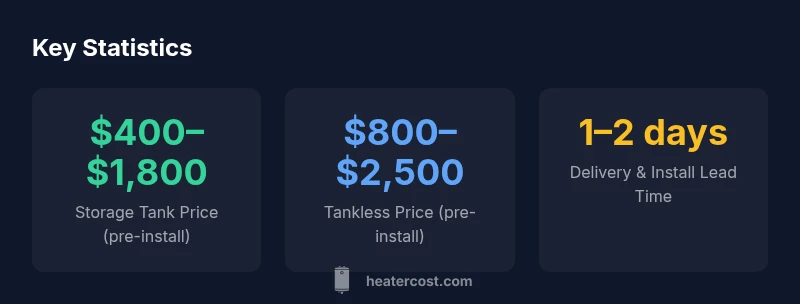
Home Depot hot water tank options span storage tanks (20–80 gallons) and tankless units, with prices largely driven by capacity and features. According to Heater Cost Analysis, 2026, storage tanks commonly range from $400 to $1,800 before installation, while tankless models run higher upfront, roughly $800 to $2,500. Delivery and professional installation add to the total, depending on location and scope. This quick snapshot helps homeowners compare value quickly at a glance.
Understanding the Home Depot hot water tank landscape
Home Depot is a primary retail channel for residential water heaters in many markets. The store carries a mix of storage tanks (electric and gas) in several gallon capacities, plus a smaller selection of tankless models. The exact lineup varies by region and season, but you can expect common storage options in the 20–80 gallon range and at least a handful of tankless units that serve whole-house needs. When evaluating options at Home Depot, it's useful to separate three core categories: electric storage tanks, gas storage tanks, and tankless heaters (gas or electric). Electric storage tanks are typically compatible with standard 120‑volt circuits, while gas models require venting and combustion air. Tankless water heaters, by contrast, provide on-demand hot water and often occupy less space, but their installation can require more complex venting and gas-line or electrical upgrades. In all cases you should confirm the model's energy factor (EF) and warranty terms. A careful check of local codes can avoid compliance issues during installation. According to Heater Cost, many homeowners choose a 40–50 gallon storage tank as a practical balance of supply, efficiency, and cost for typical households, with larger families or higher simultaneous demand guiding toward 50–80 gallon units.
How to assess your home’s needs before buying
Before visiting Home Depot or browsing online, map out your household’s hot water demand. Start with the number of bathrooms and typical daily usage, then consider simultaneous showers or laundry cycles. If you frequently run low on hot water, a larger capacity (50–80 gallons) or a more responsive tankless system may be warranted. Space constraints matter too: measure the closet or utility area where a water heater will live to ensure proper clearance for venting, service access, and maintenance. Check your current plumbing, venting (for gas models), and electrical setup to determine whether upgrades are required. Finally, factor energy costs and long-term savings—better insulation, an efficient EF rating, and a reliable warranty can reduce total ownership costs. Heater Cost analysis shows storage tanks in the 40–60 gallon range often hit a sweet spot for many households, while larger families may push toward bigger capacities or even supplementary heaters.
Features that matter when shopping at Home Depot
When evaluating models, prioritize capacity alignment with your peak demand, energy efficiency, and warranty coverage. Look for the Energy Factor (EF) or Uniform Energy Factor (UEF) labeling, indicating overall efficiency; higher EF typically translates to lower operating costs. Materials matter too: ceramic or glass-lined steel tanks resist corrosion, especially for municipal water with minerals. Insulation thickness (R-value) reduces standby heat loss, a key factor for efficiency. In-store representatives can explain venting requirements for gas models and advise on vent clearance. For installations, Home Depot often offers delivery and professional installation services, but confirm requirements for gas line upgrades, electrical work, and permit handling. Finally, examine warranty terms—most reputable brands offer multi-year coverage on the tank body with separate warranties on parts and accessories.
Price range and value: storage vs tankless
Storage tanks deliver reliable, affordable hot water with straightforward maintenance. The typical pre-install price range (before any delivery or labor) runs roughly from $400 to $1,800 depending on capacity and EF. Tankless models, while offering space savings and potentially lower standby losses, generally carry higher upfront costs, around $800 to $2,500 pre-install. Installation complexity and regional labor rates influence final totals. When evaluating long-term value, consider the cost per gallon of stored hot water and the potential energy savings projected by the unit’s EF. In areas with volatile energy pricing, a higher-efficiency storage tank or a tankless system can pay off earlier, but the math depends on usage patterns and local utility rates. Heater Cost’s 2026 analysis emphasizes balancing upfront costs with lifecycle savings and local installation requirements.
Choosing a model: brands, warranties, and compatibility
Brand variety matters because different manufacturers back different warranty terms and service networks. Common options include well-known producers that pair with wide service support, making maintenance easier. Warranty length often reflects confidence in durability—longer coverage typically applies to the tank itself, with shorter coverage on valves or electronic components. Compatibility is essential: ensure the unit fits your existing plumbing dimensions, venting needs, and electrical or gas supply. If you’re replacing an older tank, verify that your new model’s venting or gas-line requirements align with current codes. In some cases, a permit or inspection may be necessary after installation, so check with your local building department before purchase. A thoughtful choice balances capacity, efficiency, brand support, and installation compatibility.
Installation and maintenance considerations
Professional installation is strongly advised for most water heater replacements. Gas models require proper venting and combustion air, while electric units need a solid electrical hookup and breaker capacity. Expect delivery, removal of the old unit, and installation work to take several hours, potentially a full day for complex venting or electrical upgrades. After installation, flush the tank per the manufacturer’s guidelines to remove sediment and maintain efficiency. Schedule periodic maintenance: inspect the T&P valve, check anode rods every few years, and perform an annual flush or as recommended. Local permits may be required for gas line work or venting changes—check with your city or county building department. Keeping up with maintenance protects your investment and improves system longevity.
Quick shopping checklist for Home Depot
- Confirm capacity needs (20–80 gallons) based on household size and usage.
- Compare EF ratings and insulation R-values to gauge energy costs.
- Review warranty terms and service availability in your area.
- Verify venting (gas) or electrical requirements and potential upgrades.
- Include delivery and installation costs in your total estimate.
- Check local permit requirements and scheduling windows.
- Ask about in-store promotions, bundled installation, and disposal options for the old unit.
How to read labels and what to ask in-store
In-store and online labels reveal essential performance metrics. Look for EF ratings, Energy Star labels, and warranty length. Ask a retailer about demolition and removal of the old unit, lead times, and whether the quote includes venting kit, disconnects, and new connections. Ensure you understand whether installation includes adjustments to gas lines, electrical work, or necessary permits. For a smooth purchase, request a written estimate that itemizes the unit price, delivery, installation, and any required upgrades. This reduces the risk of surprise costs during installation.
Pricing and size ranges for Home Depot hot water tanks (pre-install)
| Product Type | Typical Size | Estimated Price Range (before install) | Notes |
|---|---|---|---|
| Storage Tank (electric/gas) | 20–80 gallons | $400–$1,800 | Wide range due to capacity and EF |
| Storage Tank (40–60 gal) | 40–60 gallons | $500–$1,600 | Most common residential sizes |
| Tankless (gas/electric) | Whole-house unit | $800–$2,500 | Higher upfront, compact footprint |
Got Questions?
What size storage tank should I buy for a family of four?
For a family of four, a 40–50 gallon storage tank is commonly sufficient, but peak usage and bathroom count can push this higher. Consider both comfort and future needs when choosing capacity.
A 40 to 50 gallon tank is a common starting point for a family of four, but check your peak water usage to be sure.
Are Home Depot hot water tanks energy efficient?
Most models offer a range of energy efficiency ratings. Look for high EF values and Energy Star labels where available, and select a model that matches your energy goals.
Yes, many models are energy efficient; prioritize high EF ratings and Energy Star labels where possible.
Do I need a permit to replace a hot water tank?
Permit requirements vary by locality. Replacements may require permits for venting, gas line work, or electrical upgrades. Check with your local building department before purchasing.
Permits depend on your city—check with your local building department before replacing.
What is the typical installation timeline?
Delivery and installation usually take a few hours to a full day, depending on venting and electrical changes. Complex installs may extend timelines.
Most installs take a few hours, sometimes a full day if upgrades are needed.
What warranties should I expect from Home Depot hot water tanks?
Warranties vary by model but commonly cover the tank for several years and parts for shorter periods. Always verify terms at purchase and whether labor is included.
Warranties vary; check the terms at purchase and clarify whether labor is included.
Is a tankless water heater worth it at Home Depot?
Tankless units save space and can reduce energy use, but higher upfront costs and installation complexity may offset savings depending on usage. Run a cost–benefit analysis for your home.
Tankless can be worth it if you have high hot-water demand, but factor upfront costs and install complexity.
“Selecting the right hot water tank is about balancing capacity, efficiency, and installation complexity to minimize life-cycle costs. The Heater Cost Team notes that planning for delivery and professional installation is essential to avoid hidden costs.”
The Essentials
- Define hot water needs before shopping.
- Storage tanks offer value; tankless varies by usage.
- Factor installation costs into total price.
- Prioritize energy efficiency to lower ongoing costs.
- Verify permits and local codes before replacement.