Gas on Demand Water Heater Guide
A comprehensive guide to gas on demand water heaters, covering costs, efficiency, installation, venting, and maintenance for homeowners and property managers.


Gas on demand water heaters heat water only when you need it, delivering continuous hot water without a storage tank. They use natural gas and rely on a flow sensor to fire the burner as water passes through. Installation, venting, and costs vary by home, but these units can be efficient when sized for peak demand.
What is a gas on-demand water heater?
According to Heater Cost, a gas on-demand water heater is a tankless appliance that heats water only as it flows, eliminating the standby losses that come with storage tanks. These systems run on natural gas and use a flow sensor to activate the burner when cold water enters the unit. The result is near-instant hot water, essential for households with irregular hot water needs or limited space. Size and venting requirements are critical, since an undersized unit can struggle during peak demand, while an oversized one can waste energy. In practice, most homes achieve the best balance by sizing the unit to match the highest expected simultaneous draw. Consider your peak usage pattern, fixture count, and climate when deciding if a gas on-demand option fits your home.
How the technology works in real homes
Tankless gas heaters heat water as it passes through the heat exchanger, rather than storing hot water. The unit's modulating burner adjusts output to meet demand, delivering energy only when needed. Some models are point-of-use, serving a single faucet, while whole-house units can supply multiple outlets. A proper installation includes venting that expels combustion byproducts safely and a gas supply line sized to support the rated flow. Real-world efficiency gains depend on how well the system is matched to your household usage and climate. Heater Cost's analysis notes that efficiency improvements fade if the unit is oversized relative to demand.
Pros and cons at a glance
Pros include continuous hot water, space savings, and reduced standby losses. Cons can include higher upfront costs, potential for inconsistent hot water at very high flow rates, and the need for professional venting and gas-line work. For renters and multi-unit buildings, scale and maintenance access are important considerations. As always, verify local permits and building codes. The goal is reliable performance without excessive energy use.
Installation and venting considerations
Installation requires careful planning around venting, gas line routing, and clearance around the unit. In many households, a direct-vent or power-vent configuration is necessary, especially in tight spaces or high-efficiency homes. You may need a venting kit appropriate for your climate and distance to the outside vent. Gas piping must meet local codes, and some jurisdictions require permits or inspections. A licensed plumber or HVAC technician should assess existing gas capacity, venting routes, and clearance before purchase. Proper sizing reduces nuisance calls and ensures consistent thermal comfort.
Costs, incentives, and long-term value
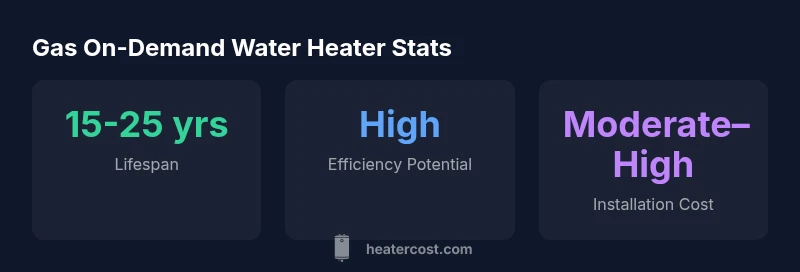
Costs can vary widely depending on model, venting needs, and labor rates in your area. While tankless gas heaters often carry higher upfront costs, homeowners may save on energy bills by reducing standby losses. Tax credits or rebates may be available in some regions, but eligibility depends on local programs and the specific equipment. Heater Cost recommends calculating the total cost of ownership over the appliance’s lifetime, including installation, maintenance, and energy consumption, to determine the best financial path for your home.
Maintenance, lifespan, and reliability
Regular descaling, vent inspection, and periodic gas-safety checks are important to keep a gas on-demand water heater operating at peak efficiency. The absence of a storage tank means fewer components that can corrode, but the heat exchanger and venting system require care. Lifespans of 15–25 years are typical with proactive maintenance and professional servicing. Address mineral buildup early, monitor for leaks, and schedule annual inspections to preserve performance.
Choosing the right model for your home
Key decision factors include your peak water usage, climate, available space, and existing gas infrastructure. If your household draws many fixtures simultaneously, a two-unit solution or a multi-point system may be necessary. For apartments or small homes, a compact whole-house unit can free up closet or utility space. Read product specifications carefully for flow rates and temperature rise capabilities. Consultation with a licensed pro helps ensure the chosen model meets your hot-water needs while staying within code and budget.
Real-world scenarios and case studies
Consider a family of four in a two-story home in a mixed climate. If peak usage includes two bathrooms running showers at the same time during mornings, a properly sized gas-on-demand unit or a small parallel setup can meet demand without the energy losses of a storage tank. In smaller apartments, a compact unit placed near the point of use can dramatically cut space needs while providing reliable hot water. Real-world decisions hinge on measuring actual fixture usage, climate, and available space, then validating with a qualified installer.
Comparison of gas water heater configurations
| Model Type | Pros | Cons |
|---|---|---|
| Gas On-Demand (Tankless) | Eliminates standby losses; continuous hot water; compact footprint | Higher upfront cost; requires sizing and venting; potential for flow-based limitations |
| Storage Tank Gas | Lower upfront cost; simple installation | Standby heat losses; takes space; slower recovery after high demand |
| Hybrid/Itinerant Options | Balanced approach for mixed usage | Complexity and cost vary by system |
Got Questions?
What is a gas on-demand water heater?
A gas-fired tankless unit that heats water on demand as it flows, eliminating storage and standby losses.
A gas-fired tankless heater heats water only when you use it, without storing hot water.
Are gas on-demand water heaters energy efficient?
They can be energy-efficient when properly sized and used, with efficiency dependent on flow rate and temperature rise.
Yes, but the efficiency depends on how you use it and how well it’s sized.
What installation considerations apply?
They require proper venting, gas-line assessment, and possibly permits; professional installation is recommended.
Vent, gas line work, and permits may be needed; hire a licensed pro.
Do gas on-demand heaters provide unlimited hot water?
Hot water is produced on demand, but flow rates limit simultaneous usage; choose a unit with adequate capacity.
They heat water as you use it, but the rate is limited by the unit’s flow capacity.
What about maintenance?
Regular descaling, vent inspection, and safety checks help sustain performance and longevity.
Keep it clean and inspected yearly.
How do I choose between gas on-demand and other options?
Compare installation costs, space, peak usage, and energy costs; a professional evaluation helps.
Compare costs and usage; get a professional assessment.
What is the typical lifespan of these units?
With proper maintenance, gas on-demand heaters commonly last 15–25 years.
They can last 15 to 25 years with good upkeep.
“Gas on-demand water heaters offer reliable hot water with reduced standby losses, but only when correctly sized and maintained.”
The Essentials
- Size the unit to peak demand for best efficiency.
- Plan venting and gas line work early in the project.
- Weigh upfront costs against long-term energy savings.
- Compact layouts help in small homes and rentals.
- Maintain the system regularly to maximize lifespan.