American Water Heater Costs and Sizing Guide 2026
Comprehensive guide to American water heater costs, types, sizing, maintenance, and energy incentives for homeowners, renters, and property managers in 2026.


An american water heater is a home appliance that heats and stores hot water for daily use. In the U.S., this category includes tank-style storage units and tankless models, each with different energy sources, efficiency, and space needs. The Heater Cost analysis shows that total ownership costs depend on fuel type, climate, and how your household uses hot water.
What is an american water heater and why it matters
An american water heater refers to the conventional and widely used devices that heat and store hot water for daily household tasks. In the United States, these systems come in several technologies, each balancing upfront cost, energy use, space, and reliability. According to Heater Cost analysis, choosing the right model starts with understanding your home’s hot-water needs, fuel availability, and climate, then matching those factors to the appliance’s design. The Heater Cost team emphasizes that a correctly sized and efficiently operated unit can dramatically affect monthly energy bills and overall comfort. Homeowners should view a water heater as a long-term investment that affects bathroom and kitchen usability, laundry routines, and even resale value. In practice, most households select between tank-style storage and tankless options, though heat-pump variants and solar-assisted systems are increasingly common in newer builds.
Common types in the United States
In the U.S., four main categories of water heaters are widely used:
- Tank-style storage heaters: Large cylinders that hold hot water for immediate use. Pros include simplicity and steady supply; cons include standby heat loss and larger footprint.
- Tankless (on-demand) heaters: Heats water as needed, saving energy but often requiring precise sizing and venting. Pros include efficiency and space savings; cons include higher upfront costs.
- Heat pump (Hybrid) water heaters: Extract heat from the surrounding air to heat water, delivering high efficiency in the right climate. Pros include strong energy savings; cons include a larger installation footprint and potential performance dips in very cold spaces.
- Solar-assisted water heaters: Use solar collectors to pre-heat water, reducing utility costs where sun is plentiful. Pros include low operating costs; cons include weather dependence and higher installation complexity.
Each type is suitable for different homes and usage patterns. For many households, a well-installed tank-style system remains the most reliable default, while larger homes with high hot-water demand may benefit from tankless or hybrid options to reduce ongoing energy bills. The choice should consider climate, fuel availability, and daily hot-water needs.
How to size a water heater for your home
Sizing a water heater requires understanding your peak-hour demand, which is the maximum hot water your household uses in a short window, typically an hour. Key measures include first-hour rating (FHR) for storage models and gallons-per-minute (GPM) for tankless units. A family of four with moderate usage often fits a 40–50 gallon tank, but more bathrooms or higher simultaneous usage can push capacity higher. For tankless systems, a common rule is to match the GPM to peak needs (e.g., simultaneous showers plus sinks) and to plan for future load when possible. If you’re unsure, many installers perform a load calculation that accounts for fixture counts, climate, and typical daily routines. A correctly sized system minimizes run-time, reduces waste heat, and improves overall comfort—without paying for excess capacity.
Costs: upfront and operating costs, and total cost of ownership
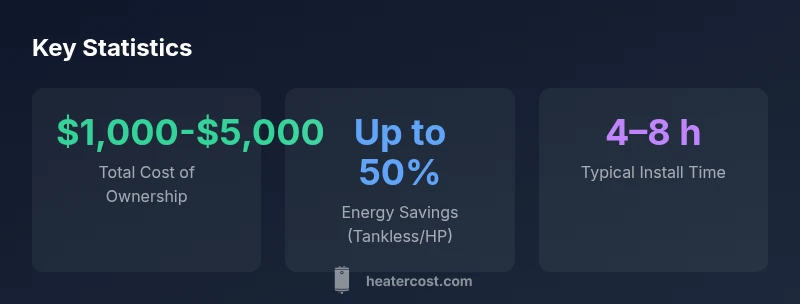
Total cost of ownership for a water heater includes several components: the purchase price, installation labor, venting and piping work, permit fees, and long-term operating costs. Tank-style systems typically cost less upfront, while tankless and heat-pump models can demand higher initial investments. Installation may involve electrical upgrades or gas line work and, for some homes, an expansion tank or new venting. Operating costs depend on energy source and efficiency, with high-efficiency models delivering lower yearly energy use. To put this in perspective, consider a range of installation scenarios rather than a single price, and factor in potential lifetime savings from reduced standby losses and improved energy efficiency.
Efficiency, incentives, and rebates
Energy efficiency ratings—such as the Uniform Energy Factor (UEF) or Energy Factor (EF)—guide comparisons among models. Energy Star-certified units typically offer favorable performance and may qualify for rebates or tax incentives in many jurisdictions. Availability varies by state and utility provider, so homeowners should check local programs and national credits. Upgrading to an efficient unit can lower energy bills over time, offsetting higher upfront costs. Keep in mind climate and usage patterns, as incentives often target specific fuel types or installation scenarios to maximize savings.
Maintenance and longevity
Regular maintenance extends the life of a water heater. For tank-type units, inspect the anode rod every 2–5 years and flush the tank to remove sediment at least once a year. Tankless heaters benefit from occasional descaling in areas with hard water and annual maintenance of gas lines or electrical connections. Heat pump models require adequate ventilation and occasional service to ensure compressor efficiency. Proactive maintenance reduces the risk of leaks and helps maintain efficiency, preserving the system’s value over time.
Installation considerations and safety
Installation requirements vary by model and home. Gas-fired heaters require proper venting and gas line sizing, while electric models depend on panel capacity and dedicated circuits. In many regions, permits are required for new installations or significant upgrades. Space considerations, such as a dedicated closet or mechanical room with adequate clearance and access for service, influence both performance and safety. From a safety perspective, ensure thermal expansion controls, pressure relief valves, and correct water connections are in place to prevent potential hazards.
Comparison of common American water heater types
| Model Type | Typical Size/Capacity | Pros | Cons |
|---|---|---|---|
| Tank-style storage | 40-80 gallons | Reliable hot water; simple installation | Standby energy loss; requires space |
| Tankless (on-demand) | 2-5+ GPM | Energy efficient; compact | Higher upfront cost; may need multiple units |
| Heat pump water heater | 40-80 gallons effective | Very high efficiency; good in moderate climates | Requires space with good airflow; potential performance drop in cold spaces |
Got Questions?
What is the most common type of water heater in the United States?
Tank-style storage heaters are the most common in U.S. homes due to straightforward installation and reliable hot-water supply. While tankless and hybrid options are growing in popularity, the traditional tank remains the baseline for many households.
Tank-style heaters are the most common in the U.S. homes.
Are tankless water heaters worth the extra upfront cost?
Tankless units can save energy and space, especially in smaller homes or with high hot-water demand. Payback depends on usage, fuel costs, and how many points of use you need heated at once; for some households, multiple units may be required.
Tankless can save energy, but consider usage and upfront costs.
How long does a typical American water heater last?
Most tank-style heaters last 8–12 years, while tankless models often exceed 20 years with proper maintenance. Longevity depends on water quality, usage, and regular servicing.
Most heaters last 8 to 12 years; tankless can last longer with care.
What maintenance does a water heater require?
Annual maintenance includes flushing the tank to remove mineral buildup, inspecting and possibly replacing the anode rod, and testing the pressure relief valve. Maintenance helps prevent leaks and maintains efficiency.
Flush yearly, check the anode rod, and test the safety valve.
Do energy incentives apply to water heater upgrades?
Yes, many programs offer tax credits or rebates for high-efficiency water heaters. Availability varies by location and utility. Check federal, state, and local programs for current offers.
There are energy incentives in many places; check local programs.
“Choosing the right American water heater means balancing upfront costs with long-term energy savings and reliability. A properly sized, efficiently operated unit reduces bills and improves comfort.”
The Essentials
- Size based on peak demand to avoid wait times
- Compare tank, tankless, and hybrid options for real needs
- Total cost of ownership matters more than sticker price
- Check local energy incentives and rebates
- Schedule regular maintenance to extend longevity