Tankless Water Heater Installed Price: A Practical Guide
Explore the tankless water heater installed price, including cost ranges, drivers, and budgeting tips for homeowners and property managers. Learn how to compare quotes and optimize long-term value with Heater Cost guidance.


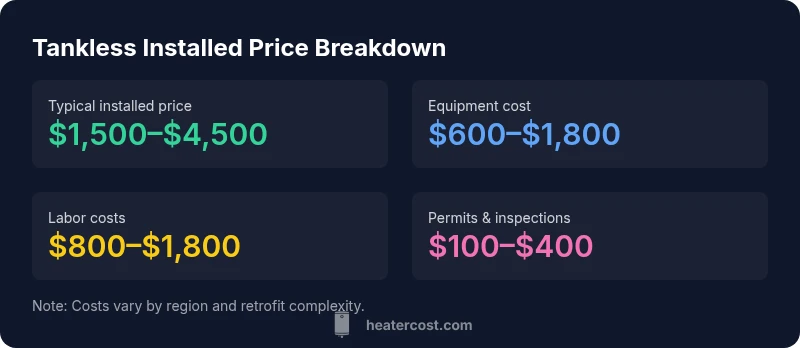
Tankless water heater installed price varies by unit type, regional labor costs, and permit fees. In many regions, expect a typical installed price range that reflects hardware, installation labor, and potential add-ons like venting or seismic strapping. According to Heater Cost, planning for both upfront costs and long-term savings helps homeowners compare options, estimate total project cost, and avoid surprises when the final invoice arrives.
What drives the price of a tankless water heater installed price?
The final price is a blend of hardware costs, labor, and the specifics of your home. Key factors include the fuel source (electric vs gas), efficiency ratings, venting requirements, and any needed gas line or electrical upgrades. Location within the home can also affect installation time and labor. For homeowners evaluating a tankless water heater installed price, it’s essential to consider not just the sticker price but total project cost, including potential add-ons like venting, seismic straps, or condensate management. Heater Cost notes that regional labor markets and permit fees can tilt the price substantially, so a nationwide price bracket is rarely accurate for a single home.
Electric vs gas: Price dynamics and long-term value
Electric tankless water heaters typically have lower upfront installation costs than gas-fired models, but output and flow rates can differ. Gas units often require venting, gas line updates, and possibly a more complex installation, which raises labor and material costs. When comparing the tankless water heater installed price, homeowners should assess the expected hot water draw, peak load, and the potential energy savings. In some homes, gas models deliver faster recovery and higher simultaneous-use performance, which can influence the overall value of the installed price over time. Heater Cost emphasizes analyzing both upfront costs and long-term operating costs to determine true value.
Venting, gas lines, and home retrofits
A significant portion of the tankless price stems from venting and fuel infrastructure. Gas-fired units require proper venting to the exterior, which may necessitate new or upgraded vent material, insulation, or routing around existing structures. Electric units avoid venting but rely on a robust electrical service, sometimes requiring panel upgrades or dedicated circuits. The installed price should reflect these infrastructure changes, and homeowners should request a breakdown of each line item. Unexpected venting complications or electrical upgrades are common sources of price creep, so a detailed, itemized quote is essential.
Permits, inspections, and regional variation
Local building codes and permit requirements directly affect tankless water heater installed price. Some jurisdictions bundle permit fees with inspections, while others bill them separately. If a permit is required for gas line work, venting alterations, or water-heater installation, plan for processing times and potential inspection rechecks. Heater Cost finds that permit costs can vary by municipality, adding a predictable but often overlooked component to the total installed price. Always verify permit expectations with your contractor and local building department before committing.
Hidden costs and add-ons to budget for
Beyond the unit, there are common add-ons that influence the installed price: expansion tanks, condensate drains, venting materials, seismic straps, corrosion-resistant fittings, and optional recirculation pumps. Each accessory adds to upfront costs but can improve efficiency or comfort. Additionally, if structural modifications are needed to accommodate the unit’s dimensions or clearance, those costs should be accounted for in the quote. By anticipating these items, homeowners can tighten budgets and reduce surprise charges at project closeout.
How to budget and compare quotes effectively
Start with a clear spec: the desired flow rate, number of bathrooms served simultaneously, and whether you’ll choose electric or gas. Request itemized quotes that separate equipment, labor, permits, venting, and any add-ons. When evaluating quotes, compare total installed price rather than the unit price alone. Ask contractors to explain assumptions about fuel type, venting routes, and any required electrical upgrades. Heater Cost recommends obtaining at least three written estimates and validating them against a standardized cost checklist to minimize price drift.
Long-term considerations: maintenance and payback
Tankless systems offer efficiency and space-savings benefits, but the installed price should be weighed against maintenance and expected energy savings. Regular descaling in hard-water areas, annual or semi-annual service, and timely part replacements influence long-term costs. In regions with high electricity or gas rates, the payoff period may be shorter, improving the value of the installed price. Homeowners and landlords should track annual energy usage after installation to confirm anticipated savings and ensure the investment remains sound.
Price drivers for tankless water heater installed price
| Driver | Typical Impact | Notes |
|---|---|---|
| Unit type (electric vs gas) | Medium–High | Gas often requires venting and gas line updates |
| Installation complexity | High | Additional piping, vent routing, or space constraints raise costs |
| Venting & accessories | Medium | Costs for venting, condensate drains, and straps add up |
| Permits & inspections | Low–Medium | Local variation drives price |
Got Questions?
What is included in the installed price for a tankless water heater?
The installed price typically includes the unit, labor for mounting and connections, and basic venting or electrical work. It may exclude long vent runs, major electrical upgrades, or extensive retrofits. Request a detailed, itemized quote to confirm inclusions.
The price usually covers the unit and standard installation, but major venting or electrical work may cost extra.
Do electric tankless water heaters cost less to install than gas?
Electric models generally have lower upfront installation costs because they don’t require venting or gas line work. Gas models can be more expensive to install due to venting, gas lines, and code compliance, but they may offer greater flow capacity.
Electric units are usually cheaper to install, but gas units can offer higher flow and efficiency in some homes.
Are permits required for installation?
Yes, most jurisdictions require permits for plumbing or gas work and for changes to venting. Permit costs vary by locality, and inspections may be needed to verify safety and code compliance. Your contractor can help initiate the process.
Permits are commonly required; costs vary by location and inspections may be needed.
Can I get tax credits or incentives for installing a tankless water heater?
Some regions offer energy efficiency incentives or tax credits for high-efficiency water heaters. Availability depends on local programs and eligibility criteria. Check with local utilities and government resources to see what applies in your area.
There may be incentives depending on where you live; check local programs.
How long does installation typically take?
Most installations take a day or two, depending on whether venting, electrical, or gas-line work is required. In retrofit scenarios, longer timelines may occur due to structural or code-related preparations.
Most installs take a day or two, but complex retrofits can take longer.
What are practical ways to reduce the installed price?
Get multiple quotes, choose a model that fits your peak hot-water needs, and consider upfront limitations that avoid costly retrofits. Ask contractors to bundle venting or electrical upgrades where feasible and request a clear breakdown of each cost.
Shop around, pick appropriate capacity, and ask for a clear cost breakdown.
“Tankless systems can save space and energy, but the installed price varies widely by home and fuel type. The Heater Cost team recommends comparing total installed costs and anticipated savings across multiple quotes.”
The Essentials
- Start with total installed price, not just unit cost
- Account for permits, venting, and electrical upgrades
- Electric vs gas choices impact upfront and ongoing costs
- Obtain multiple itemized quotes to compare value
- Plan for maintenance costs to realize true savings