Tankless vs Heat Pump Water Heaters: Which Is Right for Your Home?
Compare tankless and heat pump water heaters to choose the best fit for your home. Learn about energy use, installation, maintenance, and long-term costs with balanced guidance.


Tankless vs heat pump water heater options each bring distinct advantages and trade-offs. According to Heater Cost, the best pick depends on your hot-water needs, climate, and energy costs. Tankless models excel in small spaces and high-demand bursts, while heat pump units shine in energy efficiency and long-term savings in mild climates. Your choice affects upfront costs, maintenance duties, and daily comfort.
How the two technologies work (tankless vs heat pump water heater)
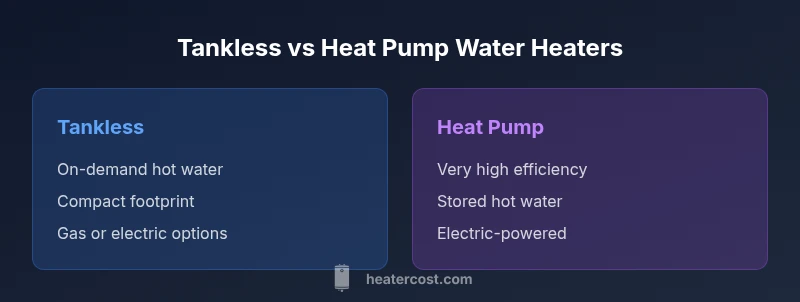
Understanding how each system produces hot water helps homeowners estimate what they’ll pay over time. A tankless water heater delivers hot water on demand by heating water as it passes through a coil or heat exchanger, which means there is no storage tank. This can minimize standby heat loss but often requires precise gas lines or electrical upgrades and can limit simultaneous supply if multiple fixtures demand hot water. By contrast, heat pump water heaters (HPWH) use ambient heat from the surrounding space to preheat water stored in a tank, then finish heating with electric resistance or the heat pump itself. HPWHs are highly efficient because they move energy rather than generate it, but performance can depend on ambient temperature and proper clearance around the unit. In practice, your decision should hinge on how you use hot water, whether you prefer on-demand supply, and what kind of space and utility upgrades you’re prepared to install. According to Heater Cost analysis, most homes benefit from choosing based on usage patterns rather than a one-size-fits-all claim.
Energy efficiency and operating costs (tankless vs heat pump water heater)
Energy efficiency is a central factor in any water-heater decision. Tankless units can offer excellent energy efficiency when hot water demand is intermittent or concentrated at specific fixtures, but efficiency varies with flow rate and the size of the unit. Heat pump water heaters tend to deliver the highest operating efficiency across a broad range of households because they leverage ambient heat and have advanced controls to minimize energy draw. The Heater Cost team notes that while HPWHs often have higher upfront costs, the long-term energy savings can close the gap for many homeowners, especially in climates where electricity costs are stable. When comparing efficiency, consider the Energy Factor (EF) or Uniform Energy Factor (UEF) ratings, as well as auxiliary features like smart controls and demand-responsive operation. For context, authoritative sources such as Energy.gov discuss how to interpret these metrics and how climate can influence performance.
Space, installation, and upfront costs (tankless vs heat pump water heater)
Installation considerations differ markedly between the two technologies. Tankless units are typically compact but may require gas-line upgrades, venting, or dedicated electrical circuits. If you’re replacing an old tank with gas, you may face more complex venting or exhaust requirements. HPWH installations usually involve a larger footprint and clearances around the unit for airflow; electrical service upgrades are common, and some models require a reinforced wall or platform. Upfront costs can range widely depending on locale, energy source, and whether you’re doing a simple swap or a full retrofit. In many homes, the initial investment for a tankless unit is higher than that of a HPWH, but this is highly situational and depends on fuel type, existing infrastructure, and local permitting.
Hot water delivery, recovery times, and flow (tankless vs heat pump water heater)
Tankless systems excel at delivering hot water instantly, but their ability to maintain flow depends on the number of concurrent outlets and the unit’s capacity. If several bathrooms or a large kitchen request hot water at once, a tankless system may struggle unless you install multiple units or a larger model. HPWHs rely on a stored volume of hot water and can deliver a steady supply even if demand is spread across fixtures, though recovery times depend on the heater’s size and the ambient conditions. For homes with high simultaneous demand, sizing is critical for both options, and professional sizing calculations help prevent shortfalls during peak usage.
Climate and environmental considerations (tankless vs heat pump water heater)
Climate plays a big role in HPWH performance. In warmer regions and spaces with moderate temperatures, HPWHs often maximize energy savings, whereas in cold areas, ambient temperature can reduce efficiency and storage preheating gains. Tankless systems, being fueled by gas or electricity, are less climate-dependent in terms of reaction to ambient air, but gas models may incur venting and combustion-related considerations in winter. From an environmental perspective, HPWHs can reduce electricity loads when paired with favorable electricity pricing, while gas-fueled tankless units may deliver fast hot water with lower electricity use but higher gas consumption. The Heater Cost analysis notes that regional energy costs and climate conditions should guide which technology offers the best long-term value.
Maintenance, durability, and lifespan (tankless vs heat pump water heater)
Maintenance needs differ between the two types. Tankless models generally require periodic descaling in hard-water areas and occasional venting inspections for gas units, with some components like sensors needing occasional calibration. HPWHs demand less on-site maintenance but benefit from annual checks of refrigerant lines, electrical connections, and tank integrity. Lifespan expectations also vary: both systems can last 10–20 years with proper care, though actual longevity depends on installation quality, water quality, and maintenance frequency. Heater Cost’s long-term cost perspective emphasizes choosing materials and warranties that align with your local water chemistry and service availability.
Cost of ownership over 10 years (tankless vs heat pump water heater)
Total cost of ownership includes upfront purchase and installation, energy costs, and maintenance. Tankless heaters often carry higher initial costs, particularly for gas models with venting requirements, but may save energy during long periods of low hot-water demand. HPWHs tend to have higher electricity use initially but benefit from superior efficiency, especially in homes with consistent hot-water needs and favorable climate. Over a decade, energy savings can narrow or widen the gap based on electricity rates and gas prices in your area. The Heater Cost analysis highlights that homeowners should run personalized energy models using current local utility rates to gauge which option yields lower lifetime costs.
Real-world scenarios and decision drivers (tankless vs heat pump water heater)
In practice, the best choice emerges from real-world usage patterns. A family that showers simultaneously across multiple bathrooms and uses large amounts of hot water for dishes may lean toward a high-capacity tankless gas model, especially in spaces with limited installation room and where gas is inexpensive. In more temperate climates, households seeking strong energy savings and a longer-term payoff may favor a HPWH, particularly if they already have ample electrical capacity and prefer a lower environmental footprint. Builders and homeowners should perform a site assessment, review utility rates, and model daily hot-water use to pick the right solution.
Common myths and misconceptions (tankless vs heat pump water heater)
A common myth is that tankless models always save energy; in reality, savings depend on flow rates and usage patterns. Another misconception is that HPWHs work equally well anywhere; performance depends on ambient temperature, space, and correct sizing. Some homeowners assume HPWHs will replace a traditional water heater entirely; in many cases, HPWHs are used as primary storage with on-demand boosting or supplemental heating. The goal is to size correctly, place strategically, and understand climate constraints. The Heater Cost team emphasizes that no single solution fits all homes.
How to size and select for your home (tankless vs heat pump water heater)
Sizing a water heater requires analyzing peak demand and the number of fixtures requiring hot water simultaneously. Tankless units should be selected based on gpm (gallons-per-minute) ratings that meet or exceed peak flow. HPWH sizing considers tank capacity, first-hour rating, and whether a second tank or booster is needed for concurrent draws. In both cases, consider accessibility for maintenance, electrical supply or gas service, insurance and permits, and future water-use plans. Use a professional assessment to translate your daily routines into a robust sizing decision.
Installation pitfalls and professional tips (tankless vs heat pump water heater)
Avoid common installation pitfalls by engaging a licensed professional. For tankless systems, ensure gas lines, venting, and water piping are correctly aligned with code requirements. For HPWHs, verify electrical panel capacity and clearances for air flow, as well as drainage and placement that minimizes heat loss. A comprehensive installation plan should include a code-compliant exhaust vent (if gas), anti-scalant treatment for hard water, and a plan for routine maintenance. Heater Cost recommends reviewing local incentives and rebates to offset upfront costs.
Quick-start planning checklist (tankless vs heat pump water heater)
- Determine peak hot-water usage and select a model with adequate capacity. - Check climate and electricity/gas availability in your area. - Estimate total installed costs and potential energy savings over 10 years. - Plan for a future upgrade path or expansion in case of changes to water use. - Schedule professional sizing, permitting, and installation, then arrange follow-up maintenance reminders.
Comparison
| Feature | Tankless water heater | Heat pump water heater |
|---|---|---|
| Upfront cost (installation needed) | $1,000–$3,000 (tankless units; gas/electric depends on lines/venting) | $1,500–$4,000 (HPWH with storage tank; plus electrical upgrades if needed) |
| Energy efficiency | High efficiency; varies by flow and fuel source | Very high efficiency; uses ambient heat and electrical input |
| Space requirements | Compact wall-mount options; may need venting for gas models | Larger footprint; requires space for the compressor and storage tank |
| Hot water delivery | On-demand; excellent for staggered usage; may have short lag if undersized | Stored hot water with steady supply; recovery depends on size and ambient temperature |
| Electrical/gas needs | Gas or electric; gas models need venting and gas lines | Electric 240V supply; may require dedicated circuit and adequate space for heat pump) |
| Best for | Small homes with space constraints and variable demand | Mild climates seeking long-term energy savings and robust hot water supply |
The Good
- No standby heat loss with tankless systems for on-demand comfort
- HPWHs deliver very high ongoing energy efficiency and potential operating savings
- Both options reduce the footprint compared with traditional storage tanks
- Tankless can be gas-powered for rapid hot water during peak demand
Negatives
- Higher upfront costs and installation complexity for many tankless models
- HPWHs can have reduced efficiency in very cold spaces and require more electrical capacity
- Maintenance expectations differ; descaling for hard-water areas is common for tankless
- If not sized properly, either option can provide inadequate hot water during peak usage
Heat pump water heaters are typically the better overall choice in mild climates, while tankless shines for space-constrained homes with high instantaneous hot-water demands.
For most homes in temperate regions, HPWHs offer long-term energy savings and robust reliability. Choose tankless if you need compact space and can handle potentially higher upfront costs or if you have a high, intermittent demand and gas availability. Always size correctly and consider local energy prices to maximize value.
Got Questions?
Which is more energy-efficient, tankless or heat pump water heaters?
Both technologies can be highly efficient. HPWHs typically offer the highest operating efficiency due to ambient heat capture, while tankless units can be very efficient when sized correctly for the load. Your actual savings depend on usage, climate, electricity/gas prices, and installation quality.
Both options are efficient, with heat pump models usually offering the best ongoing energy savings. Proper sizing and climate matter for your actual results.
What is the typical install cost range for these systems?
Install costs vary by type, location, and existing infrastructure. Tankless systems may require venting or gas line upgrades, increasing upfront costs. HPWH installations may need electrical upgrades and more space, which also affects price. Expect a broad range depending on local labor and materials.
Costs vary a lot by location and setup, but expect higher upfront for tankless gas or HPWH with new wiring.
Will either option meet the hot water needs of a family of four?
Both can meet family needs with proper sizing. Tankless systems can provide abundant flow if you install multiple units or select a high-capacity model. HPWHs supply stored hot water reliably, but peak demand should be matched with the tank size and recovery rate.
Yes, both can work for a family of four when correctly sized for peak usage.
Can I switch from a traditional tank to a tankless or HPWH?
Switching is possible but involves planning. Gas tankless installations may require venting adjustments, while HPWHs require electrical upgrades and space planning. A professional sizing and install assessment helps determine feasibility and cost.
Switching is possible with proper planning and professional sizing.
What maintenance do they require and how often?
Tankless heaters require periodic descaling in hard-water areas and vent checks for gas models. HPWHs benefit from annual or semi-annual inspections of refrigerant lines, electrical connections, and tank integrity. Regular maintenance helps sustain efficiency and extend lifespan.
Descaling for tankless and annual checks for HPWH keep them running well.
Do cold climates affect Heat Pump Water Heaters?
Yes. HPWH performance can decline in cold spaces since they rely on ambient heat. Placing the unit in a warmer indoor area or insulating the surrounding space can help maintain efficiency. Tankless units are less sensitive to ambient temperatures but still benefit from proper sizing and venting when applicable.
Cold climates can reduce HPWH efficiency; proper placement matters.
The Essentials
- Assess hot-water usage patterns before choosing.
- Consider climate impact on HPWH performance.
- Factor upfront costs against long-term energy savings.
- Ensure proper sizing to avoid cold-water or short-hot-water events.
- Plan for electrical or gas upgrades if needed.