High Efficiency Water Heater Tankless: A Practical Guide
Explore high efficiency water heater tankless options, sizing, installation, cost considerations, and maintenance tips to maximize energy savings and home comfort.


High efficiency water heater tankless systems offer on-demand hot water with no storage tank, eliminating standby heat loss and typically achieving higher energy efficiency than traditional tanks. Proper sizing and professional installation are crucial. In many homes, the energy savings offset higher upfront costs over time, especially in climates with high hot-water use.
How high efficiency water heater tankless systems work
A high efficiency water heater tankless system heats water on demand as soon as a hot-water faucet is opened, instead of storing hot water in a tank. Because there is no cold-water storage tank to keep heated, standby heat losses are minimized, and energy use can be lower overall. The main performance difference comes from the heat exchanger technology (copper, stainless, or hybrid materials) and the control system that modulates flame or electric resistance according to demand. In practice, a properly sized tankless heater delivers a consistent flow of hot water at a chosen temperature, often more responsive than a storage tank in homes with variable hot water use. However, the label “high efficiency” depends on several factors: the unit’s EF rating (for gas units), installation quality, and how well the device is matched to the home’s hot water draw. For homeowners seeking long-term savings, sizing for actual demand is critical, and professional installation can unlock the full efficiency potential. According to Heater Cost Analysis, 2026, efficiency gains are most pronounced when the unit is matched to real daily usage rather than overspecified.
Sizing and system selection for best efficiency
Maximizing efficiency begins with accurate sizing. Start by assessing your daily hot-water usage, number of bathrooms, and typical simultaneous-demand scenarios (showering, laundry, dishwashing). Tankless units are rated by flow in gallons per minute (GPM) at a specified temperature rise; choose a model that meets or slightly exceeds your required GPM at your climate’s typical water temperature. Cold climates reduce the effective GPM, so a larger unit or a staged set of units may be necessary. Avoid oversized units, which waste upfront money and can complicate control. A professional installer can perform a home assessment, calculate realistic demand, and recommend a unit with an appropriate EF for your fuel type. According to Heater Cost Analysis, 2026, proper sizing delivers the bulk of efficiency gains and avoids common performance pitfalls.
Fuel type, venting, and efficiency differences
Gas and electric tankless heaters both offer high efficiency potential, but the path to that efficiency differs. Gas models rely on venting and combustion air; improper venting or undersized venting reduces efficiency and can create safety issues. Electric tankless units avoid venting entirely, but electricity costs and available power supply influence operating expenses. Efficiency ratings (EF for gas, COP/EF for electric) reflect heat losses in the appliance, not in the home. In practice, a gas unit with proper venting and correct sizing can save more energy in colder climates, while electric models excel where electricity is inexpensive and supply is ample. Always match fuel type, venting, and electrical capacity to the installation site.
Costs, payback, and energy savings
The economics of high efficiency water heater tankless systems depend on upfront costs, installation complexity, and ongoing energy prices. Upfront costs are typically higher than traditional storage tanks, due to advanced heat exchangers, controls, and, for gas units, venting requirements. Payback periods vary widely by household hot-water use, climate, and local utility rates. In climates with high hot-water demand and expensive energy, homeowners may see meaningful savings over the life of the unit. The exact payback is case-specific, so obtain a qualified quote that itemizes equipment, installation, and any required upgrades to gas lines or venting. According to Heater Cost Analysis, 2026, the long-term efficiency gains depend on proper sizing and climate.
Installation considerations and professional help
Installation quality is a major determinant of whether a high efficiency water heater tankless will perform as advertised. The installation should include proper clearance, venting (for gas), condensate management, clearance from walls, and correct gas line or electrical supply sizing. Many homes require upgrades to electrical service or gas line sizing, which adds to upfront costs. A licensed contractor will verify venting integrity, pressure, and temperature settings, and will calibrate the unit for your incoming water temperature. Permits may be required in your area. Working with the right installer helps ensure performance and safety over the unit’s life. According to Heater Cost Analysis, 2026, professional sizing is essential to realize full efficiency benefits.
Maintenance and longevity
To keep high efficiency steady, schedule regular maintenance. Annual descaling or flushing (for mineral-rich water) helps preserve heat transfer efficiency and prevent clogging. Gas units require vent inspection and safe combustion checks; electric units benefit from electrical and control-system diagnostics. In hard water areas, consider a dedicated water conditioner or a descaling strategy to reduce mineral buildup on the heat exchanger. Routine maintenance extends life, maintains efficiency, and protects your investment. According to Heater Cost Analysis, 2026, regular maintenance is a key driver of long-term performance.
Real-world performance and case studies
Real-world performance of high efficiency water heater tankless systems varies with climate, usage, and installation quality. In homes with steady, moderate hot-water demand, tankless units often outperform storage tanks in energy efficiency and satisfaction, because standby losses disappear and heat is delivered on demand. In large households or in freezing climates, careful sizing or multiple units may be necessary to meet demand. A well-sized system can provide consistent comfort with fewer energy losses, while undersized units can struggle during peak demand, leading to temperature fluctuations. When comparing options, consider both EF and your local energy costs, as those numbers drive the economics more than sticker price alone. The Heater Cost Team notes that performance gaps are most common where sizing was based on peak loads rather than typical daily usage.
Quick-start buyer’s checklist
- Determine your daily hot-water usage and required GPM at your climate’s temperature rise.
- Compare EF (gas) or COP/EF (electric) ratings for multiple models in your fuel type.
- Assess installation costs, venting needs, electrical upgrades, and permit requirements.
- Get a professional sizing assessment and itemized quotes.
- Plan for maintenance: annual flush, vent inspection, and system calibration. The Heater Cost team recommends starting with a formal sizing assessment and a comparative installation quote to maximize long-term efficiency and comfort.
Feature comparison: tankless vs traditional tanked water heaters
| Feature | Tankless Range | Tanked Range | Notes |
|---|---|---|---|
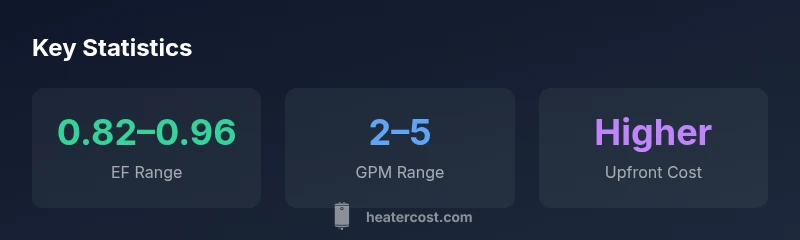
| Energy Efficiency (EF) | 0.82–0.96 | 0.75–0.85 | Tankless generally higher EF |
| Flow Rate (GPM) | 2–5 | 2–4 | Depends on unit size and climate |
| Upfront Cost | Higher | Lower | Installation complexity adds cost for tankless |
| Maintenance | Annual service recommended | Biannual checks typical | Maintenance frequency varies by model |
Got Questions?
What defines a high efficiency tankless water heater?
High efficiency is measured by the energy factor (EF) and the unit’s ability to meet demand without standby losses. Modern tankless models often show higher EF ratings than storage tanks, especially when sized correctly.
High efficiency tankless units are defined by their EF and ability to deliver hot water on demand without standby losses.
Is tankless right for small households?
For low hot-water use, tankless systems can still save energy, but the payback may be longer due to higher upfront cost. Sizing and climate matter.
For small households, tankless can work if you have reasonable hot water demand.
What maintenance keeps efficiency high?
Annual descaling or flushing, checking venting for gas units, and annual professional inspection help sustain efficiency.
Keep a yearly maintenance schedule to sustain efficiency.
Gas vs electric tankless – which is more efficient?
Both can be highly efficient; gas depends on fuel costs and venting, while electric depends on electricity prices and available supply. Check EF and installation requirements.
Both types can be efficient; compare EF and energy costs in your area.
What is a typical payback period?
Payback varies widely based on hot-water usage, energy costs, and installation. Expect several years in many homes.
Payback depends on usage and energy costs, often several years.
Can a tankless system handle a large home?
Yes, with appropriately sized units or multiple units, but ensure proper plumbing and zoning to meet peak demand.
Yes, but size correctly and plan for capacity across the house.
“Tankless units deliver hot water on demand with minimal standby losses when properly sized. Proper installation and correct sizing are essential to achieving high efficiency in real-world homes.”
The Essentials
- Size to demand to maximize efficiency
- Tankless saves standby losses but upfront costs are higher
- Match GPM to household demand
- Professional sizing and installation are essential
- Climate and incoming water temperature affect efficiency