Rheem RTEX-18 Tankless Electric Guide for Homeowners
Explore the Rheem RTEX-18 tankless electric heater: performance, installation costs, maintenance tips, and how it compares to traditional tanked systems for homes.


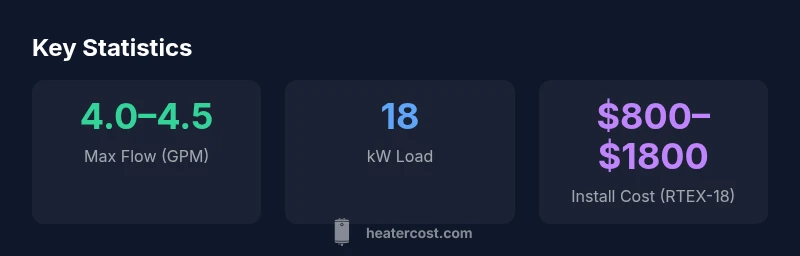
The Rheem RTEX-18 is a compact electric tankless water heater that typically delivers about 4.0–4.5 GPM, ideal for small homes, apartments, or point‑of‑use setups. Installation costs generally range from $800 to $1,800, depending on required electrical upgrades. When comparing tankless vs traditional tanked systems, RTEX-18 offers space savings, on‑demand hot water, and potentially lower standby losses.
Overview and Key Characteristics
The rheem rtex 18 is a compact electric tankless water heater designed for small homes, apartments, or point-of-use applications. It delivers hot water on demand with a compact footprint that fits in a utility closet or along a wall. The unit is part of Rheem's RTEX family, known for modular heating elements and straightforward installation. In our analysis of the rheem rtex 18, homeowners recognize its compact size and scalable design as a key strength for tight spaces while maintaining reliable performance when the incoming water temperature and flow meet expected ranges. The compact design reduces the space taken by a traditional storage tank, while still providing on‑demand hot water. Users should plan for electrical capacity and consider how many fixtures will draw hot water simultaneously.
For homeowners, the model also emphasizes ease of installation and the potential for modular expansion if demand grows. The Rheem RTEX line typically supports horizontal and vertical mounting, but proper clearances around service panels remain important for safe operation and future maintenance.
Performance and Sizing for Small Homes
For the rheem rtex 18, peak flow is typically in the 4.0–4.5 GPM range, depending on incoming water temperature. In colder climates, the effective flow decreases as temperature rise requirements increase, which may necessitate staggered usage or multiple units. This section explains how to estimate demand: list common fixtures (shower, sink, dishwasher) and estimate simultaneous usage. If your home regularly uses multiple hot-water outlets at once, you may need a higher-capacity unit or a multi‑unit configuration. When sizing, consider the first-hour rating and potential blending with a cold-water line. This is particularly important for the rheem rtex 18, whose compact size might tempt under‑sizing—but matching capacity to daily demand is critical for comfort and energy efficiency. We also discuss installation orientation: horizontal versus vertical mounting can affect clearance around service panels and venting requirements, even for electric models. Heater Cost's guidance emphasizes that a proper assessment reduces cold-water sandwiches and ensures consistent hot water to fixtures.
Understanding your climate, family size, and typical usage helps ensure the rheem rtex 18 meets daily needs without overpaying for capacity.
Installation Costs and Electrical Requirements
Installing a rheem rtex 18 involves more than the unit itself: electrical readiness and panel capacity matter just as much as the heater. Typical installation costs range from $800 to $1,800, depending on how far the wiring must run, whether a dedicated 240V circuit is added, and whether electrical upgrades are required to support the unit’s power draw. A dedicated circuit and proper grounding are essential to prevent nuisance tripping and ensure safe operation. The electrical service panel may need a upgrade, and some homes require conduit runs or new wiring from the main panel to the installation location. The Rheem RTEX family is designed to simplify installation, but an experienced electrician should verify circuit capacity and wire gauge before finalizing the project.
Planning for potential electrical upgrades early in the process can prevent delays and surprise costs at the install stage.
Operating Costs, Efficiency, and Maintenance
Operating costs for the rheem rtex 18 depend on local electricity rates and your hot-water usage profile. The unit’s energy factor generally falls in a mid‑range band for electric tankless heaters, typically around 0.82–0.88, which translates to efficient, on‑demand heating with limited standby losses. Because hot water is produced only when needed, homeowners can see savings over time compared with traditional storage tanks, especially in households with intermittent hot-water demand. Routine maintenance is relatively light: periodic descaling in regions with hard water can help preserve element efficiency, and annual checks of electrical connections and venting (where applicable) keep performance steady. For owners of the rheem rtex 18, annual professional inspection remains a prudent practice to catch issues before they escalate.
Tankless vs Tanked: Pros, Cons, and Real-World Scenarios
Tankless electric models like the rheem rtex 18 offer several advantages: space efficiency, on‑demand hot water, and reduced standby energy. However, they also present potential drawbacks: higher initial installation complexity, the need for electrical upgrades, and possible reduced flow at very cold inlet temperatures if only a single unit is used. In contrast, traditional tank heaters deliver larger hot-water buffers and straightforward upgrades for very high simultaneous demand but incur higher standby energy costs and a larger footprint. For small homes and apartments with modest hot-water needs, tankless models can provide a compelling mix of efficiency and convenience. In larger homes, a multi‑unit configuration or a different heater strategy may be more cost‑effective over the long term, depending on installed capacity, energy costs, and climate.
When evaluating options, consider local energy prices, climate, and your household’s peak demand. For many readers, the rheem rtex 18 represents a practical entry point into tankless heating, especially if space is at a premium and daily demand stays within its supported range.
Practical Tips for Choosing and Maintaining a Rheem RTEX-18
- Confirm your electrical service can support an 18 kW load and a dedicated 240V circuit.
- Check your incoming water temperature and calculate expected GPM to ensure a single unit suffices, or plan multi‑unit setups.
- Budget for possible electrical panel upgrades and wiring runs.
- Arrange for professional installation and an annual inspection to keep efficiency high.
- Use water-softening or descaling strategies if you have hard water to extend element life.
- Schedule routine maintenance checks to ensure connections remain tight and corrosion is avoided.
- Compare against higher‑flow tankless models if your household demand grows over time.
- Review warranty terms and service support in your region to minimize downtime during repairs.
Following these steps helps maximize the benefits of the rheem rtex 18 and ensures reliable hot water for daily routines.
Comparison of Rheem RTEX tankless electric models
| Model | Type | Max Flow (GPM) | Energy Source | Typical Installation Cost | Notes |
|---|---|---|---|---|---|
| Rheem RTEX-18 | Tankless electric | 4.0–4.5 | electric | 800–1800 | Compact, ideal for small homes |
| Rheem RTEX-24 | Tankless electric | 5.0–6.0 | electric | 1000–2300 | Higher flow for larger homes |
Got Questions?
Is the Rheem RTEX-18 suitable for whole-house use?
For many single-family homes with modest hot-water demand, the RTEX-18 can cover essential needs. In larger homes or households with simultaneous high-demand fixtures, you may need additional units or a different configuration. Always perform a load calculation to confirm suitability.
For small homes, yes. For larger homes, you might need more than one unit or a different setup. A proper load calculation is key.
What electrical upgrades are required for installation?
A dedicated 240V circuit capable of handling the unit’s power draw is typically required, and in many cases an upgrade to the home’s electrical panel is advisable. An electrician should verify wiring size, circuit capacity, and safety clearances before install.
You’ll likely need a dedicated 240V circuit and possibly panel upgrades. Have a licensed electrician assess your electrical system.
How does a tankless unit compare to a storage tank heater?
Tankless units provide on-demand hot water with less standby energy and space savings, but they may have higher upfront costs and require electrical or gas upgrades. Tanks offer buffering for peak demand but have higher ongoing standby costs and larger footprints.
Tankless saves space and standby energy, but may need upgrades. Tanks are simpler but take more space and can waste energy.
What maintenance is required for the RTEX-18?
Regular descaling in hard-water areas helps maintain efficiency. Schedule annual professional checks for electrical connections and unit performance. Follow manufacturer guidance on flushing and cleaning around heat elements.
Descale in hard water areas and have yearly professional checks.
How long does installation typically take?
Installation duration varies with electrical readiness and wiring routes, but most residential installs are completed within a day or two, assuming no major upgrades are needed. Unexpected panel work or permits can extend timelines.
Most installs take a day or two, depending on electrical work needed.
“The RTEX-18 provides reliable on-demand hot water in a compact footprint, but proper sizing and electrical readiness are crucial for optimal performance.”
The Essentials
- Choose RTEX-18 for small spaces and modest hot-water needs
- Ensure a dedicated electrical circuit and panel capacity
- Expect installation costs to vary with wiring and upgrades
- Tankless reduces footprint and standby energy versus tanks
- Maintain scales and conduct annual inspections for longevity