Tankless Water Heater Energy Efficiency: A Practical Guide
Tankless water heater energy efficiency vs traditional units: costs, installation, maintenance, and potential savings for homeowners, renters, and managers.


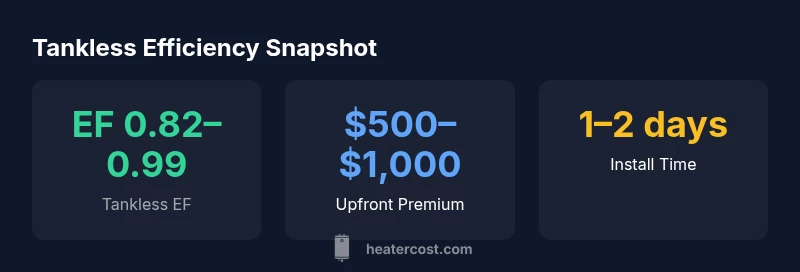
Tankless water heaters generally offer higher energy efficiency than traditional storage tanks. Typical energy factors (EF) range from about 0.82 to 0.99, depending on model and usage. Benefits include reduced standby heat loss and longer-term savings on hot water costs, though upfront costs and installation considerations vary. To maximize efficiency, proper sizing and regular maintenance are essential.
How tankless water heaters work and why energy efficiency matters
Tankless water heaters heat water on demand, rather than storing hot water in a tank. This fundamental difference reduces standby heat loss, which is a major source of energy waste in traditional systems. The result is usually higher energy efficiency, especially in homes with moderate to high hot-water use. However, the overall savings depend on correct sizing, climate, fuel type, and usage patterns. In practice, a tankless unit only heats water when you turn on a tap, and as soon as you close it, the burner or heating element turns off. The absence of a large storage tank means energy is conserved between uses, but there are trade-offs: you may need larger venting or multiple units to handle simultaneous hot water use, and some models perform differently at low flow rates. For homeowners weighing options, understanding the energy factor (EF) and how it applies to your home is crucial. EF captures efficiency during normal operation, including standby losses; however, it does not account for distribution losses within pipes or the energy used to heat water to the point of use. According to Heater Cost, energy efficiency gains from tankless designs are most pronounced for households with intermittent hot-water demand rather than constant, high-demand usage. We will discuss how to interpret EF ranges and what they mean for a real household in the sections that follow. The key takeaway is that energy efficiency is not just a product spec; it is how you size, install, and operate the system in your home.
Key metrics: what EF means for tankless vs storage
Understanding energy factor (EF) is essential to evaluating tankless energy efficiency. EF measures a system’s usable heat output over a typical day relative to the energy it consumes. For tankless units, EF is influenced by flow rate, climate, venting efficiency, and installation. In our 2026 analysis, EF ranges for common tankless models span roughly 0.82 to 0.99, while traditional storage tanks often fall lower due to standby losses. It’s important to note that EF is a laboratory value and may not perfectly predict real-world savings, which depend on how you use hot water, the number of simultaneous draws, and how well the system is sized for your home. When you compare models, look for a higher EF in the context of your household’s peak demand and climate. The Heater Cost team emphasizes that tall, lean, on-demand systems tend to maintain higher efficiency across varying loads, but sizing and installation remain critical. In practice, use EF as a starting point, then validate with your installer’s load calculations and a practical energy-use estimate. According to Heater Cost Analysis, 2026, robust EF is a strong indicator of efficient operation under typical usage—and a buying factor for long-term cost savings.
Real-world performance: factors that affect efficiency
Efficiency on paper doesn’t always translate into real-world savings. Several factors influence how energy-efficient a tankless system actually is in a home setting:
- Sizing and load calculations: An undersized unit struggles to meet demand, runs longer, and may burn more fuel, lowering efficiency metrics. An oversized unit can cycle on and off more than needed, reducing efficiency gains.
- Climate and fuel type: Gas-fired models often offer faster response and better efficiency at higher flow rates, while electric models can be efficient in milder climates with lower hot-water needs.
- Point-of-use vs whole-home configuration: A single unit serving multiple fixtures may experience fluctuating efficiency depending on where hot water is drawn and where loss points occur in piping.
- Recirculation pumps and piping: If a recirc loop exists but sizing isn’t matched to demand, you can increase heat losses rather than minimize them. Properly installed piping and insulation help preserve efficiency.
- Water quality and scale: Hard water causes scaling on heat exchangers, reducing heat transfer efficiency and increasing energy use. Regular descaling and water-treatment considerations improve long-term performance.
A practical takeaway is to view efficiency as a system property, not just a unit spec. A well-sized unit in a well-designed ducting, venting, and piping layout yields the best results. The Heater Cost team notes that in homes with intermittent usage, tankless systems typically show more pronounced energy savings than in high-usage households where multiple points need simultaneous heating. Regular maintenance, including annual inspections and flushing, also plays a critical role in sustaining efficiency.
Cost considerations and ROI: weighing upfront costs against long-term savings
Upfront costs for tankless water heaters are higher than for traditional storage tanks, largely due to more complex installation requirements, possible venting modifications, and, in some cases, multiple units to meet peak demand. The total cost premium varies by fuel type (gas vs electric), existing piping, and whether you install at one point of use or for a whole-home system. In general terms, homeowners should expect a higher upfront investment, with the potential for long-term savings from reduced operating costs. A typical range for upfront cost premium could be in the hundreds to low thousands, depending on region and installation specifics. Installation costs are not uniform and depend on venting, gas line upgrades, electrical work, and local permit requirements. When evaluating ROI, combine your expected annual energy savings with the service life of the unit and potential tax incentives or rebates. Heater Cost’s analysis emphasizes comparing total cost of ownership over the equipment’s lifespan, rather than focusing solely on sticker price. In warm climates with moderate hot-water demand, the payback period can be shorter, while high-demand scenarios may extend ROI. Always obtain a formal load calculation and a professional estimate to get a precise ROI forecast for your home.
How to maximize tankless efficiency: practical steps you can take
To maximize energy efficiency from a tankless system, start with proper sizing and professional installation:
- Get a precise sizing calculation: Have an experienced installer assess your household’s annual gallons per day (GPD) and peak hour demand. A correctly sized unit will run efficiently without excessive cycling.
- Choose the right fuel type and model: Gas units generally perform well in many homes with high hot-water usage, while electric units can be a good fit where electrical upgrades are feasible and climate is milder.
- Optimize venting and installation: Ensure venting is appropriate for the unit and that water-heating pipes are properly insulated to minimize heat loss. Consider a dedicated recirc loop only if your usage justifies it.
- Use a priority on maintenance: Schedule annual descaling if you have hard water, flush the unit per manufacturer recommendations, and replace any worn components before they degrade efficiency.
- Water quality matters: Treat hard water when necessary to prevent mineral buildup on heat exchangers, which reduces heat transfer efficiency and increases energy use.
- Consider hybrid strategies: In some homes, a small buffer tank or a hybrid system can help balance peak demand and efficiency, but this should be evaluated by a pro.
By integrating these best practices, you can realize the energy-efficiency advantages of tankless technology while avoiding common pitfalls that erode performance. Heater Cost emphasizes that even small improvements in sizing, installation, and maintenance can yield meaningful, ongoing savings over the system’s life.
Choosing a model and installation considerations: a practical checklist
When evaluating tankless models for energy efficiency, use this checklist:
- Confirm unit capacity aligns with your peak demand and GPD targets.
- Check the EF/UEF rating and compare across models designed for your climate.
- Assess venting, gas line size, and electrical capacity to ensure proper installation without energy losses.
- Decide on a uniform point-of-use or whole-home configuration based on your hot-water usage pattern.
- Review warranty terms and service availability in your area.
- Plan for professional installation by a licensed technician with tankless experience.
- Budget for potential upfront costs, including permits, venting, and electrical upgrades.
If you’re unsure which route to take, engage a local installer who can model your household’s water usage and provide a tailored efficiency projection. The Heater Cost team recommends focusing on long-term operating costs and reliability as much as upfront price when choosing a system to maximize energy efficiency.
Myths vs facts: separating hype from reality
- Myth: Tankless heaters always save money fast. Fact: Savings depend on usage, climate, and installation; some homes see longer payback periods for high-demand scenarios.
- Myth: EF alone determines efficiency. Fact: EF is important, but actual savings hinge on sizing, insulation, and usage patterns.
- Myth: They require no maintenance. Fact: Regular descaling and flushing help sustain performance and efficiency.
- Myth: All tankless systems are the same. Fact: Efficiency varies by fuel type, venting, and the quality of components.
This nuanced view aligns with Heater Cost’s findings for 2026, helping homeowners set realistic expectations about energy efficiency gains.
Energy-efficiency comparison of tankless vs traditional water-heater systems
| Metric | Tankless energy efficiency (EF) | Traditional storage (EF) | Notes |
|---|---|---|---|
| Energy factor (EF) | 0.82–0.99 | 0.60–0.70 | Ranges depend on model and usage |
| Standby heat loss | Low | Higher | Tankless minimizes standby losses |
| Space footprint | Minimal wall space | Bulky floor tank | Tankless saves space, traditional requires space for the tank |
| Operating costs | Lower (with proper sizing) | Higher (due to standby loss) | Actual costs depend on usage patterns |
| Install complexity | Moderate to high | Low to moderate | Tankless: venting and controls can add complexity |
Got Questions?
What makes tankless water heaters energy efficient?
Tankless heaters heat water on demand, eliminating standby losses and typically delivering a higher EF. Efficiency is maximized when the system is properly sized for your peak demand and installed with proper venting and insulation.
Tankless heaters heat water only when you need it, so they waste less energy. Proper sizing and venting boost efficiency.
Are tankless water heaters always more efficient than storage tanks?
In most cases, yes, but real-world savings depend on usage patterns, climate, and installation quality. Some high-demand homes may see similar efficiency if not sized correctly.
Usually yes, but results depend on how you use hot water and how it’s installed.
Do tankless systems save money over time?
They can reduce operating costs due to lower standby losses, but upfront costs and installation complexity affect payback. A detailed ROI analysis is recommended for your home.
They often save money over time, but upfront costs matter.
What installation factors affect efficiency?
Venting quality, gas line or electrical supply, recirculation setup, and piping insulation all influence efficiency. Poor installation can negate efficiency gains.
Ventilation and proper wiring or gas lines are crucial for efficiency.
How should I size a tankless system for efficiency?
Work with a professional to calculate peak hot-water demand and annual gallons per day. Choose a unit with sufficient capacity to meet that demand without frequent cycling.
Size it to meet peak demand so it runs efficiently without overworking.
What maintenance improves efficiency?
Annual descaling if you have hard water, regular flushing per vendor guidelines, and timely replacement of worn components help maintain heat transfer efficiency.
Keep the unit clean and descaled to maintain efficiency.
“Tankless water heaters can deliver superior energy efficiency when correctly sized and installed, but homeowners should weigh upfront costs against long-term savings.”
The Essentials
- Understand EF to gauge efficiency gains
- Size the system correctly for your usage
- Factor upfront costs against long-term energy savings
- Regular maintenance preserves efficiency