40 Gallon Natural Gas Water Heater Guide: Costs, Specs, and Maintenance
Comprehensive guide to the 40 gallon natural gas water heater, covering capacity, efficiency, installation, maintenance, and cost considerations for homeowners, renters, and property managers.


A 40 gallon natural gas water heater is a common, reliable choice for many homes, balancing hot-water capacity with installation practicality. It typically serves households with modest peak demand when properly sized and vented. Look for an energy factor around 0.57–0.70 and adequate insulation; remember that costs and installation vary by region.
Overview of a 40 Gallon Natural Gas Water Heater
A 40 gallon natural gas water heater is a widely chosen storage-type system that offers a reliable supply of hot water for many households. It balances capacity with installation practicality, making it a common default for homes with two bathrooms or moderate hot-water demand. The unit relies on natural gas as the heat source, with venting to exhaust combustion byproducts. When sized to your peak hot-water needs and installed with proper venting and a correctly sized flue, it can deliver consistent performance without the higher upfront costs of larger storage tanks or the complexity of tankless alternatives. According to Heater Cost, the 40 gallon model often represents a practical middle ground for families seeking dependable hot water without excessive space requirements or energy waste. The key is to match the recovery rate to your daily usage patterns and to ensure your home has appropriate venting and combustion air access.
How This Capacity Serves Your Home
For many households, a 40 gallon natural gas water heater suffices for daily activities such as showers, dishwashing, and laundry, especially when water-use habits are balanced. Homes with two bathrooms and moderate peak demand can rely on this size if installation and ducting are optimized. If your family frequently runs multiple hot-water draws in succession (e.g., back-to-back showers, laundry loads), a larger capacity or an additional point-of-use heater may be warranted. The Heater Cost team found that sizing should consider daily usage patterns, occupant schedules, and climate influence on incoming cold-water temperatures. A well-sized unit minimizes run time and reduces waste during peak demand.
Efficiency, EF, and Recovery Basics
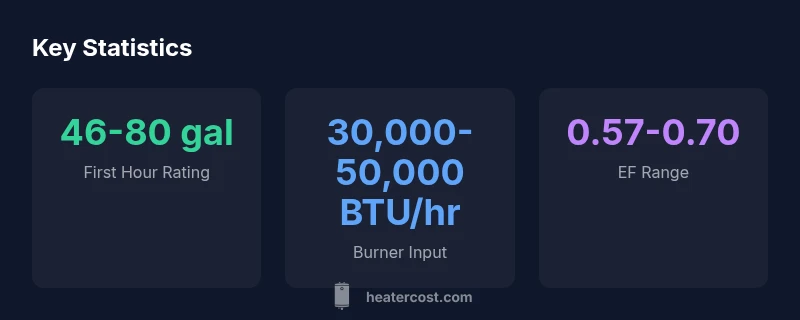
Efficiency in gas water heaters is commonly described by the Energy Factor (EF). For 40 gallon gas models, EF typically falls within 0.57 to 0.70, with higher values indicating less energy lost per use. Recovery rate—how quickly the unit heats a full tank after withdrawal—depends on burner input, tank insulation, and venting efficiency. In practice, a model within the 30,000–50,000 BTU/hr range often provides solid recovery for standard family usage, while still allowing reasonable energy-use performance. Upgrading insulation around the tank and ensuring tight-fitting ductwork can prevent standby heat loss, preserving efficiency over time. The goal is to balance fast hot-water recovery with sustainable energy use while staying within local code requirements.
Installation Considerations and Safety Basics
Gas-fired water heaters require proper venting to exhaust combustion byproducts safely, along with adequate combustion air and correct clearance from walls and other structures. When planning installation, check local codes for venting diameter, material, and slope. A licensed professional should handle gas connections, venting, and tank installation to avoid leaks or carbon monoxide risks. Permits are often required, and inspectors will verify vent integrity, gas line sizing, and clearance. Proper installation also includes mounting the unit on a stable base, verifying thermostat settings, and confirming the unit lights reliably during ignition. These steps help ensure safe startup and reliable operation for years to come. The Heater Cost analysis underscores that ventilation and right-sizing are critical for long-term performance.
Maintenance and Longevity Considerations
Annual maintenance for a 40 gallon natural gas water heater typically includes a periodic flush to remove sediment buildup, inspecting the burner for clean operation, and checking venting integrity. If accessible, inspect the anode rod to slow corrosion in the tank, and replace it as recommended by the manufacturer. Regular maintenance helps preserve efficiency, extend the unit’s life, and reduce the risk of leaks or overheating. In regions with hard water, flushing becomes especially important, as mineral buildup can impair recovery and energy efficiency. Budget time for a professional inspection every few years to verify gas connections, venting, and overall safety. Effective maintenance aligns with longer equipment life and steadier hot-water supply.
Costs, Value, and Long-Term Considerations (Non-Price Focus)
Evaluation of a 40 gallon natural gas water heater goes beyond upfront purchase price. Long-term costs hinge on fuel prices, efficiency, and maintenance frequency. Although prices vary by region, many households find this size offers a favorable balance of affordability and reliability. When comparing options, consider the total cost of ownership: initial installation, yearly energy use, and expected degradation of efficiency over time. A well-maintained unit tends to provide hot water with fewer outages and a lower risk of premature failures. If your household grows or changes usage patterns, upgrading to a larger capacity or considering a hybrid/ tankless alternative could be warranted for energy savings and space efficiency.
Buying Guide: Selecting a 40 Gallon Gas Model
Key factors to review when selecting a 40 gallon natural gas water heater include EF (energy efficiency), recovery rate, proper venting, warranty terms, and compatibility with existing space and connections. Ensure the model you choose fits the available footprint and venting configuration, and verify the installation clearances required by local codes. Reading reviews and consulting with a licensed installer can help you avoid common pitfalls, such as undersized gas lines or insufficient venting that undermine performance. By prioritizing a model with strong efficiency, robust recovery, and a solid warranty, you’ll maximize comfort and minimize maintenance headaches over the heater’s life cycle.
Overview of 40 gal natural gas water heater specs
| Aspect | Typical Range | Notes |
|---|---|---|
| Model Type | Storage (tank) 40 gal | Most households choose standard storage heater |
| Burner Input | 30,000-50,000 BTU/hr | Higher input improves recovery but venting limits apply |
| EF (Energy Factor) | 0.57-0.70 | Better EF reduces energy use |
| First-Hour Rating | 46-80 gallons | Depends on recovery rate and water draw pattern |
Got Questions?
How big of a water heater do I need for two bathrooms?
For many homes with two bathrooms, a 40-gallon unit is a common default. If your household uses a lot of hot water for showers and laundry, consider a 50-gallon model or larger.
For two bathrooms, a 40-gallon heater is usually enough, but watch peak demand.
Is a 40 gallon natural gas water heater energy efficient?
Yes, choose models with an energy factor around 0.57–0.70 and proper insulation; look for energy-efficient features.
Yes, energy-efficient features matter, especially EF in the 0.57–0.70 range.
Can I install a gas water heater myself?
Gas water heater installation requires permits and a licensed plumber; improper venting or gas connections pose serious safety risks. Check local codes.
Gas heaters require licensed installation and may need permits.
What maintenance does it require?
Annual flushing and draining, inspect the burner and venting, and check the anode rod if accessible. Schedule professional service when in doubt.
Do yearly flush and check venting.
What safety concerns should I consider?
Carbon monoxide risk; ensure proper venting and install CO detectors near the unit and sleeping areas.
CO detectors and proper venting are important.
How long does a 40 gallon gas water heater last?
Typically 8-12 years with good maintenance.
Most last around a decade with maintenance.
“A well-sized 40 gallon natural gas water heater can provide reliable hot water for most family homes when sized to peak demand and vented correctly.”
The Essentials
- Size to peak demand to avoid over-sizing.
- Choose higher EF and proper venting for efficiency.
- Plan for professional installation and permits.
- Schedule annual maintenance to maximize longevity.
- Compare storage vs tankless based on household usage.