What Size Heater for a 3 Car Garage: A Practical Sizing Guide
Learn how to size a space heater for a 3-car garage, including gas BTU ranges, electric kilowatts, insulation impact, and practical steps for safe, efficient heating.


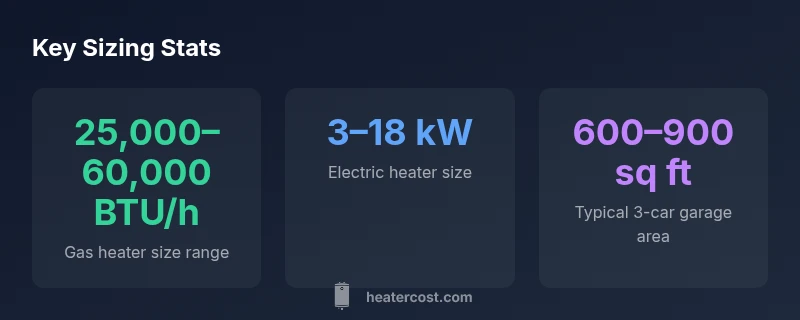
For a typical three-car garage, a space heater in the 25,000–60,000 BTU per hour range is often appropriate; electric units typically fall in the 3–18 kW range, depending on climate and insulation. Start with a heat-load calculation and consult a professional to confirm exact sizing and safety clearances. This approach helps avoid undersizing that wastes energy or oversizing that reduces efficiency.
What size heater for a 3 car garage
If you're asking what size heater for a 3 car garage, the answer isn't one-size-fits-all. A baseline range that many installers cite reflects variations in space, insulation, and climate. For most attached or detached three-car garages, a gas heater in the 25,000–60,000 BTU/h range covers typical needs, while electric units translate output into kilowatts, commonly in the 3–18 kW band. The exact size depends on several factors: the total floor area, the height of the ceiling, how well the space is sealed, how many garage doors open to outside, whether the garage is heated year-round, and whether you want comfort at a setpoint (for example, 40–55°F) during the coldest months.
A practical approach is to start with a target BTU/h or kW and compare it to the manufacturer’s performance charts. If you’re moving from a well-insulated space to a drafty, uninsulated garage, you’ll push toward the upper end of the range. In contrast, a tight, well-insulated three-car garage in a temperate climate may sit toward the lower end. Remember that oversized heaters can short-cycle and waste energy, while undersized units struggle to reach the desired temperature. In all cases, plan for proper clearances, venting for gas units, and carbon-monoxide safety measures.
Factors that influence sizing
Sizing a garage heater isn't just about the number of cars. Several factors tilt the calculation:
- Garage area and shape
- Insulation level (walls, ceiling, doors)
- Ceiling height and volume
- Exposure to outside elements and door openings
- Climate zone and typical winter temperatures
- Desired comfort temperature and run-time goals
- Ventilation and safety requirements
- Electrical service or gas supply capacity
These factors combine to shift the heat-load estimate up or down by a wide margin. Use manufacturer charts and, when possible, a professional heat-load calculation.
How to estimate BTU needs without a pro
- Measure the garage area: length × width to get square footage. 2) Note the climate zone and typical winter temperatures. 3) Assess insulation, door seals, and ceiling height; drafty spaces raise sizing needs. 4) Use a simple per-square-foot guideline based on climate and insulation: for mild climates or well-insulated garages, plan for roughly 15–25 BTU per square foot; for cold climates or poorly insulated spaces, plan for 30–60 BTU per ft². 5) Convert the estimate to BTU/h or kW using manufacturer charts. 6) Compare results across several models and consider future changes (additional insulation, door upgrades). 7) When in doubt, choose a conservatively sized unit and plan for zoning or staged heating to avoid oversizing.
Gas vs electric: pros and cons for garages
Gas heaters typically deliver higher heat output and are well-suited for larger spaces or detached garages where electricity may be limited. They require venting, combustion air, and CO monitoring. Electric heaters are usually easier to install, require less space for venting, and work well in well-insulated spaces or for supplemental heating. They may have lower upfront costs but can incur higher operating costs in very cold climates. Safety considerations differ: gas ignition and venting versus electric shock risks and GFCI protection.
Safety and installation basics
Regardless of fuel type, ensure adequate clearance around the unit—keep at least several feet of space from walls, shelving, and vehicles. Install CO detectors for gas heaters and ensure proper venting to the outdoors. For electric units, verify existing electrical service, use dedicated circuits where required, and implement surge protection. Regular inspections, routine maintenance, and CO alarms are essential to maintain safe operation over the life of the heater.
Getting sizing right with professional help
A certified HVAC professional can perform a formal heat-load calculation, considering the exact layout, insulation, climate, and usage patterns. They will verify fuel supply, venting paths, electrical connections, and safety clearances. Even if you start with DIY estimates, a professional review helps prevent undersizing or oversizing and ensures compliance with local codes.
Buying checklist and next steps
- Confirm fuel type and availability (gas vs electric). - Identify insulation upgrades if needed (seal gaps, add insulation). - Review manufacturer performance charts for multiple models. - Check venting, clearances, and CO detectors. - Plan for zoning or staged heating if the space is large or variable in use. - Schedule a professional heat-load calculation for final sizing.
Sizing ranges by typical garage size and insulation level
| Garage Size (sq ft) | Gas BTU/h | Electric kW | Notes |
|---|---|---|---|
| 600–700 | 25,000–40,000 BTU/h | 3–12 kW | Well-insulated, attached |
| 800–900 | 40,000–60,000 BTU/h | 9–18 kW | Moderate insulation, attached |
| 1000–1200 | 60,000–90,000 BTU/h | 12–24 kW | Cold climate, high ceilings |
| 1400+ | 80,000–120,000 BTU/h | 20–40 kW | Uninsulated or large space |
Got Questions?
What is the typical BTU range for a 3-car garage?
Typically 25,000–60,000 BTU/h for gas and 3–18 kW for electric, depending on climate and insulation. A load calculation confirms the exact size.
Most three-car garages fit a gas heater in the 25k to 60k BTU per hour range or an electric unit from 3 to 18 kilowatts, but a professional calculation is best for precision.
Can I size a heater myself without a pro?
You can estimate with rough guidelines, but for safety and consistent comfort, a formal heat-load calculation is strongly recommended.
You can estimate, but a professional heat-load calculation is recommended for accuracy and safety.
Do I need ventilation for gas heaters in a garage?
Yes. Gas heaters require proper ventilation and combustion air, plus CO detectors. Follow local codes and manufacturer guidelines.
Gas heaters need venting and CO detectors; check local codes and the manual.
How does insulation affect heater size?
Better insulation lowers heating needs, allowing smaller heaters and reducing operating costs. Seal gaps to minimize heat loss.
Good insulation lowers sizing needs and saves energy; seal gaps for best results.
Is ceiling height important for sizing?
Yes. Higher ceilings increase volume, which can raise heating needs. Most sizing guidance focuses on floor area and insulation rather than ceiling height alone.
Higher ceilings add volume, so you may need more heat, but focus on floor area and insulation.
“Sizing a garage heater correctly is the most critical step for comfort and energy efficiency. An accurate load estimate prevents wasted energy and ensures even heating.”
The Essentials
- Start with a heat-load calculation for accuracy
- Gas and electric units use different sizing metrics
- Insulation quality drives most of the sizing decision
- Oversized units waste energy; undersized units underheat
- Consult a professional for final verification