Infrared vs Convection Heater: Which is Better for Your Home?
Compare infrared and convection heaters to decide which suits your space, energy costs, and comfort. Practical, objective guidance for homeowners, renters, and property managers.


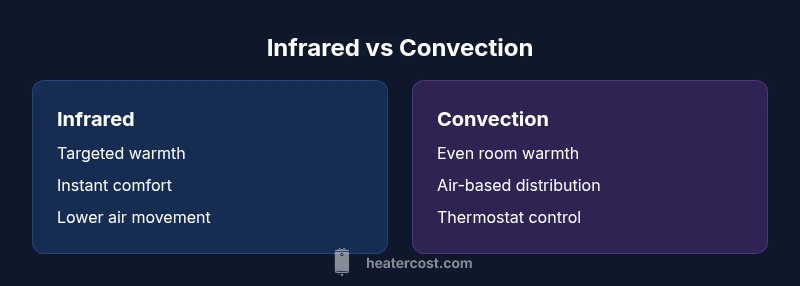
Infrared heaters excel for targeted warmth and fast comfort in small spaces or occupied zones, while convection heaters shine for evenly warming entire rooms over time. The best choice depends on room size, insulation, and how you use the space. For most open-layout homes, convection provides steady heat; infrared is ideal as a supplemental or spot-heating solution.
Understanding the question: which is better infrared or convection heater
Choosing between infrared and convection heating means choosing between radiant warmth and ambient air heating. According to Heater Cost, the best option depends on room size, insulation, occupancy patterns, and thermostat control. In this comparison, we break down how infrared and convection heaters operate, what they cost to run, and where each shines in real homes. This guide will help homeowners, renters, and property managers determine which approach aligns with their comfort goals and budget. For many spaces, the decision hinges on the balance between immediate warmth and sustained comfort, making it essential to evaluate how heat travels in your living area. Heater Cost's analysis emphasizes practical factors over marketing claims, ensuring you can make a cost-effective choice.
- Quick takeaway: infrared for spot warmth, convection for even room heating.
- Note: installation, insulation, and usage patterns dramatically shape long-term costs and comfort.
How infrared heaters work
Infrared heaters emit radiant energy that travels in straight lines and heats objects, people, and surfaces directly without first warming the surrounding air. This means you experience warmth almost instantly when you stand in front of the heater, which is why infrared is popular for spot heating in bathrooms, home offices, or a chilly corner of a living room. Because infrared heat targets objects rather than air, there is typically less warm-air circulation and minimal stray airflow, which can be advantageous in occupied spaces where you want fast comfort without hijacking the entire room’s air.
In terms of efficiency, infrared can be effective when you’re only partially occupying a room or when you want localized warmth. Wattage ranges for consumer infrared heaters vary, but the key factor is heat flux and surface temperature. Safety features such as tip-over protection, overheat shutoffs, and proper clearance from combustible materials are essential. While infrared doesn’t rely on ductwork or fans, the physical placement of the heater matters for optimal comfort and safety. For homeowners evaluating energy costs, it’s important to remember that infrared heat energy is not wasted if you’re in direct line of fire; efficiency depends on how you use the heat and the room’s insulation.
From a maintenance perspective, infrared units typically have fewer moving parts than fan-based convection heaters, often translating to lower ongoing maintenance. However, dust accumulation around heating elements and housing can affect performance, so periodic cleaning is wise. In terms of durability, many infrared units are compact and robust, enabling flexible placement in different rooms without complex installation.
How convection heaters work
Convection heaters warm the air in a room, which then circulates and rises as it becomes buoyant, setting up a natural or forced air loop that gradually increases the room temperature. This approach creates a more uniform heat distribution over time, which is especially beneficial in larger spaces or open-plan layouts where you want steady warmth across multiple zones. Convection heaters often incorporate a fan or rely on natural convection to move air, and many models offer programmable thermostats and timers that help manage energy use.
The energy cost and efficiency of convection heating depend on room size, insulation, and how well the space retains heat. In well-insulated homes, convection can provide consistent warmth with lower operating fluctuations, while in poorly insulated rooms, heat loss can require higher wattage or longer runtimes. Maintenance for convection units may include cleaning or replacing filters if the model uses a fan and air intake. Safety considerations include ensuring clearances around the heater, avoiding obstruction of air intake, and using models with thermal cutoffs and tip-over switches. Overall, convection heating is well-suited for continuous, even warmth in living spaces that remain occupied for extended periods.
To maximize efficiency, choose convection heaters with smart thermostats that maintain a stable temperature and minimize cycling. Pairing a convection unit with good insulation and weatherstripping can significantly reduce energy costs while delivering reliable comfort.
Key differences at a glance
- Heat distribution: Infrared concentrates warmth at the surface or object it hits; convection heats air for uniform room warmth.
- Response time: Infrared provides near-instant warmth in targeted zones; convection reaches a comfortable room temperature more slowly but steadier over time.
- Best for: Infrared is ideal for spot heating and occupied zones; convection is best for whole-room and open-plan spaces.
- Energy efficiency in use: Infrared minimizes wasted heat in occupied spots; convection efficiency depends on room insulation and thermostat control.
- Installation and maintenance: Infrared units are often portable with minimal setup; convection units may require space for air intake and safe clearance, plus potential filter maintenance.
- Safety considerations: Infrared heat is intense at the surface; ensure proper clearance. Convection units can have fans that add noise and filter needs, depending on model.
The choice depends on your space, climate, and how you use rooms. If you want fast warmth in a small zone, infrared shines. For even heating across a larger area, convection often wins.
Cost considerations and efficiency
Operational cost is a primary factor for homeowners budgeting heating expenses. Infrared heaters can be more energy-efficient on a per-second basis when you only need to warm specific objects or people, since you’re not heating the entire room. If you’re using infrared in a small, well-insulated space or as a supplemental heat source, you may see lower energy usage during occupied periods. However, if you rely on infrared for full-room heating in a larger space, you may end up running at higher wattages for longer periods, increasing running costs.
Convection heaters distribute heat across the air, which can be more efficient for entire rooms, particularly in spaces where occupants stay for extended periods. The energy cost with convection is heavily influenced by room size, insulation, thermostat control, and outside temperature. In a well-insulated home, convection can maintain comfortable temperatures with moderate energy use. In less insulated spaces, you might need continual operation, which could increase energy consumption. The decision should factor in installation costs, potential ductwork (for whole-home systems), and whether you use zone controls or single-room convection units. For renters or homeowners evaluating long-term costs, consider how often you’ll reconfigure spaces and how insulation changes over time.
Comfort and heat distribution in real rooms
Comfort is a multi-faceted concept. Infrared warmth feels different from air-heated warmth because it targets surfaces and people rather than the surrounding air. In occupied zones where you want rapid comfort—such as a desk area, bedside, or a cold corner near a window—infrared can deliver a pleasant, immediate sensation. However, since infrared heat doesn’t warm air uniformly, other occupants or distant areas might feel cooler, especially in rooms with drafty corners or low insulation. In such cases, infrared is best used as a supplemental heat source rather than the sole heating method.
Convection heating offers a more uniform temperature across a room, which many people perceive as more comfortable for long periods. It’s particularly effective in living rooms, home offices, and bedrooms where people are present throughout the day. The main caveat is that convection depends on air movement; in dusty environments or with allergies, dust can be circulated by fans, and poorly sealed rooms may experience heat loss, reducing perceived comfort. Both types can be tuned with thermostats, zoning, and smart-home integrations to optimize comfort and energy use. Testing heater placement in a room before committing to a full setup is a practical step to ensure you achieve the desired balance of warmth and comfort.
Real-world scenarios: when each type shines
- Small, occupied zones: Infrared is often preferred for quick warmth without heating an entire room.
- Open-plan living spaces: Convection provides more uniform warmth and can be managed with zoning to balance comfort.
- Bathrooms or drafty corners: Infrared can deliver targeted comfort where you stand or sit, without heating adjacent air.
- Rooms with insulation gaps: Convection can help maintain overall warmth, especially if paired with door seals and draft blockers.
- Energy-conscious households: A hybrid approach—infrared for occasional spot heating and convection for general warmth—can maximize comfort while controlling energy use.
Ultimately, the best solution may involve a combination of heat sources that align with your routines, room layouts, and energy goals.
Safety, maintenance, and lifespan
Heat source safety remains a priority in any heating decision. Infrared heaters typically pose lower risk of air contamination and do not rely on fans or ductwork, reducing some maintenance concerns. Panoramic safety features such as tip-over switches and overheat protection remain essential, as does ensuring clearances around the unit. Regularly cleaning the heater’s housing and elements helps maintain performance and longevity. Convection heaters with fans may require occasional filter cleaning or replacement, and fans can introduce additional wear over time. Both types benefit from routine checks of cords, outlets, and surface temperatures to prevent accidental burns.
Lifespan varies by brand, usage, and environment. Portable infrared units can last many years with proper care, while convection heaters with fans may have slightly shorter lifespans if used heavily in dusty or humid spaces. Choosing models with robust safety features, quality components, and a warranty appropriate to your climate will help maximize lifespan. Maintenance plans that include annual inspections or professional service are advisable for larger installations or rental properties where reliability is critical.
Choosing the right heater for your space: a decision framework
To select between infrared and convection heaters, start with a simple decision framework:
- Define the space size and layout: small, enclosed areas favor infrared for quick comfort, larger, open rooms tend to benefit from convection.
- Assess insulation and drafts: well-insulated rooms retain heat better, letting convection maintain comfortable temperatures with moderate energy use; drafty spaces may benefit from targeted infrared warmth stopping heat loss at the source.
- Consider occupancy patterns: spaces with people present briefly or periodically will benefit from infrared; spaces where people stay longer each day will value convection’s even warmth.
- Examine energy costs and thermostat control: combine heat sources with smart thermostats to optimize energy usage and comfort.
- Plan for safety and maintenance: ensure you choose models with essential safety features and a manageable maintenance plan.
- Factor in noise and aesthetics: fans add slight noise; some buyers prefer silent infrared panels for bedrooms or offices.
By mapping your space and routine to these criteria, you can select a heater type—or a hybrid approach—that balances comfort, energy efficiency, and cost.
Practical buying tips and common myths debunked
- Myth: Infrared heat is only useful outdoors. Reality: Infrared panels can provide efficient warmth in indoor spaces when used as a targeted heat source or supplement.
- Myth: Convection heaters always heat rooms evenly. Reality: Room geometry, insulation, and airflow significantly affect distribution; radiative heat can outperform in certain layouts.
- Tip: Look for models with adjustable wattage, safety features, and thermostats that integrate with smart home systems.
- Tip: Check for a warranty that covers a reasonable period, especially for rental properties or busy households.
- Tip: Consider a hybrid system if you have mixed-use spaces with varying heating needs.
This practical approach helps homeowners avoid common pitfalls and select a solution that meets both comfort and cost goals.
Comparison
| Feature | Infrared heater | Convection heater |
|---|---|---|
| Heat distribution | Targeted warmth to objects/people | Even warmth through room air |
| Response time | Near-instant warmth in hit zones | Slower to heat entire room |
| Best for | Spot heating, occupied zones | Whole-room heating in larger spaces |
| Energy efficiency (operating costs) | Efficient for partial heat; low air heating waste | Depends on insulation; thermostat control key |
| Initial cost | Often lower for basic infrared panels | Mid-range to higher for feature-rich convection models |
| Maintenance | Fewer moving parts; simple upkeep | Possible filter/fan maintenance in some models |
| Safety considerations | Surface heat risk; keep clearance | Fan noise and grills; ensure safe placement |
The Good
- Infrared provides fast, localized warmth where you need it most
- Convection delivers even room-wide warmth over time
- Low airflow reduces heat loss in occupied zones when used correctly
- Thermostats and zoning enhance energy efficiency for both types
Negatives
- Infrared warmth may feel uneven in larger spaces or away from the heated surface
- Convection may take longer to reach comfort in cold rooms and can circulate dust via fans
- Infrared panels require proper placement to avoid glare or heat hotspots
- Convection units may introduce noise and require regular filter maintenance
Convection offers reliable, whole-room heating for most open layouts; infrared excels as targeted, rapid warmth for specific zones.
If comfort means steady room temperature, choose convection. If you need quick warmth in focused areas, infrared is the better fit, possibly as a supplementary heat source.
Got Questions?
What is the fundamental difference between infrared and convection heating?
Infrared heating relies on radiant energy to warm surfaces and people directly, while convection heats the air in a room to create circulation and overall warmth. Each method delivers warmth differently, affecting comfort and energy use.
Infrared heats you directly like sunlight, while convection warms the air to heat the whole room.
Which heater is more energy-efficient for small spaces?
For small, occupied zones, infrared can be more efficient because it targets heat where people are. If you only need warmth in a specific spot, infrared often delivers better energy efficiency than heating an entire small room with convection.
Infrared is typically more energy-efficient for small, targeted areas.
Are infrared heaters safe to use in bedrooms and living rooms?
Yes, with proper clearance and safety features like tip-over and overheat protection. Avoid placing infrared heaters where they could be bumped or exposed to flammable materials. For bedrooms, consider models with quiet operation and low glare.
They’re generally safe with proper clearance and safety features in bedrooms and living rooms.
Can I use both infrared and convection heaters together?
Yes, combining infrared for spot warmth with convection for whole-room comfort can optimize comfort and energy use. Zoned systems and smart thermostats help manage when and where each type operates.
Yes—infrared for spots and convection for the room can work well with smart zoning.
What maintenance do these heaters require?
Infrared units typically require minimal maintenance beyond dusting. Convection heaters with fans may need periodic filter cleaning and fan checks. Regular inspection of wiring and safety components is advised for all.
Infrared needs little upkeep; convection may need filter and fan care.
Which heater lasts longer or costs more upfront?
Durability and upfront costs depend on model quality, features, and usage. Generally, infrared panels are affordable and durable; convection heaters with fans may incur higher upfront costs but offer broader room coverage and features that can improve long-term cost efficiency.
Costs and longevity vary by model; infrared panels are often economical and durable, convection may cost more upfront but can be efficient long-term.
The Essentials
- Assess room size and layout before picking heat type
- Infrared: target heat for quick comfort in occupied zones
- Convection: even heat distribution for entire rooms
- Combine with zoning/thermostats to save energy
- Prioritize safety features and maintenance plans