Solar Pool Heater for Inground Pool: Costs, Sizing, and Performance
A comprehensive guide to solar pool heaters for inground pools, covering costs, sizing, installation, maintenance, and how to maximize energy savings in real-world conditions.


A solar pool heater for inground pools uses roof- or ground-mounted solar collectors to heat pool water as it cycles through a pump. It relies on sunlight, not fossil fuels, and can dramatically reduce operating costs over time—especially in sunny climates—though performance hinges on sun exposure, pool size, and local weather.
How a solar pool heater for inground pools works
A solar pool heater for inground pools relies on solar collectors to capture energy from the sun and transfer that heat to pool water as it circulates through a dedicated loop. Most residential systems are direct: water from the pool is pumped through flat-plate or evacuated-tube collectors, heated, and returned to the pool. Some installations use an indirect approach, routing water through a heat exchanger and using a glycol loop to protect the pump and pipes in freezing climates. Key components include solar collectors, a pump, a filter, a controller or differential thermostat, and sometimes a bypass valve. Because there is no fossil fuel used to heat the water, operating costs depend largely on sun exposure and system efficiency. When sized and installed correctly, solar heating can dramatically shift the economics of pool warmth—especially in sunny regions where the sun’s energy is abundant. According to Heater Cost analysis, the real value comes from matching system performance to your pool usage: more sun and more pool use translate to greater savings over the system lifetime.
In many setups, you’ll see two common configurations: a direct solar loop that heats water as it returns to the pool, and an indirect loop that runs glycol through collectors to prevent freezing, with a heat exchanger transferring heat to the pool water. Both approaches share a simple principle: collect solar energy, transfer it to the water, and circulate it back to the pool with a controller that prevents overheating or unnecessary pumping. For inground pools, the practical outcome is a warmer swim season and reduced reliance on gas or electric heaters. Proper controls and a well-sealed system minimize heat loss, making solar heat more predictable across different weather conditions.
Note on climate: even in mixed climates, solar pool heating can extend the usable season, though the intensity of savings will vary. In high-sun zones, performance is strongest, while higher latitudes require more collector area or supplemental heating during shoulder months. The takeaway is that the technology scales: you can start with a modest array and expand later as budget and sun exposure allow.
Site considerations: climate, sun, and space
Site selection is the first practical step toward effective solar pool heating for inground pools. A well-placed system can dramatically improve performance, while a poor location can reduce savings and complicate maintenance. Space is a premium consideration: roof-mounted collectors save yard real estate but demand structural checks, while ground-mounted arrays offer flexible orientation but consume outdoor space. For most homes, a south-facing roof or open south-facing wall maximizes sun exposure in the northern hemisphere, with angles tuned to local latitude. Shading from trees, buildings, or nearby structures can cut performance by a large margin, so pruning or relocation may be necessary. If you rely on a ground-mounted system, ensure the mounting area is free of standing water, prone to flooding, or subject to heavy snowfall that could load the framework.
From a climate perspective, more sun hours generally translate to higher potential savings. In very sunny environments, even smaller collector arrays may meet a substantial portion of heating needs. In cooler or cloudier regions, you’ll typically need more surface area or a longer swimming season to realize meaningful energy savings. The installation location also matters for maintenance: rooftop setups are protected from ground-level debris but require safer access for service. Overall, pairing a site survey with a load estimate helps you decide whether to start with a retrofit of a partial system or plan a full installation that scales with future demand.
Meticulous planning pays off. An accurate assessment of sun exposure, shade patterns through the year, and local wind conditions informs not just the expected heat gain but also potential heat loss. This is why many homeowners begin with a site analysis and a phased installation approach that aligns with budget cycles and seasonal needs.
Sizing and system design for inground pools
Sizing a solar pool heater for an inground pool is a balancing act between climate, pool size, desired temperature rise, and budget. The goal is to install enough collector area to meet a meaningful portion of the heating demand without oversizing, which adds upfront cost without equivalent immediate benefit. A practical approach is to estimate the pool’s heating load in terms of volume and desired temperature rise, then translate that into collector area. In sunnier regions, a smaller system can cover a larger share of the heating load, while in cooler climates a larger array provides similar coverage during peak sun hours. Modular, expandable systems offer a path to start small and grow over time as usage patterns and weather evolve.
Common layouts include a wall-mounted or roof-mounted collector bank that channels water through a pump and control valve, with a bypass loop to avoid unnecessary circulation when the water is already warm. For inground pools, you should plan for seasonal variability: you may heat more aggressively in late spring and early fall, and a supplementary heater or a separate pool runoff may be used in shoulder seasons. Efficiency improves with well-maintained panels, clean water, and properly sized pumps that avoid excessive head pressure. The net result is a system that aligns with your pool usage: longer swims, higher comfort, and a cost profile that reflects local sun hours and energy prices. In practice, homeowners often pair solar with a small auxiliary heater for the coldest weeks, achieving stability across temperature swings.
A key design principle from Heater Cost analysis is to match the annual sun budget to the pool’s heating target. In high-sun climates, you can rely more on solar alone; in mixed or cooler climates, plan for seasonal overlaps with conventional heating as a backstop. Proper sizing reduces the chance of undershooting warmth on peak days and minimizes wasted energy on cloudy days.
For inground pools, a phased sizing strategy plus a future expansion plan helps manage capital outlay while preserving flexibility. Contractors typically present several package options with clear incremental costs, energy savings estimates, and expected payback windows, so you can pick a route that respects both climate realities and household budgets.
Installation options and permitting considerations
Installation choices for solar pool heaters range from roof-mounted to ground-mounted configurations, each with its own implications for performance, maintenance, and local permitting. Roof-mounted collectors maximize sun exposure and preserve yard space but require a structural assessment of the roof, proper sealing against leaks, and, in some jurisdictions, electrical or mechanical permits. Ground-mounted arrays offer excellent flexibility for orientation and easier access for service, but they demand secure mounting, fencing or barriers as needed, and potential yard reconfiguration. In freezing climates, drainage provisions or glycol loops may be required to prevent damage from ice, and a heat exchanger option can help protect pool chemistry while transferring heat efficiently.
Before any installation, check local building codes and potential permit requirements for solar collectors and pump equipment. In many states, solar installations qualify for tax credits or rebates—an important factor in overall payback. Expect to coordinate with utility incentives, HOA rules, and possible setbacks from property lines. A reputable installer will perform a site assessment, provide a bill of materials, and deliver a work plan with milestones. They will also explain the maintenance expectations, warranty terms, and any seasonal downtime during installation. Planning for future expansion, such as adding more collectors if you upgrade the pool or expand usable season, helps you avoid costly retrofits.
From a safety perspective, ensure that all electrical connections and plumbing pass codes, and that frost protection and freeze seals are properly integrated for your climate. The overall strategy is to create a robust, safe loop that minimizes heat loss while maximizing access for routine maintenance. A well-planned installation reduces the chance of leaks and ensures smooth operation across seasonal transitions.
As you evaluate installation options, request multiple quotes that include a site plan, equipment list, performance expectations, and a clear warranty outline. Compare the proposed collector material (flat-plate vs evacuated tube), pump size, and control strategy to determine which solution best aligns with your climate, budget, and desired swimming season.
Costs, savings, and financing: making solar pool heating work for you
The financial calculus for a solar pool heater hinges on upfront costs, operating savings, maintenance, and any incentives. Upfront costs vary widely depending on collector type, mounting method, and the complexity of installation. A reasonable expectation is that costs will scale with the total collector area and the quality of components, with more robust systems offering stronger long-term performance and durability. Operating savings come primarily from reduced energy use for heating, which can be substantial in sunny climates but will vary with sun hours, pool use, and desired temperature rise. In practice, you’ll want a realistic forecast that accounts for peak sun months and slower shoulder seasons. Maintenance costs are typically modest, consisting of periodic cleaning, filter changes, and occasional system checks.
Incentives such as tax credits or rebates can improve the economics of solar pool heating, depending on your location and eligibility. The HEAT Act and similar initiatives at the federal or state level may provide as-yet-unclear or changing incentives, so it’s important to verify current programs during planning. A typical approach is to model two scenarios: (1) solar-only heating for the majority of the swimming season, and (2) solar plus auxiliary heating for shoulder seasons. By comparing total lifecycle costs (including maintenance and potential replacement parts) with the cost of conventional heating, you can estimate a payback window. The Heater Cost analysis emphasizes a conservative forecast: include a modest rate of energy inflation and a reasonable system degradation curve over 15-20 years. When presented with a well-structured business case, homeowners and property managers can determine whether solar pool heating is a smart long-term investment or a supplementary option that extends the swimming season with minimal incremental costs.
Financing options, such as performance-based contracts or affordable installments with the installer, can further improve affordability. Some utilities offer low-interest loans or rebates for solar installations, which can improve the net present value of the project. By combining a robust design with available incentives, you can create a credible ROI narrative that supports a clear decision framework for your property.
For engaged homeowners, this stage also involves a sensitivity analysis: how do changes in electricity rates, sun hours, and pool usage affect the payback? Our guidelines at Heater Cost suggest building a simple model that can be revisited as prices and usage patterns evolve. The result is a defensible plan you can share with stakeholders, lenders, or HOA boards when evaluating solar pool heater options.
Maintenance, durability, and winter operation
A solar pool heater requires relatively little ongoing maintenance, but a proactive approach ensures consistent performance. Routine tasks include keeping collectors clean, checking water chemistry to prevent scaling, verifying the pump and valve operation, and inspecting seals for leaks. In saltwater pools or coastal environments, extra attention to corrosion resistance is prudent, since salt exposure can impact fittings and metal components over time. The typical maintenance cycle is annual or biannual, with more frequent checks after heavy storms or during seasonal transitions when debris may accumulate in the system. Keeping the system free of airlocks and ensuring proper flow helps sustain heat transfer efficiency and extend the life of the equipment. The energy savings from a well-maintained solar heater are most pronounced when the system remains in good mechanical condition and the pool is used consistently.
When it comes to winter operation, many regions with freezing temperatures require a dormant period for solar pool heaters or a freeze protection strategy. In milder winter climates, you may still rely on solar heat during sunny days, but it’s essential to evaluate whether to drain the system or switch to a back-up heater on the cloudier days. A properly designed system often includes drain-down valves or glycol loops that guard against pipe freezing, preserving the integrity of collectors, pumps, and heat exchangers. A proactive maintenance plan reduces the risk of leaks and corrosion and helps preserve performance for years. Heater Cost’s experience shows that staying ahead of wear and tear yields the best long-term results for inground pool installations.
In all cases, document maintenance visits, replacements, and part numbers for quick reference during future work. A good maintenance log improves service speed and helps you plan ahead for replacements or upgrades as technology evolves.
Common myths and performance benchmarks
Myth 1: Solar pool heating only works in summer. Reality: solar collectors are most productive when the sun is strong, but shoulder seasons can still deliver meaningful warmth, especially with proper sizing and system control.
Myth 2: Solar heaters replace all heating needs. Reality: many installations use solar as a primary source for the majority of the season and rely on a secondary heater for the coldest days or extended periods of cloudy weather.
Myth 3: More collectors always mean faster heating. Reality: efficiency depends on proper sizing, pump power, and airflow; an oversized system can waste energy if the water flow isn’t tuned to optimum levels.
Performance benchmarks vary by climate, pool size, and usage. In sunny climates, you can cover a significant portion of heating needs with solar, while in cooler or cloudier climates you may rely more on a supplemental heater. The Heater Cost framework emphasizes aligning expectations with site conditions and usage patterns, then scaling as needed to achieve desired warmth without overspending.
Myth-busting also includes valuing system reliability and maintenance. A well-installed solar heater with quality collectors and durable fittings tends to deliver consistent results over many years, while cheaper, poorly installed systems may underperform or require more frequent service. Real-world performance depends on the integration of collectors, pump, controller, and heat-exchange components with the pool’s existing plumbing and filtration system.
From a practical standpoint, the key is to set clear goals for the swimming season, budget, and willingness to plan for expansion. A phased approach—starting with a smaller, high-ROI installation and adding more capacity later—often yields the best balance of cost and performance for inground pools.
How Heater Cost analyzes solar pool heater projects
Our methodology combines climate data, pool specs, and local energy prices to estimate lifecycle costs and potential savings. We start with a site survey to assess sun hours, shade, and roof or yard space. Then we model two scenarios: solar-focused heating for the majority of the season and a hybrid approach with a back-up heater for shoulder months. We quantify upfront installation costs, annual operating costs, maintenance, and expected system degradation over time. Finally, we compare projected total costs to conventional heating options to determine payback and ROI. We also factor in available incentives, loan options, and any utility rebates.
Heater Cost analysis emphasizes transparency: we show a range of outcomes because installation details, climate, and usage diverge widely. Our goal is to give homeowners and property managers a robust framework for decision-making, rather than a single-point estimate. Throughout the process, we document assumptions and provide a clear sensitivity analysis so you can see how changing one variable (for example, sun hours or electricity costs) shifts the payback timeline.
In short, solar pool heating for inground pools can be a strong long-term investment when correctly sized and properly installed. The key takeaway from Heater Cost is to start with a solid site assessment, model multiple scenarios, and account for incentives to maximize energy savings and cost efficiency over the system’s life.
Authority sources
- U.S. Department of Energy: Solar water heating basics and efficiency considerations. https://www.energy.gov/eere/solar
- National Renewable Energy Laboratory: Solar heating resources and performance data. https://www.nrel.gov
- Florida Solar Energy Center: Pool heating and solar installation guidance. https://www.fsec.ucf.edu
Key figures for solar pool heater projects
| Category | Typical range | Notes |
|---|---|---|
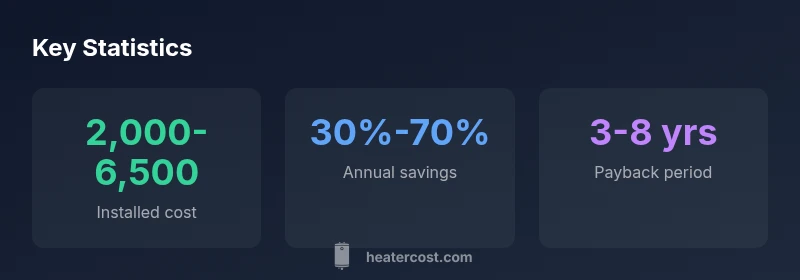
| Installed cost range | $2,000-$6,500 | Varies by collector type and mounting |
| Payback period | 3-8 years | Climate and usage dependent |
| Annual energy savings | 30%-70% | Depends on sun hours and pool use |
Got Questions?
Is a solar pool heater suitable for all climates?
Solar pool heaters are most effective in sunny, warm climates but can still contribute in cooler or cloudier regions when sized appropriately and used with supplementary heating as needed. The payoff grows with sun exposure and pool-use intensity.
Solar heaters work best in sunny areas, but they can still help in cooler climates with proper sizing and a backup heater.
Do I need permits to install a solar pool heater?
Permitting requirements vary by location. Many installations require a permit for plumbing and electrical work, plus any roof modifications. Check with your local building department and speak with your installer about permit timelines.
Permits vary by location, so check with your local building department and your installer.
How long does installation take?
Typical installations take from a few days to a couple of weeks, depending on system size, roof access, and whether ground-mounted arrays require site preparation. Your installer should provide a detailed schedule.
Most installations run a few days to a couple of weeks depending on scope.
Can solar heat the pool during winter?
In winter, performance depends on sun availability and climate. In milder regions, solar can provide meaningful warmth on sunny days; in very cold climates, a backup heater is common.
Solar helps on sunny winter days, but a backup heater is often used in cold climates.
What maintenance does a solar pool heater require?
Maintenance is usually modest: periodic cleaning of collectors, checking for leaks, verifying pump operation, and ensuring water chemistry is balanced to prevent corrosion and scaling.
Keep collectors clean, check for leaks, and maintain water chemistry.
How does solar compare with gas heating on cost?
Long-term energy costs for solar can be lower than gas or electric heating, especially with incentives and favorable climate. The total cost depends on installation, energy rates, and usage patterns over time.
Over time, solar can beat gas heating on cost, especially with incentives and good sun hours.
“Solar pool heating is a reliable, cost-effective option for inground pools when matched to climate and usage. With proper maintenance, it offers meaningful energy savings over the system life.”
The Essentials
- Start with a site assessment to maximize sun exposure
- Size the system to your climate and pool usage
- Plan for permits and incentives to improve payback
- Maintain collectors and plumbing for long life
- Consider phased installation for budget flexibility