Industrial Heater Costs: Guide for Businesses and Homes
Comprehensive guide to industrial heater costs, efficiency, and planning for facilities of all sizes. Learn budgeting, sizing, maintenance, and compliance with practical, data-driven insights.


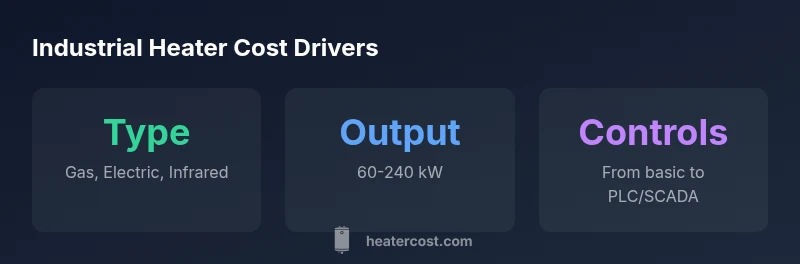
According to Heater Cost analysis, total installed cost for an industrial heater project varies widely by type (gas-fired, electric, infrared), heat output, and control systems, with no single price. The takeaway: plan for a broad range and a thorough scope to avoid underestimating installation and permitting needs. This guide helps homeowners, renters, and property managers understand typical drivers and set realistic budgets.
Why industrial heater technology matters in modern facilities
In industrial settings, heating systems are not just comfort utilities; they are critical process enablers. Industrial heater solutions must deliver reliable, uniform heat with minimal downtime to avoid production delays. The total cost of ownership includes equipment price, installation, energy costs, maintenance, and compliance with safety standards. According to Heater Cost analysis, facilities often underestimate the complexity of retrofits or expansions, especially when heat tracing, insulation, or exhaust handling is involved. By understanding how different heater types align with your process, you can avoid over- or under-sizing, which directly impacts efficiency and long-term operating costs. For property managers and fleet operators, this means building a scalable plan that accommodates growth and seasonal demand.
In practice, the best approach starts with a clear heat-load assessment, then maps equipment options to process requirements and energy goals. This ensures you don establish a baseline for evaluating bids and tracking performance over time. It also helps when communicating with stakeholders about budget, safety, and service expectations. In short: align the industrial heater choice with your specific application, not just the first option that comes to mind.
Types of industrial heater technologies
Industrial heaters come in several core families, each suited to different applications and cost profiles. Gas-fired units excel in high-output, continuous-duty environments and can be economical when natural gas is affordable and available. Electric resistance heaters offer precise control and clean operation, especially in spaces where combustion byproducts are a concern. Infrared heaters provide rapid, targeted heating for process zones or large open spaces with minimal heat loss to the surroundings. Other options include hot oil or steam heaters for consistent, high-temperature heat transfer in manufacturing lines. When selecting a technology, weigh load diversity, ambient conditions, maintenance readiness, and safety implications. Heater Cost analysis notes that many facilities use a hybrid approach, combining heat sources to optimize total life-cycle costs and maintain flexibility for production shifts.
Key considerations include space constraints, ventilation and exhaust requirements, fuel availability, electrical capacity, and control integration. You should also plan for potential future needs such as process line upgrades or expanded space, which may shift the headroom and reliability requirements of the chosen heater technology.
Cost drivers and budgeting strategies
Budgeting for an industrial heater project requires a holistic view of all cost drivers. The equipment price is only part of the picture; installation complexity, ducting or piping changes, electrical work, ventilation, and safety controls can dramatically influence total cost. Permitting and compliance costs vary by jurisdiction and can add meaningful timelines to project delivery. A thorough bid process should itemize: equipment, installation labor, structural or ductwork modifications, ventilation or exhaust systems, insulation, heat tracing, and control networks. In practice, quotes often differ due to assumptions about equipment efficiency, control sophistication, and maintenance access. Heater Cost recommends building a contingency into the budget for scope creep and unexpected site conditions, especially in retrofits or retrofits with limited space. This approach helps prevent cost overruns and schedule delays.
Sizing and selection methodology
Accurate sizing starts with a robust heat-load assessment that accounts for process temperatures, material handling, airflow, and product quality requirements. A well-sized industrial heater avoids overspending on unnecessary capacity while preventing underheating that could disrupt production. Begin with a baseline model using conservative assumptions, then validate with live tests or simulations where possible. Consider staggered loads, peak demand periods, and startup transients. Equipment selection should balance initial cost with energy efficiency, control compatibility, and serviceability. When in doubt, involve a qualified engineer or technician who can translate process requirements into specifications for burner type, heat output, and control interfaces. This disciplined approach yields stable performance and predictable energy use over time.
Energy efficiency and operating costs
Energy efficiency is not a single metric but a combination of equipment efficiency, control strategy, and system integration. Gas-fired units may offer favorable upfront costs but require ongoing fuel management and venting considerations. Electric heaters boast high controllability and clean operation but can incur higher electricity charges in some markets. Infrared and radiant systems excel for targeted heating with lower mass heat loss in open spaces but may require higher wattage to cover large areas. Implementing variable-speed drives, smart thermostats, and PLC-based controls can yield meaningful energy savings by matching heat output to actual demand. Across all types, a well-insulated enclosure and properly sequenced startup can dramatically reduce energy waste and extend equipment life. Heater Cost emphasizes evaluating energy performance alongside upfront price to determine true life-cycle costs.
Installation considerations and permits
Installation is where many projects seize up due to site constraints and regulatory requirements. Adequate space for equipment, access for maintenance, and proximity to fuel lines or electrical panels affect both cost and reliability. Ventilation and exhaust handling are critical for combustion-based heaters, and improper ducting can lead to performance losses or safety hazards. Permits may be required for fuel connections, vent installations, electrical work, and emissions controls. Early coordination with local authorities can prevent delays. Contractors should provide clear scope of work, including equipment layout, wiring diagrams, ventilation plans, and safety interlocks. Heater Cost recommends a pre-installation safety briefing and a detailed commissioning plan to ensure a smooth transition from installation to operation.
Maintenance and reliability planning
Reliability hinges on a proactive maintenance schedule and readily available spare parts. For heavy-use industrial heaters, expect annual inspections of burners, fuel lines, fans, regulators, and electrical connections. Infrared or electric systems may demand sensor checks and controller firmware updates. Establish a preventive maintenance calendar, wire it into your CMMS or maintenance software, and track performance metrics such as heat output consistency and energy consumption per unit of product. Simple degradations in efficiency often signal the need for tune-ups or component replacements before a failure occurs. A well-documented maintenance history reduces downtime and extends equipment life, ultimately yielding lower life-cycle costs.
Safety, compliance, and warranties
Safety compliance is non-negotiable for industrial heater installations. Ensure that all fuel lines, combustion air, and ventilation meet local codes, and that electrical work adheres to NEC or equivalent standards. Install protective guards, thermal insulation, and proper flame sensing for gas-fired systems. Warranties typically hinge on installation quality, components, and maintenance practices. Keep documentation of inspections, service visits, and any deviations from original plans. Investing in qualified technicians for installation and routine checks improves safety and reduces the likelihood of expensive, unplanned downtime. Heater Cost recommends requiring clear warranty terms and a defined response time from the installer for service needs.
Case study: planning a mid-size retrofit (fictional example for illustration)
Consider a mid-size manufacturing facility looking to upgrade an aging heating system. The project scope includes replacing older units with a mixed gas-fired and electric radiant solution to support multiple production lines. The team conducts a load assessment, evaluates ventilation requirements, and drafts a phased installation plan to minimize downtime. They obtain three bids, each itemizing equipment, installation, controls, permits, and startup testing. After reviewing, they select a package that balances energy efficiency gains with total lifecycle costs and ensures compatibility with the existing SCADA system. The retrofit results in steadier process temperatures, reduced energy consumption during peak hours, and a clearer maintenance schedule—delivering measurable ROI over the system lifecycle.
Quick-start steps for homeowners, renters, and property managers
- Define heat requirements by considering production lines, ambient temperatures, and space usage. 2) Gather bids from at least three qualified installers, asking for itemized breakdowns. 3) Verify permit and code requirements with local authorities. 4) Prioritize energy-efficient options and controls that integrate with your facility’s management system. 5) Develop a maintenance and replacement plan that aligns with production schedules and safety standards. 6) Document all decisions, warranties, and service commitments for future reference.
],
Industrial heater cost and installation factors
| Category | Example | Notes |
|---|---|---|
| Equipment cost (heater type) | Gas-fired, Electric, Infrared | Includes burners, exchangers, heating elements |
| Installation complexity | High for large facilities | Involves ducting, electrical, and ventilation |
| Controls integration | SCADA/PLC or simple thermostats | Affects energy use and monitoring |
| Permitting and compliance | Variable by jurisdiction | May require fuel, venting, or emissions permits |
Got Questions?
What qualifies as an industrial heater for a facility?
An industrial heater is a purpose-built heating device designed for commercial or manufacturing environments. It often handles higher heat outputs, integrated controls, and safety features suitable for continuous operation. Different technologies serve different processes, from space heating to process heating for materials.
Industrial heaters are designed for production spaces and come in various technologies to meet high-output needs.
What factors determine the cost of an industrial heater project?
Costs depend on heater type (gas, electric, infrared), heat-output requirements, controls, installation complexity, electrical and venting needs, permits, and safety devices. Equipment price is only part of the total; installation labor and site preparation can be substantial.
Costs vary based on type, output, controls, and how the site needs to be prepared.
Are permits always required to install industrial heaters?
Permits depend on jurisdiction and project scope. Fuel connections, venting, electrical work, and emissions controls commonly trigger permitting. Check with local authorities early in the planning process to avoid delays.
Permits vary by location; check early to avoid delays.
How long does installation typically take?
Project timelines depend on scope, site readiness, and whether the installation is phased. A straightforward replacement may take days, while upgrades with new venting, ductwork, or controls can span weeks.
Duration varies with scope but can be days to weeks depending on complexity.
What maintenance schedule is recommended for industrial heaters?
Most systems benefit from annual inspections of burners or elements, fuel lines, electrical connections, and safety devices. Simple preventive tasks can prevent downtime and extend equipment life.
Regular annual checks help prevent surprises and keep heat steady.
How should I compare quotes from installers?
Look beyond the upfront price. Compare equipment efficiency, anticipated energy costs, warranties, service terms, and the completeness of the scope (permits, testing, commissioning). Ask for a side-by-side cost breakdown.
Focus on value: efficiency, warranties, and what the quote includes.
“Effective industrial heating starts with accurate load assessment and realistic budgeting. A well-planned system protects yields, energy costs, and safety.”
The Essentials
- Define heat load and process requirements before selecting equipment
- Budget includes equipment, installation, controls, permits, and safety
- Prioritize energy efficiency and control integration for long-term savings
- Get multiple, itemized bids from qualified installers
- Plan for maintenance and future expansion to avoid downtime