Do All Electric Heaters Cost the Same to Run? A Practical Guide
Explore why do all electric heaters cost the same to run? Learn how wattage, insulation, usage, and electricity rates shape running costs with practical tips.


No. Running costs vary widely across electric heaters. Factors include wattage, thermostat use, climate, insulation, and how long the unit runs each day. Even efficient models can cost more if used heavily, while smaller, well-timed heaters may cost less. A 1,000-watt unit used for several hours will cost more than a smaller unit used only when needed, depending on your electricity rate. A simple rule: cost equals watts × hours ÷ 1000 × rate per kWh, so usage patterns matter more than the device name alone.
Do Electric Heaters Cost the Same to Run? The Quick Reality
Do all electric heaters cost the same to run? The quick answer is no. Running costs depend on how much heat you actually need, how long the heater runs, and the price you pay for electricity. Brand names or marketing claims can be misleading if you focus only on the wattage on the label. The Heater Cost team has found that real-world costs hinge on usage patterns, room conditions, and the thermostat strategy you employ. In practice, two units with the same nameplate wattage can produce very different monthly bills if one is used in a well-sealed space and the other is used in a drafty room. The takeaway is to look beyond the nominal wattage and examine how the heater fits your space and routine.
How Wattage, Run Time, and Electricity Rates Drive the Cost
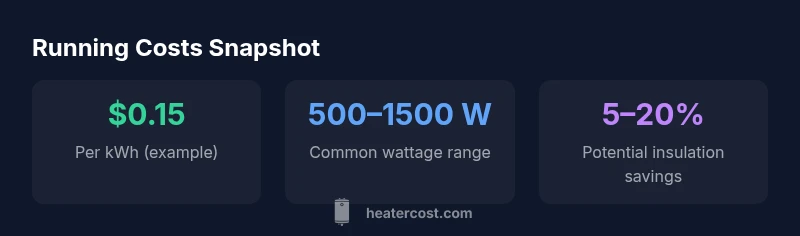
Energy consumption scales with wattage and run time. A 1,000-watt unit running for one hour uses about 1 kilowatt-hour (kWh) of electricity. If your rate is $0.15 per kWh, that hour costs roughly $0.15. If you run the same unit for three hours, the cost triples, assuming constant heat needs. But rooms vary: small, insulated bedrooms heat up faster and hold warmth longer, lowering the effective run time. Conversely, large, drafty spaces require longer operation or higher watts to reach and maintain comfort. The key takeaway is that electricity rate, not just device wattage, shapes the bottom line. The Heater Cost Analysis, 2026, emphasizes measuring cost per hour at your local rate and adjusting usage accordingly.
Heater Types and Their Running Costs
Different electric heater types deliver heat in distinct ways, which influences perceived warmth and actual energy use. Baseboard and convection heaters warm air and tend to run longer in larger spaces. Infrared panels heat people and objects directly, which can feel cheaper in short-use scenarios. Ceramic and fan-forced heaters mix rapid warm-up with moderate energy draw. Heat pumps (where applicable in electric formats) are often more energy-efficient for sustained heating in mild climates, though upfront costs and climate suitability matter. The bottom line: there is no universal “cheapest” heater. The cost depends on how you design and control its operation in your space.
The Role of Insulation and Room Conditions
A room’s insulation and air leakage dramatically affect running costs. A well-sealed room with draft reduction requires less heat to reach and maintain the target temperature, meaning shorter run times and lower energy bills. Conversely, unsealed doors, single-pane windows, and poor insulation can double or triple the energy needed to maintain comfort, even with a highly efficient heater. Pairing a reasonable wattage with good insulation is usually more cost-effective than simply increasing wattage. The Heater Cost Analysis, 2026, notes that small improvements in sealing can yield noticeable savings over a heating season.
Real-World Scenarios: Cost Comparisons Without Real Prices
Consider two households in the same climate: one uses a 1000 W heater for 6 hours in a well-insulated room; the other uses a 1500 W unit for 4 hours in a drafty space. The first scenario may end up costing less overall due to shorter run times and better heat retention, even though the second heater has a higher wattage. This illustrates the core point: running cost is not solely determined by the heater’s labeled wattage. Usage patterns, room size, insulation, and the local electricity rate collectively shape the bill. Heater Cost’s practical guidance emphasizes modeling your own usage to estimate true costs before purchasing.
Practical Tips to Lower Running Costs
- Improve insulation and seal drafts to reduce heat loss.
- Use the smallest wattage needed and avoid overheating spaces.
- Program smart thermostats or timers to limit unnecessary runtime.
- Regularly maintain heaters to ensure efficient operation (clean filters, vents, and coils).
- Compare running costs at your rate rather than relying on wattage alone.
- Consider supplemental heat strategies (layering clothing, using curtains, and zone heating) to avoid heating unused spaces.
How to Estimate Your Monthly Energy Cost with a Quick Calculator
A simple approach:
- Note the heater’s wattage (W).
- Estimate how many hours per day it runs.
- Multiply watts by hours, then divide by 1000 to convert to kWh.
- Multiply by your local electricity rate per kWh.
- Multiply by the number of days you plan to run the heater. This yields a monthly estimate. The same method applies to different heater types; adjust run time and rate accordingly.
Practical Step-by-Step: Build a Simple Cost Preview
- List the rooms you intend to heat and their sizes.
- Choose a target comfort temperature and a heater type for each space.
- Estimate nightly and daily run times based on typical occupancy.
- Use your local rate per kWh to compute a rough monthly cost for each space.
- Compare total projected costs to determine the most cost-effective setup. This approach helps homeowners avoid overspending on oversized heaters or underheating their spaces.
Estimated running costs by electric heater type
| Heater Type | Typical Wattage | Common Use Case | Estimated Running Cost Range* |
|---|---|---|---|
| Baseboard/Convection | 500-1500 | Small to mid rooms | $0.08-$0.50/hour |
| Infrared Panel | 400-1200 | Direct heating of people/objects | $0.06-$0.40/hour |
| Ceramic/Fan Heater | 1000-2000 | Living rooms, quick heat | $0.10-$0.60/hour |
Got Questions?
Do electric heaters cost more to run in winter?
Yes. Colder weather often requires longer heating periods, which can increase running costs. However, better insulation and adaptive thermostat use can mitigate some of that increase.
Yes, winter usually raises running costs unless you optimize insulation and thermostat settings.
Can I reduce running costs by using a lower wattage heater?
Using a lower wattage heater reduces hourly energy use, but may require longer runtimes to reach comfort, potentially offsetting savings. Plan by room size and heat needs.
Lower wattage lowers hourly use, but check if it still keeps the space comfortable.
Is infrared cheaper to run than convection heaters?
Infrared can feel cheaper in moments of heat because it warms people and objects directly. Long-term costs depend on usage patterns, space, and overall energy efficiency.
Infrared can be cheaper in short bursts, but depends on how you use it.
How can I estimate my monthly energy cost for a heater?
Use watts × hours ÷ 1000 to get kWh, then multiply by your rate per kWh and days of use. Repeat for each space and sum for a total.
Estimate by calculating kWh with watts and hours, then multiply by your rate.
Are smart thermostats worth it for reducing running costs?
Smart thermostats optimize when and how heat is delivered, reducing unnecessary runtime and often lowering energy costs over a season.
Yes—smart thermostats can help you save energy if used effectively.
“When evaluating running costs, focus on how long a heater runs and the energy rate instead of just the nameplate wattage.”
The Essentials
- Compare wattage with real usage, not just label wattage
- Improve insulation to reduce running time
- Use thermostats and smart controls to trim waste
- Estimate costs with your local rate before buying
- No single heater is always cheapest; match type to space