Radiant vs Convection Heaters: A Side-by-Side Guide
An in-depth, objective comparison of radiant vs convection heaters, covering heat delivery, distribution, efficiency, safety, installation, and practical guidance for homeowners and property managers.


According to Heater Cost, radiant heaters and convection heaters deliver heat in different ways, influencing comfort and operating costs. This quick comparison highlights how radiant heat warms people and objects directly, while convection heats the air for even room warmth. The Heater Cost team found that the best choice depends on room layout, insulation, and daily use.
Radiant heater vs convection heater: key differences
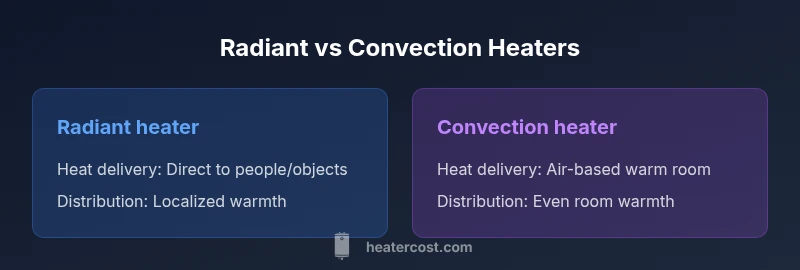
Homeowners evaluating radiant heater vs convection heater should start with the core distinction: radiant heaters emit infrared energy that warms objects, people, and surfaces directly in the line of sight, while convection heaters warm the air, circulating it to establish overall room temperature. In practice, this difference influences how quickly a space feels warm, how heat spreads, and what the occupants perceive. Understanding this fundamental contrast helps you align a heating solution with room layout, insulation quality, and daily routines. The Heater Cost framework presents an objective guide that emphasizes practicality over hype, helping homeowners make informed decisions based on real-use scenarios.
How radiant heaters deliver warmth
Radiant heaters operate by emitting infrared radiation that travels until it encounters objects or people, which then absorb the energy and convert it to heat. This means warmth can feel immediate when you stand in front of the heater, even in a cool room. The radiant energy does not rely on heating the air first, so drafty spaces or rooms with heavy air movement may still feel warm in the occupied zones while the surrounding air remains cooler. Radiant systems come in electrical panel heaters, infrared panels, and gas-fired units, offering versatile installation options. For homeowners seeking quick comfort near seating areas, a radiant heater can be a practical match, especially in bathrooms, garages, or outdoor enclosures where direct warmth matters most.
How convection heaters deliver warmth
Convection heaters heat the air, which rises or sinks to create a circulation pattern that blankets the entire room over time. Natural convection relies on buoyancy as heated air rises and cool air sinks, while forced convection uses a fan to accelerate air movement. The outcome is a more uniform temperature distribution across larger spaces, reducing cold pockets near windows or corners. Convection heaters are common in baseboard units, space heaters with built-in fans, and many electric and gas furnaces. They excel in open layouts and well-insulated rooms where steady, long-duration warmth is desirable. The trade-off is that the initial feel of warmth may take longer than radiant heat, and temperature changes can be more noticeable if a door opens or a window leaks air.
Heat distribution and comfort patterns
The way heat moves through a room shapes comfort as much as peak temperature. Radiant heat creates localized warmth at the point of contact, which can feel more comfortable in quick cooldown conditions but may leave distant corners cooler. Convection produces a more even air temperature, smoothing out gradients over time, but the air movement can stir dust or irritants and may create a slight draft near vents. For rooms with reflective surfaces, large glass areas, or seating zones, radiant warmth can supplement overall comfort by delivering targeted warmth to people sitting on couches or in chairs. In rooms with high ceilings or irregular layouts, convection patterns generally deliver better overall warmth distribution, reducing noticeable cold zones.
Response time and zoning capabilities
Radiant heaters typically offer fast perceived warmth in the area they directly serve; turning one on can produce immediate warmth on skin or objects without needing to heat the entire space. Convection heaters distribute heat more slowly as they warm the surrounding air, but their effect compounds as the room air stabilizes. Zoning capability—heating specific zones or micro-environments—depends on the system you choose. Radiant panels or heaters installed in a workshop corner or under a desk can provide localized comfort without heating the whole room, which is advantageous in mixed-use spaces. Convection-based setups can also be zoned if multiple units are used, though airflow can affect consistency. When evaluating a radiant heater vs convection heater, consider how often you need “spot warmth” versus “whole-room warmth” and how occupants move through the space.
Efficiency and operating costs in real-world use
Energy efficiency depends on multiple factors beyond the heater type: insulation quality, air leakage, thermostat control, and local energy prices. Radiant systems can be economical in scenarios where only selective people or zones require warmth, because you avoid paying to heat unoccupied areas. However, if every corner of a large room needs warmth, convection approaches may deliver heat to the entire space more evenly and potentially use less energy to maintain comfort. Gas-fired radiant or convection heaters have their own efficiency dynamics and venting requirements that influence fuel costs and installation complexity. Electric models often present simpler installation and control options, including thermostats and timers. In all cases, selecting a model with good insulation, healthy radiating elements, and properly rated wattage helps minimize standby losses and temperature swings.
Space fit: room types and layouts
The right choice often comes down to room geometry and usage patterns. Small, drafty spaces such as bathrooms or entryways benefit from radiant heaters because occupants encounter warmth quickly without heating the entire room. Bedrooms with heavy fabric or area rugs may also prefer radiant warmth near seating or sleeping areas, providing comfort where people sit. Larger living rooms, family rooms, and open-concept spaces typically respond well to convection heaters that can maintain a steady baseline temperature across the area. In sun-drenched or well-insulated rooms, both types can work, with radiant heat providing targeted comfort in seating zones and convection handling the rest of the space. When deciding, map energy needs to distinct zones, not only square footage, and consider how doors, windows, and furniture impact airflow and heat retention.
Safety, maintenance, and lifespan considerations
Both radiant and convection heaters require basic safety checks: keep combustibles away, ensure proper clearance, and protect cords or gas lines as applicable. Radiant panels generate surface heat that can be very hot to the touch; use guards and mounting that minimize accidental contact, particularly in homes with children or pets. Convection heaters with fans may experience longer-term wear on moving parts, but modern units typically include heat-safe housings, thermal cutoffs, and safety switches. Regular cleaning is important to reduce dust buildup near heating elements or vents, which can affect efficiency and indoor air quality. Lifespan varies by build quality, usage patterns, and maintenance, but choosing reputable models and following manufacturer guidance generally yields reliable performance.
Installation and setup considerations
Electrical and venting requirements vary by model. Electric radiant heaters often require dedicated circuits or compatible outlets; ensure your panel capacity matches the heater wattage, and consider tempering controls to avoid sharp temperature swings. Convection heaters may require proper clearance for air intake and exhaust, and gas-fired units typically need venting and professional installation. In open-plan homes, you might place radiant heaters to serve primary seating zones and rely on convection to support ambient warmth elsewhere. For retrofit projects, evaluate existing walls, ceilings, and floor structure to minimize heat loss and optimize placement. Finally, think about programmable thermostats and smart controls that can coordinate many units across a home, maximizing comfort while curbing energy waste.
Real-world scenarios: bathrooms, living rooms, and basements
In bathrooms, radiant heat delivers immediate comfort without circulating moisture; many bathrooms employ electric radiant panels or underfloor elements with safety features for damp environments. Living rooms benefit from a mix approach: radiant warmth near seating and convection to distribute baseline heat across the room. Basements, which are often poorly insulated, may rely on convection for stable warmth or use radiant elements strategically to heat occupied zones quickly. In garages or workshops, radiant heaters can provide targeted warmth where people work or gather, while convection helps keep the broader space comfortable. Always pair heaters with proper humidity management, leak protection, and ventilation considerations relevant to the space.
Sizing and selecting a model
Correct sizing is essential to avoid overspending or underheating. Start with a planning concept: determine the area to heat, the insulation level, and typical occupancy. For electric radiant heaters, wattage directly translates to heat output; for convection units, consider airflow and heat-exchange surfaces. Energy controls like thermostats, zoned programming, and smart-home integration can materially affect annual costs. When evaluating options, compare efficiency ratings, noise levels, maintenance requirements, and warranty terms. In spaces with high ceilings or large windows, you may need higher capacity or multiple units. Finally, consider the reliability of the heating source and how easily you can service or replace components over time.
Practical budgeting considerations and long-term value
While initial cost matters, the total cost of ownership includes installation, maintenance, and energy use over years. Radiant systems can offer lower installation complexity in some spaces, but demand precise mounting and protective enclosures; convection systems may require bigger upfront expenditures due to airflow components and venting. If energy costs are high in your area, the efficiency of controls and the ability to zone heat can have a larger effect on annual bills than the heat delivery method alone. To optimize value, plan for a system that integrates with existing thermostats and supports remote monitoring. Finally, align expectations with climate patterns, occupancy, and seasonal use. The Heater Cost analysis suggests a balanced approach: choose the method that best serves your most-used rooms and complements your insulation strategy.
Making the final choice: a practical decision framework
Use a structured decision framework rather than chasing the latest trend. List your priority factors: speed of warmth, coverage area, installation cost, energy efficiency, and maintenance needs. If you prioritize near-immediate warmth for occupied zones and are heating smaller spaces, radiant heater wins. If your goal is steady, uniform warmth across a larger, well-insulated room, a convection heater is typically the better fit. Consider hybrid or multi-unit solutions to cover different zones effectively. Finally, verify that your choice complies with safety codes and local regulations. This framework helps homeowners and property managers choose the right heating approach with confidence.
Comparison
| Feature | Radiant heater | Convection heater |
|---|---|---|
| Heat delivery | Direct radiant warmth to people/objects | Air-based heat distribution to space |
| Heat distribution | Localized warmth; potential cold spots farther away | Even warmth across the room over time |
| Response time | Fast surface warmth in the zone | Slower to heat entire room but steadier |
| Ideal spaces | Bathrooms, drafting nooks, seating areas | Open-plan living rooms, large spaces, well-insulated rooms |
| Maintenance/parts | Fewer moving parts; electric panels have low maintenance | Fans and vents require occasional service |
| Upfront cost range | Varies by model; electric radiant often cheaper to install | Convection units may have higher initial cost depending on design |
The Good
- Immediate warmth in target zones
- Good for drafty spaces or bathrooms
- Flexible placement options and a wide model range
- Better control with zoning and thermostats
Negatives
- May feel less uniform in large rooms
- Air movement in convection can spread dust
- Radiant heat can create hot spots if misapplied
- Convection units may require more space for ducting or fans
Choose based on space: radiant for targeted warmth; convection for even coverage
For small, drafty spaces or zones where you want rapid warmth, radiant heaters are advantageous. For larger rooms or open layouts that require steady, uniform heat, convection heaters typically perform better and can reduce cold pockets over time.
Got Questions?
What is the main difference between radiant and convection heaters?
Radiant heaters emit infrared energy that warms people and objects directly, while convection heaters heat the surrounding air to warm the whole room over time. The choice depends on whether you value immediate spot warmth or even room warmth.
Radiant heaters heat you directly; convection heaters warm the air for the whole room. The best pick depends on where you plan to place heat.
Which type is more energy-efficient overall?
Efficiency depends on usage and space. Radiant heat can be more efficient in small zones, while convection can be more efficient for maintaining a steady temperature in larger spaces when well-insulated. Control and insulation matter as much as the heat delivery method.
Efficiency hinges on usage and space. Use radiant heat for small zones or convection for larger, well-insulated rooms, with good controls.
Are radiant heaters safe for bathrooms and damp spaces?
Many radiant heaters are designed for moist environments, especially electric panels rated for bathrooms. Always follow manufacturer guidance, use GFCI outlets where required, and ensure proper clearance and ventilation.
Yes, many radiant heaters are suitable for bathrooms when installed correctly and with proper safety measures.
Can radiant heaters heat a large open room evenly?
Radiant heat provides targeted warmth but may leave distant corners cooler in large spaces. For uniform warmth in bigger rooms, supplemental convection heating can help balance the temperature.
Radiant heat warms people directly, so large rooms may need convection to balance the space.
Do I need professional installation for gas models?
Gas models typically require professional installation due to venting and fuel connections. Electric radiant and convection models can be installed with standard electrical work, though size and circuit loads matter.
Gas units usually need a professional install; electric models can be installed by a competent technician.
Can I use both types in the same home to optimize comfort?
Yes. Many homes benefit from a hybrid approach—radiant heat for high-use zones and convection for larger common areas. Proper control strategies can minimize energy waste and maximize comfort.
Absolutely—using both can tailor comfort while saving energy with smart zoning.
The Essentials
- Match heat delivery to room use (targeted vs. ambient warmth)
- Consider room size, insulation, and air movement
- Use thermostats and zoning to maximize efficiency
- Factor installation complexity into total cost
- Plan for safety features and maintenance needs