Radiant heater vs ceramic heater: A comprehensive comparison for home heating
Compare radiant heater vs ceramic heater to assess heat delivery, efficiency, safety, and cost for 2026 homes. Practical buying guidance from Heater Cost helps you pick the right option for your space and budget.


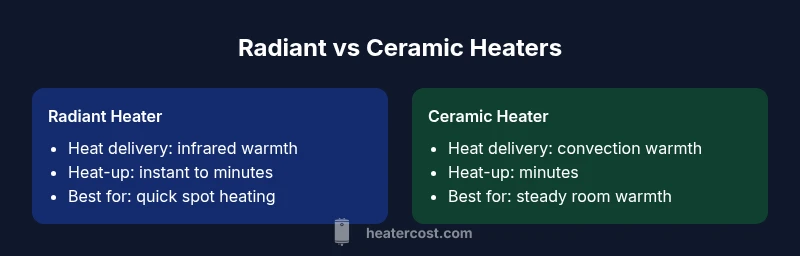
Radiant heater vs ceramic heater: In quick terms, radiant heaters warm people and objects directly with infrared energy, while ceramic heaters heat air that then circulates to warm a room. For most homes, ceramic models deliver steadier, energy-efficient warmth and safer long-running operation, whereas radiant units shine in spot heating and chilly corners. Heater Cost analysis suggests choosing based on space, usage, and safety needs.
Understanding the core differences between radiant heaters and ceramic heaters
When homeowners weigh radiant heater vs ceramic heater, the first distinction is how heat is produced and distributed. Radiant heaters emit infrared energy that warms people and objects directly, creating a sensation of warmth even in a cooler room. Ceramic heaters rely on a heating element that warms ceramic plates, which then heat surrounding air through convection. This difference matters for comfort, efficiency, and where the heat ends up in your living space. According to Heater Cost, the choice often hinges on whether you want rapid spot warmth or steady whole-room warmth. For smaller spaces or drafty corners, radiant units can feel more effective, while mid-to-large rooms typically benefit from ceramic convection heat. The decision should align with your climate, room layout, and daily routines to optimize comfort and cost.
How radiant heaters work: infrared warmth at the speed of light
Radiant heaters generate infrared radiation that travels directly to objects and people in the room. There is little heat lost warming air that will later rise and circulate. The warmth you feel is immediate, making radiant models well-suited for quick comfort around a couch, a desk, or a kitchen island. Infrared heat is efficient in short bursts, which can be beneficial in intermittent-use scenarios. However, radiant heaters can be less effective at distributing heat evenly in larger spaces without strategic placement and supplemental airflow. The Heater Cost team emphasizes starting with a clear spot-heat need—like a seating area or a drafty corner—before picking a model.
How ceramic heaters work: convection and even room warmth
Ceramic heaters use a heating element to warm ceramic plates, which then radiate heat and warm the surrounding air. The warmed air rises and circulates, creating a more even warmth throughout the room. This convection-based approach tends to suppress cold spots and provide a more stable temperature in moderate-to-large spaces. Ceramic heaters often include a fan that accelerates heat distribution, which can generate a gentle white-noise that some users find soothing. For households prioritizing uniform warmth and predictable comfort, ceramic models frequently outperform radiant units over time, especially when the heater runs for extended periods.
Heat-up time and warmth delivery: spot heating vs room warming
The speed at which a heater becomes noticeably warm matters. Radiant heaters excel at instant warmth near the heater, with occupants feeling warmth within moments. Ceramic heaters require a bit more time to warm the air and circulate it, but once running, they tend to maintain a comfortable ambient temperature across the room. In practical terms, if you frequently heat a single chair or a small work area, radiant models deliver faster perceived warmth. If you want to heat an entire living room or bedrooms overnight, ceramic heaters usually provide more consistent warmth with fewer temperature swings. Heater Cost notes that consumer experience often correlates with room size, ceiling height, and insulation quality, which can amplify or dampen both technologies.
Efficiency, energy costs, and long-term value: comparing operating costs
Energy efficiency depends on usage patterns and space coverage. Radiant heaters can be cost-effective for targeted, short-duration heating because energy goes directly into warming people and objects rather than the air. However, using a radiant model for continuous, all-room heating can be less efficient and lead to higher energy consumption in larger volumes. Ceramic heaters typically deliver better cost-per-hour when kept on for longer periods in a medium-sized room, thanks to more uniform heat distribution and reduced heat loss through drafts. Heater Cost Research indicates that the best value often arises from matching the heater type to the room’s needs—spot heat for comfort hotspots and convection heaters for general warmth. Remember to consider thermostat integration, energy source, and local electricity rates when estimating annual costs.
Safety features, maintenance, and long-term reliability
Both radiant and ceramic heaters incorporate essential safety features such as tip-over protection and overheat shutoffs. Radiant heaters may sport highly efficient reflectors and guards to reduce direct contact with hot surfaces, while ceramic heaters frequently include cool-touch housings and carbon steel bodies designed for durability. From a maintenance standpoint, ceramic heaters generally require less frequent cleaning of air pathways because heat is distributed through convection rather than a direct flame-like heat transfer. The Heater Cost Team stresses looking for models with certified safety features, cool-to-touch surfaces, and stable bases to minimize tip-overs in households with kids or pets. Long-term reliability is tied to build quality, cord durability, and the presence of a protective grille that remains cool to the touch.
Noise levels, comfort, and perceived room ambiance
Noise can influence the perceived comfort of a heater. Radiant units that operate without a fan are almost silent, providing warmth without contributing to ambient noise. Ceramic heaters with built-in fans can produce a noticeable hum or soft whir, which some users find distracting in bedrooms or study spaces. If you are sensitive to sound, prioritize models marketed as “quiet” or “silent operation” and consider fan speeds or thermal control features that minimize airflow when the room is at desired comfort. Heater Cost suggests evaluating noise on a rating scale or by reading user reviews to gauge real-world performance.
Room size, placement, and usage scenarios
The room’s dimensions, insulation, and layout determine which heater type performs best. For compact spaces, radiant heaters deliver targeted warmth with minimal heat loss, especially usable in home offices, bathrooms, or near a drafting window. In larger rooms or open-plan areas, ceramic heaters can offer steady warmth with less fluctuation in temperature. Placement matters: avoid obstructing air paths in ceramic heaters, and ensure radiant heaters are positioned to avoid direct exposure to skin or curtains. In seasonal climates, a hybrid approach—using radiant heat for quick comfort in the morning and a ceramic unit to maintain warmth in the evening—can maximize comfort and minimize operating costs.
Maintenance, durability, and warranty considerations
Both heater types benefit from regular cleaning to prevent dust buildup on grilles or reflectors, which can impede efficiency. Ceramic heaters with reinforced casings and higher thermal mass often withstand more daily use and may come with longer warranties. Radiant heaters, especially compact models, can offer portability but may rely on smaller components that require occasional replacement. When evaluating warranties, prioritize units with at least a 1–3 year coverage for parts and labor, and read the fine print on conditions that void coverage (for example, if used in damp environments). HeatersCost analyses suggest checking for UL certification or equivalent safety marks for peace of mind.
Practical buying tips: how to select based on climate, layout, and budget
To choose wisely between radiant heater vs ceramic heater, start with your climate and room profile. In cooler climates or rooms with uneven insulation, a ceramic heater can deliver more reliable warmth and lower energy waste. For quick warmth in a drafty entryway or near seating, a radiant heater makes sense. Compare initial costs, running costs, and expected heat coverage when evaluating models. Look for built-in thermostats, multiple heat settings, safety features, heat-output indicators, and warranty length. Finally, assess local electrical capacity and outlet placement to ensure the selected heater integrates safely with your home’s electrical system. Heater Cost recommends focusing on a model with a clear energy-use rating, simple controls, and a strong safety track record.
Common myths vs realities: setting expectations straight
A common myth is that radiant heaters “dry the air” more than ceramic heaters. In reality, both types can alter perceived comfort without significantly changing humidity levels unless used for extended periods in very dry climates. Another misconception is that bigger heaters are always better. Size should match room volume and insulation. The most practical approach is to test a heater’s warmth in the intended space, observe comfort over several hours, and compare operating costs across different settings. Heater Cost’s practical guidance emphasizes honest testing and a plan for phased usage rather than relying on loud spec sheets.
Installation considerations and regulatory notes for portable heaters
Portable radiant and ceramic heaters typically do not require professional installation or permits, but safety remains paramount. Follow manufacturer instructions for placement, keep heaters at least three feet from combustibles, and ensure outlets are compatible with the device’s plug and wattage. If you live in areas with strict energy codes or plan to use heaters in bedrooms or nurseries, review local regulations and product safety standards. Consider smart plugs or thermostats for more precise control and added energy savings. The Heater Cost team encourages keeping a log of maintenance checks and safety inspections to extend heater lifespan.
Comparison
| Feature | Radiant heater | Ceramic heater |
|---|---|---|
| Heat distribution | Direct infrared warmth to people/objects | Convection-based air warming with some radiant output |
| Heat-up time | Seconds to minutes for immediate warmth | Minutes to achieve room-wide warmth |
| Energy efficiency | High efficiency for spot heating | Efficient for steady room warming in medium-to-large spaces |
| Operating costs | Lower cost when used for targeted heating | Often lower hourly costs for whole-room comfort in moderate rooms |
| Safety features | Tip-over protection, cool surfaces (varies by model) | Overheat protection, tip-over, fan control |
| Noise level | Typically quiet (no fan needed) | Can produce fan noise during operation |
| Best for | Spot heating, immediate warmth | Whole-room warmth and consistency |
| Ideal room size | Small to medium spaces | Medium to large rooms |
The Good
- Fast, targeted warmth for specific tasks or spots
- Compact and portable options available
- Low upfront cost for basic units
- Wide selection across brands and features
Negatives
- Less uniform heat distribution in larger spaces
- Higher long-term operating costs if used to heat large areas
- Can cause dry air in dry climates with prolonged use
- Some models lack advanced safety features unless you pay more
Ceramic heaters generally offer better value for whole-room warmth and safety, while radiant heaters excel at targeted, quick spot heating.
If your goal is steady warmth across a room, a ceramic heater is usually the safer, more economical choice. For quick warmth in a specific area or spot heating, a radiant heater shines. Use Heater Cost’s guidance to match your room size, climate, and daily patterns to the right model.
Got Questions?
Which is more energy-efficient, radiant heater or ceramic heater?
Efficiency depends on use. For targeted, short-term warmth, radiant heaters can be efficient. For whole-room comfort and consistent temperatures, ceramic heaters often provide better energy efficiency overall, especially in medium to large rooms. Heater Cost analysis supports matching heat delivery to room requirements.
Efficiency depends on how you use it. Targeted warmth favors radiant heaters, while whole-room comfort favors ceramic heaters.
How quickly do radiant heaters heat a space compared to ceramic heaters?
Radiant heaters deliver near-instant warmth in the area they face, since heat travels directly to people and objects. Ceramic heaters take longer to warm the room because they first heat air and then distribute it. For rapid comfort in a small zone, radiant wins; for steady room warmth, ceramic often performs better over time.
Radiant heats instantly near the heater; ceramic warms the room more evenly but takes a bit longer.
Are radiant heaters safer for families with kids and pets than ceramic models?
Both types can be safe when used properly. Radiant models with protective grills and cool-touch exteriors reduce burn risk, but placement matters. Ceramic heaters typically offer good safety features as well, including tip-over protection and automatic shut-off. Choose models with certified safety marks and stable bases.
Both can be safe when placed correctly and equipped with safety features.
Can I use either heater in a bedroom or sleeping area?
Yes, but consider noise, heat distribution, and humidity. Ceramic heaters provide steady warmth ideal for bedrooms, while radiant heaters should be positioned away from sleeping faces and bedding to prevent overheating in a single spot. Always follow manufacturer safety guidelines.
You can, but pick a model with quiet operation and proper clearance.
What maintenance do these heaters require?
Regular cleaning to prevent dust buildup on grills, checking cords for wear, and periodic safety checks are sufficient for most models. Ceramic heaters may be cleaner to maintain due to fewer exposed moving parts, but both types benefit from annual inspections if used heavily.
Keep them clean, inspect the cord, and test safety features regularly.
What should I look for when buying a radiant or ceramic heater?
Look for thermostat accuracy, energy-efficiency features, safety certifications (UL/ETL), tip-over switches, cool-touch housings, and appropriate wattage for your space. Read reviews on reliability and warranty length. Heater Cost recommends comparing total operating costs over a year, not just upfront price.
Check safety marks, thermostat accuracy, and total running costs.
The Essentials
- Assess room size and insulation before choosing
- Prioritize ceramic for even warmth in larger spaces
- Use radiant for fast spot heating in small areas
- Check safety features and warranty coverage
- Consider noise preferences and thermostat accuracy