heater or blower: A data-driven comparison for homeowners
An objective, data-driven comparison of heater vs blower options to help homeowners choose the right space-heating solution based on room size, usage, and safety.


Blower-based heaters heat air quickly and excel in drafts, but can be noisier and cost more to run. Portable heaters are cheaper upfront and easier to move, yet they heat slower and are best for smaller spaces. Your choice depends on room size, usage patterns, and safety needs.
Understanding the heater or blower decision
For homeowners, renters, and property managers, selecting between a standalone heater or a blower-equipped unit is more than a preference; it shapes comfort, energy use, and safety. At a high level, a heater refers to any device that emits heat into a space, while a blower adds a fan to move warm air and accelerate warmth distribution. The Heater Cost team finds that the presence or absence of a built-in blower changes how quickly a room reaches comfort temperature, how loud the device is, and how the operating costs compare over time. In this section, we’ll unpack what each option does, the physics behind how they heat, and how to match them to room size and usage patterns. You'll learn practical guidelines for choosing the right tool for your space and budget, with real-world scenarios to illustrate trade-offs.
How heating methods differ: convection, radiant, and fan-forced
Heating methods vary in how heat is delivered and how it interacts with a room's layout. Convection heaters rely on ambient air circulation to warm the space, often delivering steady warmth over time. Radiant heaters emit infrared heat that directly warms objects and people in their line of sight, which can feel warmer on contact even if the air temperature is cooler. Fan-forced (blower) heaters combine elements of both by using a built-in fan to distribute heated air quickly, reducing cold spots across larger areas. The choice is not merely a matter of speed; it affects comfort balance, heat distribution, and energy impact. Understanding these differences helps homeowners align a product with room geometry, insulation quality, and preferred warmth patterns.
Energy efficiency and operating costs: what to expect
Energy efficiency is not a single metric; it depends on the room, setpoint, and usage. In many cases, blower heaters achieve rapid warmth, which can reduce the time the heater runs at high power. Conversely, convection-only or radiant heaters may deliver heat more gradually but maintain a stable, comfortable temperature with longer cycles. According to Heater Cost analyses, a device with a blower can improve perceived warmth quickly in drafty spaces, yet the ongoing energy cost can be higher if used for extended periods. Homeowners should compare efficiency ratings, estimated operating hours, and the energy source, then weigh these against room size and insulation quality. The goal is to minimize waste while achieving consistent comfort.
Safety standards, placement, and child/pet considerations
Safety is a core criterion when choosing between a heater or blower-based unit. Portable electric heaters should be placed on stable surfaces away from flammable materials, with clearance around vents. Look for features like tip-over switches, overheat protection, and automatic shutoffs. Blower-equipped models add moving parts and sometimes a louder operation; ensure the device is rated for the intended room and that cords do not pose tripping hazards. For homes with children or pets, favor models with robust safety features and consider automatic shutoffs when doors or windows are opened, reducing the risk of overheating and energy waste. Heater care routines — regular cleaning of dust from vents and filters — improve safety and efficiency over time.
Room dynamics: size, insulation, draft, and ceiling height
Room size and insulation are major determinants of whether a heater or blower is appropriate. Small rooms with good insulation benefit from compact heaters that deliver comfortable warmth without chasing heat across a large volume. Large rooms or spaces with drafts benefit from blower heaters that distribute warmth quickly and evenly, mitigating cold spots. Ceiling height also influences heat stratification; in high-ceiling rooms, outlets and vents placed higher can help deliver warmth where it’s needed. When evaluating options, homeowners should estimate the sensible heat load of the space and match it to the device’s heat output profile and distribution pattern.
Comfort factors: noise, air movement, humidity impact
A key trade-off is noise and perceived air movement. Blower heaters generate airflow, which can feel more aggressive and audible, especially at higher settings. Some users appreciate the immediate warmth, while others prefer a quieter, slower warm-up. Radiant and convection-only models tend to be quieter but may require longer runtimes to reach the same comfort level. Noise levels also influence air quality perceptions, as constant airflow can slightly dry the air in dry climates. Practically, homeowners should balance desired pace of warmth with tolerance for sound and potential humidity shifts.
Portability, installation constraints, and long-term planning
Portability matters for renters or multi-room homes; compact portable heaters can be moved between rooms, offering flexibility without installation. Built-in or plug-in blower heaters offer faster warm-up in dedicated spaces but may reduce flexibility. Consider long-term plans: if you expect to stay in a space for several years, a more robust, permanently installed solution may offer better efficiency and safety features. If you anticipate frequent reconfiguration of living areas or seasonal use, portability becomes a major factor in total cost of ownership.
Practical buying checklist: what to compare on labels
When shopping, read the label for heat output (in watts or BTUs), energy efficiency ratings, and safety certifications. Check the presence of a tip-over switch, cool-touch exteriors, and insulated cords. For blower models, examine the airflow rate and noise level at different settings. For compact portable devices, verify weight and ergonomic design for easy relocation. Consider warranty length, service availability, and replacement-part accessibility, which impact long-term reliability and total ownership costs.
Real-world scenarios: when to pick which option
In a drafty apartment with a small living area, a blower heater can quickly raise comfort levels in minutes, making it a sensible choice. In a well-insulated bedroom used at night, a radiant or convection heater may provide steady warmth with minimal runtime and reduced noise. In a sunlit kitchen or a workshop, a portable convection-only unit might be sufficient. Across these cases, the key factors are the room’s volume, insulation, user tolerance for noise, and how often heat is needed. A careful comparison helps you avoid overpaying for capacity you don’t need.
Maintenance and longevity: keeping heat devices safe and efficient
Regular maintenance is essential for safety and efficiency. Clean dust from vents and fans, inspect power cords for wear, and replace worn filters if applicable. Store devices away from moisture and direct sunlight when not in use. Blower-equipped units may require periodic fan lubrication or service checks to ensure smooth operation. For prolonged use, schedule annual inspections where feasible, especially in homes with children, pets, or high-traffic rooms. Proper maintenance reduces fire risk, improves heat delivery consistency, and extends the life of the equipment.
The ROI and environmental considerations of heating choices
Choosing between a heater and a blower-based unit involves balancing upfront cost, operating cost, and environmental impact. While blower models can deliver warmth quickly, the energy consumed during fast heat-up periods may raise annual electricity usage. Efficient models with smart thermostats and proper sizing offer the best ROI by minimizing wasted heat. From an environmental perspective, better insulation and draft reduction often yield more significant savings than selecting one device type over another. Heater Cost's framework emphasizes sizing accuracy, usage patterns, and safety as the core drivers of responsible heating choices.
How to decide now: a six-step decision plan
- Measure the room and estimate heat load; 2) Assess insulation and drafts; 3) Define how often and how long you’ll heat the space; 4) Compare blower vs non-blower heat delivery and noise tolerance; 5) Check safety features and warranty coverage; 6) Test different models in-store or via reputable reviews and select the one that best matches your space and budget. This structured approach helps you avoid overbuying and ensures reliable comfort.
Comparison
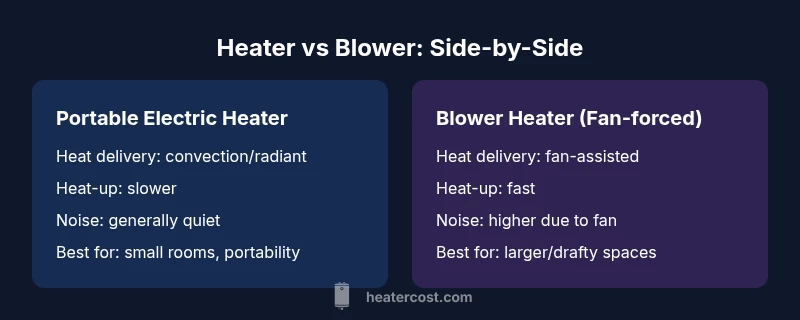
| Feature | Portable Electric Heater | Blower Heater (Fan-forced) |
|---|---|---|
| Heating Method | Convection and/or radiant heat (no built-in blower) | Fan-assisted air distribution (built-in blower) |
| Heat-Up Time | Slower to warm a room | Faster warmth due to fan distribution |
| Typical Heat Output | Lower to moderate for small rooms | Higher heat output for quick warmth in larger or drafty spaces |
| Energy Efficiency Considerations | Efficient for short bursts; may run longer to maintain temperature | Can be efficient for rapid comfort but may consume more when run at high speed |
| Noise Level | Generally quiet at low to mid settings | Can be noticeably louder due to air movement |
| Best For | Small rooms, temporary heating, apartments, portability | Drafty spaces, larger rooms, quick warmth when needed |
| Price Range (qualitative) | Lower upfront cost; budget-friendly | Higher upfront cost; premium features sometimes available |
The Good
- Low upfront cost for portable options
- High portability and flexibility
- Blower heaters deliver rapid warmth in drafts
- Simple to use and relocate between rooms
- Wide availability and broad model selection
Negatives
- Running costs can be higher with continuous use
- Blower models tend to be noisier
- Limited heat coverage in very large spaces without multiple units
- Portable units may lack advanced safety features of some built-ins
Blower heaters win for speed in drafts; portable heaters win for cost and flexibility
Choose blower if you need fast warm-up in a drafty space. Opt for portable heaters when budget, mobility, and simple operation matter most.
Got Questions?
What is the main difference between a heater and a blower heater?
A heater can emit heat without a fan, using convection or radiant methods. A blower heater includes a built-in fan to move warm air, speeding heat distribution and warming larger spaces more quickly. The choice depends on how fast warmth is needed and space layout.
A heater uses heat without forcing air movement, while a blower heater adds a fan to push warm air out quickly. Your space size and how fast you want to feel warmth will guide the choice.
Which option is safer for households with children and pets?
Both can be safe if used properly. Prioritize models with automatic shutoff, tip-over protection, and cool-touch surfaces. Place units away from reach and ensure cords are secured. Regular maintenance reduces risks.
Safety depends on features like tip-over shutoff and cords kept out of reach. Choose models with strong safety certifications and keep space clear.
Can I use either option year-round?
Yes, both can be used year-round in appropriate climates, but efficiency and comfort will vary with seasonal needs. For long-term usage, consider insulation improvements and thermostat-based controls to maximize efficiency.
You can use either year-round, but think about your climate and insulation to keep costs reasonable and comfort steady.
What maintenance is typically required?
Regular cleaning of vents and fans, checking cords for wear, and ensuring safety features work. Blower units may need periodic fan checks; follow manufacturer guidelines for service intervals.
Keep vents clean, inspect cords, and test safety features. Schedule annual checks if possible, especially in busy homes.
Are there energy-efficient models available for both options?
Yes, many models offer energy-saving modes, programmable thermostats, and ECO settings. Efficiency depends on proper sizing, usage patterns, and insulation quality rather than the device type alone.
There are energy-saving modes and smart controls in both options; efficiency comes from good sizing and usage, not just the model.
What is a typical warranty range for home heaters?
Warranties vary by brand and model, commonly spanning from one to several years. Check parts coverage, labor terms, and the availability of service centers in your area.
Warranties usually cover several years but vary; verify what is included for parts and service.
The Essentials
- Assess room size and insulation before choosing
- Blowers heat quickly but may be louder and cost more
- Portable heaters offer flexibility and lower upfront cost
- Safety features are essential for households with kids or pets
- Choose based on usage pattern, not just wattage