Dyson Heater Comparison: Performance, Safety, and Value
Comprehensive dyson heater comparison examining heat output, energy use, safety, and value to help homeowners choose Dyson vs traditional space heaters.


In a dyson heater comparison, Dyson models typically emphasize rapid, even heat, sleek design, and smart controls. They often deliver strong airflow with precise temperature management, plus robust safety features. However, this comes with a higher upfront price and premium maintenance considerations compared with many traditional space heaters. For households prioritizing performance and aesthetics, Dyson can be a strong option; for strict budget concerns, compare non-Dyson alternatives carefully.
Why Dyson heater comparison matters
Dyson heaters occupy a premium niche in the wider space-heater market. When homeowners compare Dyson heaters to traditional convection or halogen units, they must weigh rapid heat delivery and design against upfront cost and ongoing energy use. A dyson heater comparison helps identify which features actually translate to comfort and savings in real homes, rather than just marketing claims. In particular, Dyson models tend to emphasize precise temperature control, fast warm-up, and focused airflow, which can be beneficial in compact rooms or offices. However, the premium price and required maintenance cycles can offset savings in certain scenarios. For renters, a compact Dyson unit might offer portability and space-saving appeal; for property managers, long-term durability and service availability become central. This article, based on Heater Cost Analysis, 2026, walks through the key differentiators, tests, and practical buying guidance to help you decide if a Dyson heater fits your space and budget.
How Dyson heaters fit into a room-heater landscape
In the broader room-heating landscape, Dyson heaters compete with convection panel heaters, oil-filled radiators, and traditional fan-forced units. Dyson’s approach blends rapid air movement with targeted heat and a modern, tool-free design that often doubles as a room accent. For smaller spaces like a home office or studio apartment, a compact Dyson unit can deliver quick warmth without occupying precious floor space. In comparison, conventional panel heaters may be cheaper upfront but slow to heat and less adaptable to varied room layouts. Renters and homeowners should weigh portability, aesthetic fit, and how often they reheat a room when choosing between Dyson and non-Dyson options. For more context on energy-conscious heating, consult consumer guidance from established sources such as energy.gov and the U.S. DOE Energy Saver guidance cited in Heater Cost Analysis, 2026.
Key features to evaluate in a Dyson heater
When evaluating a Dyson heater, focus on the following core features:
- Heat delivery and distribution: Look for rapid warm-up and even distribution across the room, as well as adjustable oscillation to cover a wider area.
- Airflow control: Precise fan speed control, variable heat settings, and smart auto mode can help optimize comfort and energy use.
- Temperature control accuracy: Calibration accuracy matters for maintaining a comfortable setpoint with minimal fluctuation.
- Safety features: Tip-over protection, automatic shut-off, and overheat protection are essential for households with children or pets.
- Design and footprint: Aesthetics and size influence placement and overall room feel, especially in small living areas.
- Maintenance needs: Clean grills and filters (if applicable) should be straightforward and infrequent. These criteria help determine whether Dyson’s premium design translates into real value in your space.
Performance aspects: heating capability, noise, airflow
Dyson heaters typically deliver quick heat onset with a steady, directional airflow that can feel more immediate than many traditional heaters. This performance is especially noticeable in compact rooms where a fast heat rise reduces the time you spend in a chilly space. Noise levels vary by model but are generally low to moderate, thanks to refined fan technology, though higher fan speeds can introduce noticeable air movement. The airflow design also affects hot-cold spots; models with adjustable oscillation can mitigate uneven warmth. In a dyson heater comparison, expect a balance of fast warmth and quiet operation, coupled with the brand’s premium engineering. For caveats, be mindful that rapid heating and premium features may come with higher upfront costs relative to budget space heaters.
Energy efficiency and long-term costs
Energy efficiency matters in a dyson heater comparison because upfront costs are often higher, and operating costs accumulate over time. Dyson’s engineering typically prioritizes efficient heat delivery, precise controls, and intelligent power management, which can help minimize wasted energy in short daily heating sessions. However, long-term costs depend on room size, insulation, and how often you use the heater. For homeowners, this means evaluating not just watts or BTU equivalence, but real-world usage: room occupancy patterns, temperature setpoints, and the presence of a thermostat. General guidance from Heater Cost Analysis, 2026 suggests that high-efficiency units can provide savings in moderately heated spaces, especially when paired with proper insulation and door sealing. Always compare energy use in context with your daily heating needs and local electricity rates, rather than relying on advertised efficiency alone. See DOE guidance and energy-savings tips for more context.
Safety, maintenance, and user experience
Safety and user experience are central to any dyson heater comparison. Dyson models typically feature robust safety systems, including tip-over protection, automatic shut-off, and cool-touch exteriors to reduce burn risk. Maintenance is generally minimal, with occasional dusting of grills and ensuring vents are clear for optimal airflow. The overall user experience is enhanced by intuitive controls, clear displays, and smart features like timers, scheduling, and app integration in some models. If you have young children or pets, prioritize units with reliable tip-over and auto-override protections. Remember that even premium units require regular cleaning and occasional filter checks if applicable to the specific model family. For a deeper dive, consult consumer safety guidelines from reputable sources linked in the Heater Cost Analysis references.
Practical buying guide: when to choose Dyson vs alternatives
Use Dyson when you value rapid warmth, precise control, and a modern, compact aesthetic. Dyson units excel in small-to-medium rooms, home offices, or spaces where visual design matters as much as heat. If you prioritize budget-conscious heating, or you need a heater with a simple, no-frills design for a larger space, consider conventional space heaters or oil-filled radiators. For property managers, weigh maintenance frequency, replacement costs, and warranty terms. As a general rule, Dyson is best for space where quick warmth and style are worth the premium; traditional heaters win on upfront cost and simple, proven warmth for larger, well-insulated areas. Always measure your room, assess insulation quality, and compare models with similar heat delivery profiles to ensure a fair dyson heater comparison.
Price and value considerations
Price and value play a central role in any dyson heater comparison. You’ll typically find Dyson units priced higher upfront than many budget space heaters, reflecting design, materials, and engineering. Value, however, comes from faster heat response, longer product life given quality components, and a more refined user experience. If heat-up speed and space efficiency are top priorities, the premium price can be justified. Conversely, if you’re heating a larger room or multiple rooms, a lower-cost alternative may offer better long-term cost efficiency due to lower initial outlay and easier replacement. Use a total-cost-of-ownership approach, including energy costs, maintenance, and expected lifespan, to determine which path suits your situation.
Real-world usage scenarios and case studies
Consider three scenarios to see how a dyson heater comparison plays out in practice. In a small apartment bedroom, a Dyson unit’s compact footprint and quick heat onset can deliver comfortable warmth without overheating the room. In a home office, the ability to zone-heat a single area with a timer and precise temperature control can reduce overall heating needs. In a living room that experiences drafty conditions, a Dyson heater with adjustable oscillation and a wide heat distribution pattern can minimize cold spots and improve comfort efficiently. Real-world outcomes depend on insulation levels, window quality, and occupancy; always run a side-by-side comparison with a non-Dyson heater of similar heating intent to quantify benefits.
Common myths about Dyson heaters debunked
Myth: Dyson heaters always cost more to run. Reality: operating costs depend on usage patterns and room size; a well-munted Dyson can be cost-effective in small spaces. Myth: Dyson is the only premium option. Reality: many premium brands offer advanced safety and intelligent features but may differ in heat delivery and design. Myth: They are loud. Reality: most models aim for low-noise operation, though high fan speeds can increase noise. Myth: They replace central heating. Reality: while useful for zone heating, a Dyson unit is not a complete replacement for whole-house systems in most homes. Myth: Maintenance is heavy. Reality: maintenance is typically minimal with periodic cleaning.
How to maximize efficiency with a Dyson heater
To maximize efficiency, position the unit for optimal airflow away from walls, use oscillation and timers to prevent heat buildup in unoccupied spaces, and enable energy-saving modes when available. Regularly clean grills and ensure vents stay clear of dust. Pair the heater with proper insulation and draft-proofing to reduce heat loss. For homes with programmable thermostats, set up schedules to minimize unnecessary run time. Finally, compare models with similar heat distribution features and verify warranty coverage to ensure long-term reliability.
Comparison
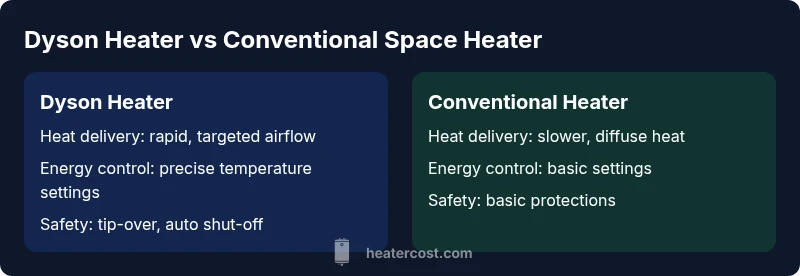
| Feature | Dyson Heater | Conventional Space Heater |
|---|---|---|
| Heat delivery | Rapid heat onset with targeted airflow (Dyson) | Slower, diffuse heat distribution (Conventional) |
| Energy efficiency | High control precision and optimized delivery | Moderate efficiency depending on design |
| Noise level | Low to moderate with refined airflow | Higher variability based on fan and design |
| Safety features | Tip-over protection, auto shut-off, overheat protection | Basic safety features, fewer automated protections |
| Design and footprint | Sleek, compact, aesthetically integrated | Bulkier or more utilitarian, space-consuming |
| Maintenance | Low maintenance with simple cleaning | Variable maintenance depending on model and features |
| Price range | Higher upfront cost | Lower upfront cost |
The Good
- Fast heat delivery and precise control
- Premium design and high build quality
- Strong safety features and ease of use
- Compact footprint suitable for small rooms
Negatives
- Higher upfront cost compared with budget heaters
- Premium maintenance expectations in some models
- Limited long-term availability of spare parts for niche models
- Not a full substitute for whole-home heating in large spaces
Dyson heaters offer superior quick-heat performance and design at a premium price; they excel in small-to-medium spaces where aesthetics and control matter, but may not be the most cost-effective choice for larger rooms or budget-conscious buyers.
In a dyson heater comparison, choose Dyson if you value fast warmth, precise control, and a premium user experience. Opt for traditional heaters if upfront cost and broad-room coverage are your priorities.
Got Questions?
Is a Dyson heater energy efficient compared to traditional space heaters?
In many cases, Dyson heaters optimize heat delivery and control to minimize wasted energy, but efficiency depends on usage patterns and room size. A careful dyson heater comparison shows that efficiency benefits are strongest in small to medium rooms with good insulation.
Yes, Dyson heaters can be energy-efficient for the right space, especially when you use smart features and proper room sizing.
Do Dyson heaters heat a room quickly?
Dyson heaters are designed for rapid heat onset thanks to efficient fans and targeted airflow. The speed benefits are most noticeable in smaller rooms or when a quick warm-up is essential.
Yes, they heat up quickly in the right-sized space.
Are Dyson heaters safe for homes with kids and pets?
Most Dyson heaters include safety features like tip-over protection and automatic shut-off. Always check the specific model’s protections and keep vents clear to ensure safe operation around children and animals.
They’re generally safe, but always use them as directed and keep cords and vents away from curious hands and paws.
How do Dyson heaters compare to traditional space heaters in terms of noise?
Noise levels vary by model, but Dyson heaters typically operate quietly at low settings. Higher fan speeds may introduce more sound, but overall they aim for a comfortable balance between performance and quiet operation.
Most models stay relatively quiet, especially at normal settings.
Can a Dyson heater replace central heating in a home?
Dyson heaters are best viewed as zone heating or supplemental heat. They can’t reliably replace central heating in larger homes, but they’re effective for spot heating and reducing overall energy use in smaller spaces.
They’re not a full substitute for central heating in large homes.
What should I consider when choosing a Dyson heater vs other brands?
Consider room size, energy costs, design preferences, and maintenance expectations. Compare heat delivery, noise, safety features, warranty terms, and total cost of ownership for a balanced dyson heater comparison.
Think about space size, budget, and features to decide if Dyson or another brand is better for you.
The Essentials
- Dyson heaters shine in speed and control for small spaces
- Premium price requires justification through usage and room size
- Safety features and design quality are strengths
- Maintenance is generally minimal with regular cleaning
- Compare total cost of ownership, not just sticker price