Solar Water Heater Installation Cost: What to Expect in 2026
Get realistic solar water heater installation cost estimates, compare system types, and learn price drivers, incentives, and payback with practical ranges from Heater Cost.


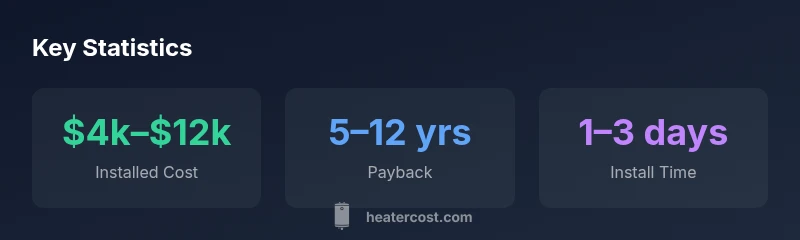
Typical solar water heater installation costs range from $4,000 to $12,000, depending on system type, roof complexity, and permitting. Incentives can reduce upfront costs and shorten payback. This quick answer introduces the main cost drivers and sets expectations for ranges, with detailed context in the body based on Heater Cost Analysis, 2026.
What Affects Solar Water Heater Installation Costs\n\nAccording to Heater Cost, the upfront price of a solar water heater installation is driven predominantly by equipment choice, roof layout, and permitting requirements. Retrofit installations on existing homes tend to incur more labor and roof work than new-construction jobs. Climate and usage patterns also influence the mix of components selected, such as whether an electric backup is included. In 2026, most homeowners see a broad cost band that reflects these variables, with incentives capable of reducing the net outlay. The key is to define your desired energy outcome (peak hot water supply, off-peak reliance, or backup performance) and then map each cost category to that goal. The rest of this article breaks down what to budget and how to get reliable quotes from qualified installers.
System Types and Their Cost Implications\n\nSolar water heating systems come in several configurations, with costs varying by technology and integration. Active systems use pumps and controls to circulate heat-transfer fluid, while passive systems rely on natural convection. Evacuated-tube collectors tend to excel in cold or cloudy climates but cost more upfront, whereas flat-plate collectors offer a lower entry price with slightly lower efficiency in extreme conditions. Storage options can be integrated, or you can pair collectors with an existing tank or a separate storage unit. When you weigh options, the critical price drivers are system type, collector technology, storage configuration, and whether a backup heater is included. Based on Heater Cost Analysis, 2026, the cost differences between configurations can be substantial but are predictable once you specify climate, usage, and efficiency goals. Tip: use a standardized quote template to compare equipment, labor, and permitting line items across suppliers.
Regional Variations and Permitting\n\nWhere you live affects both the price and the process. Regional climate affects equipment choices, and local building codes determine permit requirements and inspections. Permit fees can range from modest to several hundred dollars, and some jurisdictions require plan reviews or engineering compliance for non-standard installations. Urban areas often add higher permit and labor costs due to busy schedules and access challenges, while rural regions may have more limited contractor options. When budgeting, include potential costs for roof penetrations, flashing, and fall-protection equipment if required by code. The Heater Cost team notes that timing for inspections can also influence labor costs if delays occur.
Equipment, Labor, and Installation Components Breakdown\n\nA typical installed price is a combination of four broad categories: equipment, labor, permits, and additional components. In many cases, equipment accounts for roughly 40–60% of the total installed cost, while labor represents 20–40%. Permits and inspections usually add 2–5%, and ancillary items such as pumps, controllers, antifreeze, and piping can add 5–15%. Geography, roof type, and installation complexity shift these shares. Understanding this breakdown helps homeowners benchmark quotes and identify where savings are feasible, such as selecting a simpler storage solution or scheduling work during periods with lower labor rates.
Financing, Incentives, and Payback\n\nFinancing options—such as home-improvement loans or energy efficiency loans—can spread out the upfront cost. Incentives and rebates vary widely by state and locality, and programs can substantially reduce net price and shorten the payback period. Because incentives are location-specific, it’s essential to check state and municipal resources early in your planning. Even without incentives, solar water heating often provides meaningful energy cost reductions over time, especially in homes with high water heating needs or rising electricity prices. By calculating net cost after incentives, homeowners can compare solar investments to other efficiency improvements.
How to Estimate Your Costs: A Practical Step-by-Step\n\nFollow these steps to estimate your project cost before you start shopping: 1) Determine current hot water usage and peak demand to size the system. 2) Choose system type and storage configuration that align with goals and climate. 3) Gather detailed quotes that break out equipment, labor, permits, and any electrical upgrades. 4) Factor in potential roof work and any required mounting hardware. 5) Include ongoing maintenance costs and potential replacements for components like pumps or controllers. 6) Subtract expected incentives and tax credits to estimate net price. 7) Get at least three quotes, and compare not only price but warranty terms and service support. 8) Review local energy rates and cooling/off-peak electricity prices to estimate long-term savings. 9) Use a simple payback model to determine whether the project meets your financial goals.
Choosing the Right Contractor and Warranty Considerations\n\nChoosing a qualified installer is as important as choosing the system itself. Look for licenses, insurance, and verifiable references. Ask for written warranties covering both equipment and workmanship, and verify the duration of coverage for collectors, tanks, and pumps. Clarify response times for service calls and whether maintenance checks are included in the warranty. A solid warranty can significantly reduce risk and long-term ownership costs, especially if performance targets aren’t met early on.Note: ensure the installer’s project plan includes roof assessment, leak testing, and a commissioning report with performance data.
Real-World Scenarios: Typical Install Profiles\n\nSmall to mid-sized homes with moderate hot-water use often fall in the lower end of the installed-cost range, typically around the mid-four figures to the lower five figures before incentives. Larger homes with high hot-water demand, 2–3-story roofs, or complex roof lines may push costs higher into the upper five figures. In all cases, climate and local codes influence both equipment choice and labor requirements. This section presents two representative profiles to illustrate how household size, climate, and roof type interact with cost. Profile A reflects a modest retrofit in a mild climate; Profile B depicts a larger system upgrade in a climate with greater heating needs. These scenarios are designed to give homeowners a sense of scale and are not quotes.**
Next Steps: Planning Your Solar Water Heater Project\n\nWith a clearer sense of cost drivers and a strategy for pricing, you can move toward a solid plan. Begin by evaluating hot-water consumption and climate, then request three to five detailed proposals from licensed installers. Compare not just price, but equipment quality, warranty provisions, and the installer’s ability to perform required permits and inspections. Consider starting with a smaller retrofit as a pilot project to validate performance before expanding to a full-system upgrade. Finally, set a realistic timeline and budget buffer for weather, supply chain shifts, and permit processing delays.
Cost comparison by system type
| System Type | Typical Installed Cost Range (USD) | Notes |
|---|---|---|
| Active solar water heater with electric backup | 4000–12000 | Common residential setup; good backup option |
| Passive solar water heater | 3500–9000 | Cheaper upfront; varies with climate |
| Vacuum tube collector with storage | 4000–10000 | High efficiency in cold weather |
| Flat-plate collector with integrated storage | 4500–11000 | Durable and reliable in diverse climates |
Got Questions?
What factors most influence the installation cost of a solar water heater?
The largest drivers are the system type, collector technology (evacuated tube vs flat plate), storage configuration, roof access, and permit requirements. Climate and hot-water usage also affect the required size and components, which in turn impact price.
The big price drivers are system type, roof access, and permits, plus climate and usage.
Are there incentives or rebates for solar water heater installation?
Yes, many jurisdictions offer incentives that reduce upfront costs. Availability varies by state, municipality, and program timing. Check local energy offices and utility programs to identify applicable rebates or tax credits.
There are local incentives that can cut upfront costs; check your city, state, and utility programs.
How long does installation typically take?
Most installations take 1–3 days for the equipment and connections, with additional time for permitting, inspection scheduling, and any roof work. Complex roofs or retrofit constraints can extend this window.
Most installs take a day or two, plus permit processing time.
Do I need permits for solar water heater installation?
Most jurisdictions require a building permit for solar water heater installations, especially if roof penetrations or electrical work are involved. Check with your local building department early in planning.
Usually yes—check with your local building department before starting.
What is a reasonable payback period for solar water heating?
Payback depends on system size, energy prices, and incentives. Typical ranges are 5–12 years, with shorter payback in regions with higher energy costs or generous incentives.
Payback is often 5–12 years, depending on incentives and energy costs.
Is solar water heating worth it for rental properties?
Solar water heating can reduce operating costs for rental properties, but upfront planning and tenant safety are crucial. Consider maintenance responsibilities and program terms before installing.
For rentals, consider long-term savings and maintenance when deciding.
“Solar water heater installation costs are highly variable, but with careful planning and the right contractor, homeowners can unlock strong long-term savings.”
The Essentials
- Budget for system type, roof, and permitting as the main cost drivers
- Incentives can meaningfully reduce net price but vary by location
- Request side-by-side quotes detailing equipment, labor, and permits
- Choose a contractor with solid warranties and documented performance
- Use a step-by-step estimation approach to avoid sticker shock