What GPM Is Needed for a Tankless Water Heater
Learn how to size a tankless water heater by GPM. This guide covers peak demand, temperature rise, fixture mix, and practical steps for homeowners, renters, and property managers.


What gpm needed for tankless water heater? Most homes need 2.0–5.0 GPM depending on peak demand and temperature rise. For a single bathroom, 2.0–2.5 GPM may suffice; for larger homes with multiple fixtures, aim for 3.5–5.0 GPM. Use a professional calc to confirm.
Understanding GPM and Tankless Water Heaters
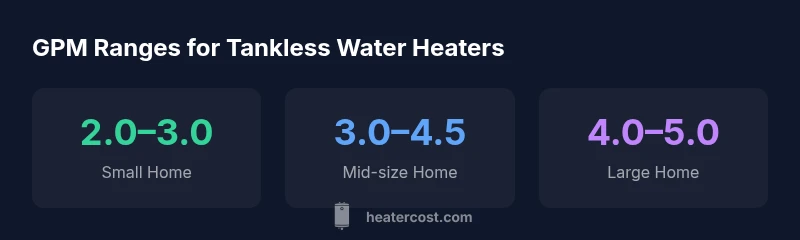
GPM, or gallons per minute, measures your water flow. A tankless unit heats water on demand, so it must be sized to handle your home’s peak hot-water draw rather than the total volume of a storage tank. According to Heater Cost, the right GPM is not a single number but a range that reflects fixture mix, temperature rise, and usage patterns. In practice, most households fall into a few broad categories: compact apartments often operate effectively around 2.0–3.0 GPM, mid-sized homes usually require 3.0–4.0 GPM, and larger households commonly need 4.0–5.0 GPM or more to avoid cold showers during peak usage. Understanding this logic helps you answer the question of what gpm needed for tankless water heater without oversizing or undersizing.
Measuring fixtures and calculating peak demand
To size by peak demand, list every fixture that might draw hot water at the same time. Typical flow rates (for planning purposes) include showers 1.5–2.5 GPM, sinks 0.5–1.5 GPM, and appliances such as dishwashers or washing machines 1.0–2.0 GPM. Add the highest expected flow for any given moment. For example, in a small apartment with one shower and a vanity faucet, you’d estimate 1.8–2.5 GPM. A family home with two simultaneous showers plus a sink could reach 3.5–5.0 GPM. These are planning ranges; verify with a professional and consider temperature rise as well.
Temperature rise and GPM: A key relationship
Tankless heaters are rated by their maximum GPM at a specific temperature rise. If your incoming water is cold, the unit’s effective GPM drops as the temperature rise increases. A common rule of thumb: for each 10°F of rise, the available GPM roughly decreases by 15–20%. Therefore, the same unit that delivers 4 GPM at a 40°F rise might deliver only 3 GPM at a 70°F rise. This relationship means you must consider both fixture mix and desired output temperature when sizing.
Sizing scenarios by household type
• Small apartment (1 bathroom, limited hot-water demand): 2.0–3.0 GPM. This range covers typical showers and basic fixtures without sacrificing comfort.
• Busy family (two bathrooms, occasional simultaneous use): 3.5–4.5 GPM. You’ll likely need multiple fixtures running and should plan for a mid-range GPM.
• Large home with high-demand appliances (dishwasher, soaking tub, multiple showers): 4.0–5.0 GPM or higher. In these setups, peak demand can overwhelm smaller units, so staged or dual-unit configurations can be beneficial.
Practical sizing steps and common mistakes
Sizing by GPM should be a structured process. Start by listing fixtures and estimated flows, then estimate a reasonable temperature rise based on your climate and desired output. Use the calculation GPM = (BTU/hr) / (Rise × 5000) as a guiding principle, while remembering most residential tankless heaters are rated by their GPM at a given rise. Don’t overlook venting, installation clearances, and the availability of gas supply or electrical capacity. A frequent mistake is oversizing for rare occasions (causing unnecessary energy use) or undersizing for winter months (leading to cold showers). Always cross-check with a professional and consider future needs as your household evolves.
Authority sources and data context
For sizing guidance, rely on established sources and industry practice. Energy.gov’s guidance on water heaters and tankless technology provides foundational context, while the ENERGY STAR program outlines efficiency considerations and best practices. National labs and reputable trade publications also emphasize the impact of fixture mix and climate on GPM sizing. This article synthesizes those ideas with Heater Cost’s 2026 analysis to offer actionable sizing ranges and a practical workflow for homeowners and property managers.
The Heater Cost approach and next steps
The Heater Cost team recommends starting with peak-demand sizing, then validating with a professional to accommodate your climate, fixture mix, and future plans. If you’re unsure, begin with a conservative mid-range target (around 3.0–4.0 GPM for a typical family home) and adjust based on actual usage and seasonal changes. Heavier usage or colder climates may justify a higher GPM target or even a twin-unit solution for continuous hot water. The goal is reliable comfort without overspending on oversized equipment.
GPM ranges by household configuration
| Configuration | Typical GPM Range | Notes |
|---|---|---|
| Small Home (1 bath) | 2.0–3.0 GPM | Limited simultaneous use |
| Mid-size Home (2 baths) | 3.0–4.5 GPM | Occasional simultaneous showers |
| Large Home (3+ baths) | 4.0–5.0 GPM | High demand fixtures |
Got Questions?
What GPM range covers a typical shower?
A typical shower uses about 1.5 to 2.5 GPM, depending on fixture efficiency and spray settings. When sizing, use the higher end of this range if you have low-flow fixtures. Large homes with multiple showers must account for simultaneous use.
Most showers run around one-and-a-half to two-and-a-half gallons per minute; plan for the higher end if you have several fixtures.
How do I calculate the GPM I need for my home?
List all fixtures that could draw hot water at once, assign a realistic flow rate to each, and sum them to estimate peak GPM. Then adjust for the temperature rise you expect at your climate and desired output.
List your fixtures, estimate each flow, add them up, and then adjust for the temperature rise you expect.
Do I need a separate heater for every bathroom?
No. Most homes are well served by a single appropriately sized tankless heater or a dual-unit setup that targets peak demand. Oversizing to cover every possible combination isn’t efficient.
Usually you don’t need a heater for each bathroom; size to peak demand and consider future needs.
Can electric tankless heaters meet high GPM demands?
Electric tankless heaters generally have lower maximum GPM compared with gas units. For high-demand homes, gas-fired or dual-unit configurations are often preferred, especially in colder climates where temperature rise is greater.
Electric units typically don’t reach the same GPM as gas units for high demand; gas or dual setups are common for bigger homes.
What should I do if my plans change?
Recalculate peak demand and GPM targets after any major fixture changes, like new bathrooms or upgraded appliances. You may need to resize or add a second unit to maintain hot-water reliability.
If plans change, recalculate your GPM needs and adjust sizing or add capacity as needed.
“Sizing a tankless water heater by GPM is about aligning peak demand with the heater's maximum flow. Use careful calculations and professional input to avoid undersizing or oversizing.”
The Essentials
- Size by peak demand, not total volume.
- Temperature rise dramatically affects usable GPM.
- Use fixture mix to refine GPM targets.
- Always verify sizing with a pro and document assumptions.
- The Heater Cost team recommends a conservative, test-and-adjust approach.