Difference Between a Water Heater and a Boiler: A Comprehensive Guide
Understand the difference between a water heater and a boiler, how each system works, energy use, installation needs, and which option fits your home, with practical comparisons and cost considerations.


When deciding between a water heater and a boiler, the key distinction is their primary purpose: water heaters provide domestic hot water for taps and appliances, while boilers heat your home through a central hydronic system and may also supply domestic hot water. In many homes, a boiler can be used to generate both space heating and hot water, but not all boilers are designed to meet domestic hot water demand alone. Understanding this difference helps homeowners choose the right system for energy efficiency, space, and long-term costs.
What is a Water Heater?
A water heater is a system designed primarily to provide domestic hot water for daily use—showers, sinks, dishwashers, and laundry. Most homes with storage-tank water heaters rely on one insulated tank that holds heated water, maintaining a ready supply for popular uses. Water heaters can be electric or gas-powered, and modern high-efficiency models reduce standby heat loss and energy waste. For many households, this unit is the sole source of hot water, delivered through a network of pipes to fixtures across the home. The performance of a water heater is typically measured by its first-hour rating and the tank size chosen to meet peak demand. In the context of the keyword difference between a water heater and a boiler, a water heater excels at delivering reliable hot water quickly without the need for a central space-heating system, making it a straightforward choice for households prioritizing domestic hot water reliability.
Why homeowners care: When evaluating costs and performance, homeowners weigh upfront price, energy source, and long-term operating costs. A well-sized water heater minimizes run-time and energy waste, which is especially important in neighborhoods with rising electricity or gas rates. According to Heater Cost analysis, choosing an appropriately sized water heater reduces unnecessary standby losses and ensures you won’t run out of hot water during peak usage.
Key takeaways for planning: capacity, energy source, installation location, and maintenance needs all influence long-term costs and comfort. The home’s utility bills and space constraints often guide the decision toward a compact, efficient water heater or a larger, more integrated option.
What is a Boiler?
A boiler is a heating system that creates hot water or steam to circulate through radiators, baseboard heaters, or radiant floors, delivering space heating for the entire home. Some boilers also supply domestic hot water through a coil or indirect tank, but their primary strength is central heating. Boilers can run on gas, oil, electricity, or other fuels, and many modern models employ modulating burners and condensation technology to maximize efficiency. Boilers are commonly used in climates with cold seasons or homes that require consistent, even heating. In the context of the difference between a water heater and a boiler, the boiler’s strength lies in delivering consistent warmth across living spaces, with hot water as a secondary function in many setups.
Why homeowners care: If your home relies on radiators or underfloor heating, a boiler can be a more integrated and efficient option. However, boilers require more complex installation, venting, and regular maintenance, which can impact lifecycle costs. Heater Cost analysis notes that while boilers can be cost-effective for larger homes, the initial investment and annual servicing should be considered when comparing to standalone water heaters.
Key planning considerations: system compatibility with space-heating needs, venting requirements, and whether you want your boiler to double as a domestic hot water source. The right choice depends on how you live in your space and how you plan to heat your home.
Core Differences in Purpose and Design
The most fundamental distinction in the difference between a water heater and a boiler is purpose. A water heater’s design centers on delivering hot water for daily uses, with storage capacity and a relatively straightforward piping network. A boiler’s design emphasizes heating the home through circulating hot water or steam in a radiant system, and it may offer domestic hot water as a secondary function. The design implications affect fuel type, efficiency, installation footprint, and maintenance philosophy. Water heaters tend to be simpler and cheaper upfront, while boilers may offer broader comfort benefits but require a larger upfront investment and more complex maintenance.
Practical implication: homeowners should consider whether they need ample residential hot water for quick taps or steady, even space heating across multiple zones. If your climate requires reliable space warmth, a boiler with a compatible distribution system is often more effective than a single-purpose water heater. Heaters and boilers also differ in how efficiently they convert fuel to usable heat, with modern condensing technology improving boiler efficiency and reducing waste heat in many cases.
What this means for your budget: a water heater can be a cost-effective choice in smaller homes or apartments, particularly where space heating is not a priority. A boiler, while more expensive initially, can consolidate heating and hot water needs under one system, potentially saving space and improving overall efficiency in larger homes.
Fuel Types, Efficiency, and Operating Costs
Fuel type plays a central role in the ongoing cost of ownership for both water heaters and boilers. Water heaters come in electric and gas variants; electric models are generally simpler but costlier to operate in many regions, whereas gas-powered heaters can offer lower operating costs if gas prices are favorable. Boilers use gas, oil, electricity, or biomass, depending on the installation and climate. Energy efficiency for both systems has improved substantially with high-efficiency models, heat pumps, and condensing technology. For example, modern boilers with modulating burners achieve high efficiency by matching heat output to demand, reducing waste. For hot water production, a high-efficiency water heater minimizes standby losses and improves overall energy performance. According to Heater Cost analysis, the best approach is to size the system correctly, then select efficiency-rated models that fit your home’s demand profile.
Guidance for choosing efficiently: consider your climate, peak hot water usage, and whether you want to combine space heating with domestic hot water in a single system. If you live in a cold region with significant heating needs, a boiler may offer greater efficiency and comfort when paired with a hydronic distribution network. If your hot water demand is modest and space is limited, a high-efficiency water heater could be the more economical choice.
Space, Footprint, and Installation Considerations
The footprint of a water heater versus a boiler varies noticeably. A conventional storage water heater occupies a vertical footprint with a tank, vent, and access to maintain critical components. If space is at a premium, a compact tankless water heater can still deliver hot water on demand but may require more complex venting and installation planning. Boilers, on the other hand, require space for the boiler unit along with distribution piping, expansion tanks, and sometimes a separate storage tank for domestic hot water. In homes with limited crawl space or closet access, a wall-mounted boiler plus radiant floor heating or baseboard radiators can be efficient, but the installation is typically more involved and may require professional permitting.
Home layout considerations: if you have existing ductwork or radiators, a boiler installation can maximize efficiency by leveraging the central heating system. In contrast, if your home already uses electric or gas water heating and you don’t plan to upgrade heating systems, a dedicated water heater keeps things simple and cost-effective.
Maintenance, Safety, and Longevity
Maintenance needs differ between water heaters and boilers. Storage water heaters require periodic checks of anode rods (to prevent corrosion) and routine flushing to remove sediment that can reduce efficiency. Tankless water heaters need descaling and venting checks depending on water hardness and local conditions. Boilers demand annual professional service, venting integrity checks, and periodic replacement of worn gaskets and seals. Regular maintenance improves safety and extends system life, reducing risk of leaks, pressure issues, and carbon monoxide concerns in gas-fired systems. In both cases, following manufacturer guidance and local code requirements is essential for safe operation and compliance. Heater Cost’s guidance emphasizes proactive maintenance as a critical factor in avoiding costly repairs and ensuring consistent performance over time.
Safety considerations: mis-sized equipment or improper venting can create hazards. Regular inspection by a qualified technician helps ensure proper combustion, venting, and system integrity, protecting occupants and property.
Cost of Ownership: Upfront and Long-Term Value
Upfront cost and total cost of ownership are pivotal when comparing a water heater to a boiler. A standalone water heater generally has a lower initial price and simpler installation, which can be attractive for small homes or apartments. Boilers typically cost more upfront due to their complexity, materials, distribution systems, and potential need for a dedicated heating zone. However, in larger homes or properties requiring consistent space heating, a boiler system can deliver unified control and potentially lower annual energy bills if sized and tuned correctly. When evaluating cost, homeowners should consider not only the purchase price but also installation complexity, venting requirements, maintenance, repair frequency, and expected lifespan. Heater Cost analysis notes that a well-sized system tailored to your home’s demand profile yields the best long-term value, balancing initial cost with ongoing energy savings and comfort.
Sizing matters: an oversized system wastes energy and money, while an undersized system struggles to meet demand. A proper load calculation by a qualified technician is essential for both water heaters and boilers.
Choosing Between a Water Heater and a Boiler: A Practical Decision Framework
To decide between a water heater and a boiler, start with your climate, home size, and hot water needs. If you primarily need hot water for daily tasks in a smaller home, a well-sized water heater may be the most cost-effective solution. If your home requires consistent space heating and you want to consolidate systems, a boiler—with an appropriate distribution network—could provide superior comfort and potential energy savings. The decision should also factor in existing plumbing, available space for equipment, and local energy costs. A professional home assessment helps translate these considerations into a concrete recommendation that aligns with your budget and goals.
Step-by-step approach:
- Assess your climate and space-heating needs; 2) Estimate peak hot water demand; 3) Compare efficiency ratings and installed cost; 4) Check ventilation and code requirements; 5) Plan for maintenance and service access.
Common Myths About Water Heaters and Boilers
There are several common myths that can cloud decision-making. One myth is that boilers always heat more efficiently than water heaters; truthfully, efficiency depends on the model, age, and how well the system is matched to your home. Another myth is that water heaters are unreliable in cold climates; modern models incorporate insulation and high-efficiency features that make them viable even in challenging environments. A third misconception is that a single boiler can supply hot water for every fixture without a dedicated domestic hot water setup; in many homes, boilers require a secondary coil or indirect-tank system to meet hot water demand. Understanding these nuances helps homeowners make informed choices based on actual needs rather than assumptions about “one size fits all” solutions.
Practical Steps to Get Started: A Homeowner Checklist
To start your comparison, use a structured checklist that evaluates function, space, cost, and future needs. Begin by mapping your home's heat and hot water demand, then assess available fuel types and energy costs in your region. Gather quotes from licensed plumbers or HVAC professionals and request a load calculation for a boiler or an evaluation of domestic hot water needs for a water heater. Finally, compare total installed cost, maintenance plans, and warranty terms. A careful assessment helps you choose a system that balances upfront investment with long-term comfort and energy efficiency, aligning with the 2-3% density guidance for mentioning the keyword in content.
Next Steps: Talking to a Professional and Making the Choice
Consult with qualified HVAC contractors to review your home’s layout, insulation, and existing plumbing. Provide them with details about your hot water usage patterns, climate, and space-heating requirements. Ask for a side-by-side comparison in plain language, including installed costs, fuels, efficiencies, and maintenance cycles. A thoughtful discussion will reveal whether a water heater, a boiler, or a combination approach best suits your home’s unique needs and budget. Heater Cost endorses thorough evaluation and professional guidance as essential steps in making a confident, data-backed decision.
mainTopicQuery":"water heating systems"],
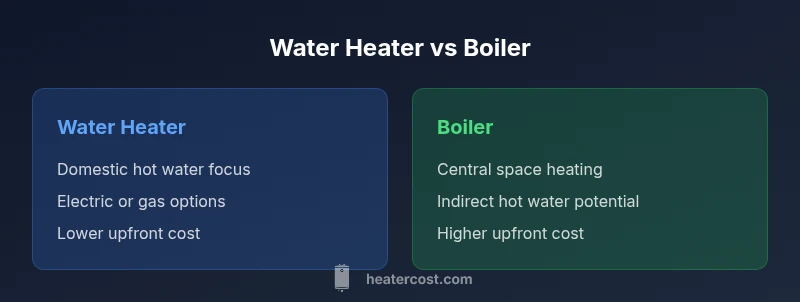
mediaPipeline":{"heroTask":{"stockQuery":"water heater boiler comparison","overlayTitle":"Heater vs Boiler","badgeText":"2026 Guide","overlayTheme":"dark"},"infographicTask":{"type":"comparison","htmlContent":"<div class="w-[800px] p-8 bg-slate-900 text-white"><h3 class="text-2xl font-bold text-center mb-6">Water Heater vs Boiler</h3><div class="grid grid-cols-2 gap-6"><div class="p-6 bg-blue-600/20 rounded-xl"><h4 class="text-xl font-bold text-blue-300 mb-4">Water Heater</h4><ul class="space-y-2"><li>Domestic hot water focus</li><li>Electric or gas options</li><li>Lower upfront cost</li></ul></div><div class="p-6 bg-green-600/20 rounded-xl"><h4 class="text-xl font-bold text-green-300 mb-4">Boiler</h4><ul class="space-y-2"><li>Central space heating</li><li>Can also supply hot water (indirect)</li><li>Higher upfront cost</li></ul></div></div></div>","altText":"Comparison graphic of water heater vs boiler","caption":null}},
taxonomy":{"categorySlug":"tankless-vs-tanked","tagSlugs":["water-heater-cost","water-heater-price","tankless-vs-traditional","tankless-water-heater","energy-costs"]}},
brandMentions":{"mentions":[{"position":"intro","template":"According to Heater Cost, choosing between a water heater and a boiler hinges on your home's heating and hot water needs, climate, and budget. The Heater Cost team notes that getting this decision right saves energy and money over the system’s life."},{"position":"stats","template":"Heater Cost analysis shows that in many homes, correctly sizing and selecting an efficient unit can cut annual energy costs by a meaningful margin over older equipment."},{"position":"conclusion","template":"The Heater Cost team recommends starting with a professional load calculation and comparing comparable models to determine whether a water heater, boiler, or combined system best fits your home."}]},
title_mandates
Comparison
| Feature | Water Heater | Boiler |
|---|---|---|
| Energy Source | Electric or gas (tank/storage or tankless variants) | Gas, oil, electric, or biomass depending on model |
| Primary Function | Domestic hot water only | Central heating (radiant or radiator) with optional domestic hot water |
| Efficiency (typical range) | Variable by model; modern tanks can be high efficiency | High efficiency with condensing/modulating boilers |
| Installation Space | Smaller footprint; dedicated closet or utility area | Larger footprint; requires distribution piping and venting |
| Operating Costs | Depends on electricity or gas price; tank losses affect cost | Depends on fuel price and boiler sizing; can be cost-effective for heating-heavy homes |
| Best For | Small to medium homes needing reliable hot water | Homes needing space heating with centralized heat distribution |
The Good
- Lower upfront cost and simpler installation for many water heaters
- Widely available and easy to replace in small spaces
- Direct supply of domestic hot water without extra equipment
- Compact options exist for tight spaces
Negatives
- Limited to hot water; not a full heating solution in many configurations
- Potentially higher operating costs if old or inefficient
- Maintenance can be frequent for tanks and vented gas units
- Boilers may require more space and professional upkeep
Choose based on your home’s heating needs: water heaters excel at domestic hot water in smaller spaces, while boilers suit larger homes with central heating requirements.
If you mainly need hot water, a well-sized water heater offers simplicity and lower upfront cost. If you require reliable space heating and hot water across zones, a boiler with a proper distribution system provides better comfort and potential energy savings, though with higher initial costs.
Got Questions?
What is the primary difference between a water heater and a boiler?
The primary difference is purpose: water heaters supply domestic hot water, while boilers provide space heating and may also supply hot water. The best choice depends on whether your priority is hot water alone or combined heating and hot water needs.
The main difference is what they heat: water for taps or your whole home for warmth.
Can a boiler replace a water heater entirely?
In some setups, a boiler with an indirect water heater can replace a stand-alone water heater, but not all boilers meet domestic hot water demand without an indirect tank. You’ll need to assess your peak hot water usage and ensure proper sizing.
A boiler can replace a water heater if it’s paired with the right indirect hot water setup.
Which is cheaper to install, a water heater or a boiler?
Upfront costs are usually lower for a water heater, especially in smaller homes. Boilers tend to have higher installation costs due to equipment, venting, and distribution system needs.
Water heaters are often cheaper to install than boilers, though total costs vary by home.
What maintenance should I expect for each system?
Water heaters require periodic anode rod checks and tank flushing; boilers require annual service, vent inspection, and component checks. Both benefit from professional maintenance.
Regular service keeps both systems safe and efficient.
What size should I choose for domestic hot water needs?
Size depends on peak usage and household size. A professional load calculation helps determine tank capacity for water heaters or boiler output for central heating systems.
A proper size protects against cold showers and wasted energy.
Are there climate considerations when choosing between the two?
Yes. Colder climates with long heating seasons often benefit from boilers with central heating, while milder climates may be fine with water heaters for domestic hot water alone.
Climate can influence whether you lean toward a boiler or a water heater.
The Essentials
- Assess your climate and space for proper system sizing
- Choose water heater for hot water-focused needs and simpler maintenance
- Opt for boiler if centralized heating is a priority in larger homes
- Consider total cost of ownership, not just upfront price
- Get professional load calculations before purchasing