RV Tankless Water Heaters: A Practical Guide for RVers
This Heater Cost guide analyzes RV tankless water heaters, evaluating sizing, installation, efficiency, and cost to help homeowners and RVers choose the right on-demand hot water solution.


An RV tankless water heater is a compact, on-demand hot water system that heats water only as you use it, avoiding a storage tank. In RVs, these units run on propane or electricity, install in tight spaces, and usually require proper venting and a dedicated fuel or electrical supply. They prioritize space efficiency and continuous hot water during travel.
What is an RV tankless water heater?
An RV tankless water heater is a compact, on-demand hot water system that heats water only as you use it, avoiding a storage tank. In RVs, these units run on propane or electricity, install in tight spaces, and usually require proper venting and a dedicated fuel or electrical supply. They prioritize space efficiency and continuous hot water during travel. For many RVers, this means fewer bulky tanks and more usable cabinet space. According to Heater Cost, the best option balances size, fuel type, and installation constraints to meet your typical travel schedule.
How RV tankless systems differ from traditional RV water heaters
Unlike traditional RV water heaters, which store and reheats a finite amount of water, tankless units heat water on demand. This eliminates standby losses from stored hot water and can free up cabinet space in a compact RV kitchen or bath. For RV applications, tankless designs come in gas-fired and electric variants; gas units often require venting and proper gas supply routing, while electric models run off shore power or a sizable inverter. The result is faster delivery of hot water, fewer heat losses, and a more flexible layout. However, there are trade-offs: tankless systems rely on adequate power or fuel to meet peak demand, and some models may experience a slight temperature drop if multiple outlets are used simultaneously. Heater Cost analysis suggests that travelers prioritizing space and efficiency should compare peak flow and fuel availability when selecting a model.
Sizing and capacity considerations for RVs
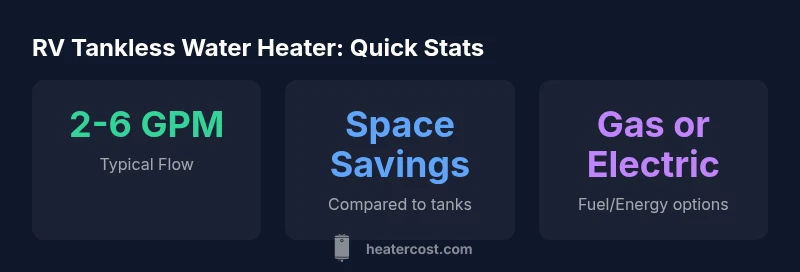
Sizing a tankless unit for an RV requires mapping your typical hot-water demand rather than chasing the highest possible flow. In practice, RV tankless water heaters offer a range of flow capacities, commonly reported as about 2-6 GPM depending on model and fuel source. A larger unit can sustain a long shower plus running a faucet, while smaller models excel in compact or solo setups. To size correctly, estimate your peak simultaneous usage (shower, sink, and dishwasher) and then choose a unit with adequate heating capacity to meet that demand. Based on Heater Cost analysis, consider the fuel source and available electrical capacity at your camping site. If you frequently camp off-grid, propane models may provide more reliable performance than electric-only units, while electric models can be exceptionally quiet and clean when connected to shore power.
Installation and venting considerations in RVs
Installing an RV tankless water heater involves more than plugging into an outlet. In gas-fired units, proper venting is essential to remove combustion byproducts and prevent carbon monoxide buildup, so many installations require dedicated vent runs and sometimes exterior exhaust openings. RV spaces have tight clearance and ducting constraints; professionals assess vent length, slope, and clearance from combustibles. Electric models simplify venting but demand consistent power supply and adequate wiring. It is crucial to check the RV manufacturer’s ballast, water lines, and propane or shore-power connections. A well-planned installation minimizes heat loss in transit and ensures detectors and safety shutoffs are functional. Heater Cost emphasizes working with a certified installer who understands RV ventilation, fuel lines, and electrical codes to avoid warranty voids or safety hazards.
Tankless vs traditional RV water heater comparison
| Aspect | Tankless RV Unit | Traditional RV Water Heater |
|---|---|---|
| Space requirements | Compact wall-mounted unit | Bulky storage cabinet and tank |
| Flow capacity | 2-6 GPM depending on model | Lower recovery with standby losses |
| Venting and fuel | Gas models require venting; electric may not | Venting required; stored water heater requires venting |
| Electrical/fuel needs | 12V controls + 120V supply or propane | Propane-powered with vented enclosure |
Got Questions?
What are the main benefits of RV tankless water heaters?
On-demand heating saves space and reduces standby energy; they deliver hot water when needed and offer flexible fuel options.
They save space and only heat water when you need it, plus you can choose propane or electric.
Do RV tankless water heaters require venting?
Gas models require proper venting to safely remove combustion byproducts; electric units typically do not vent but require adequate electrical capacity.
Gas models need venting; electric ones usually don’t, but you still need power.
Can I install a tankless water heater in a small RV?
Yes, many compact models are designed for tight spaces; professional installation ensures proper clearances, venting, and connections.
Yes, there are compact options, but you should use a pro for proper hookup.
Are electric RV tankless water heaters practical off-grid?
Off-grid use depends on available power; electric models require a robust power source or generator, while propane models work more reliably off-grid.
Electric units need steady power; propane often works well off-grid.
What maintenance does an RV tankless water heater require?
Regular maintenance includes periodic flushing and checking connections; inspect venting or wiring and replace filters as needed.
Keep it clean with periodic flushes and checks; follow the manual.
“Tankless RV water heaters offer space efficiency and on-demand hot water when sized correctly. They shine for frequent travelers who value compact design and flexible fuel options.”
The Essentials
- Choose tankless if space is limited and you use hot water often
- Size the unit to your peak demand to avoid cold-water bursts
- Gas models require proper venting for safety
- Electric models need sufficient shore power or a robust inverter
- Expect higher upfront costs but potential long-term energy savings